

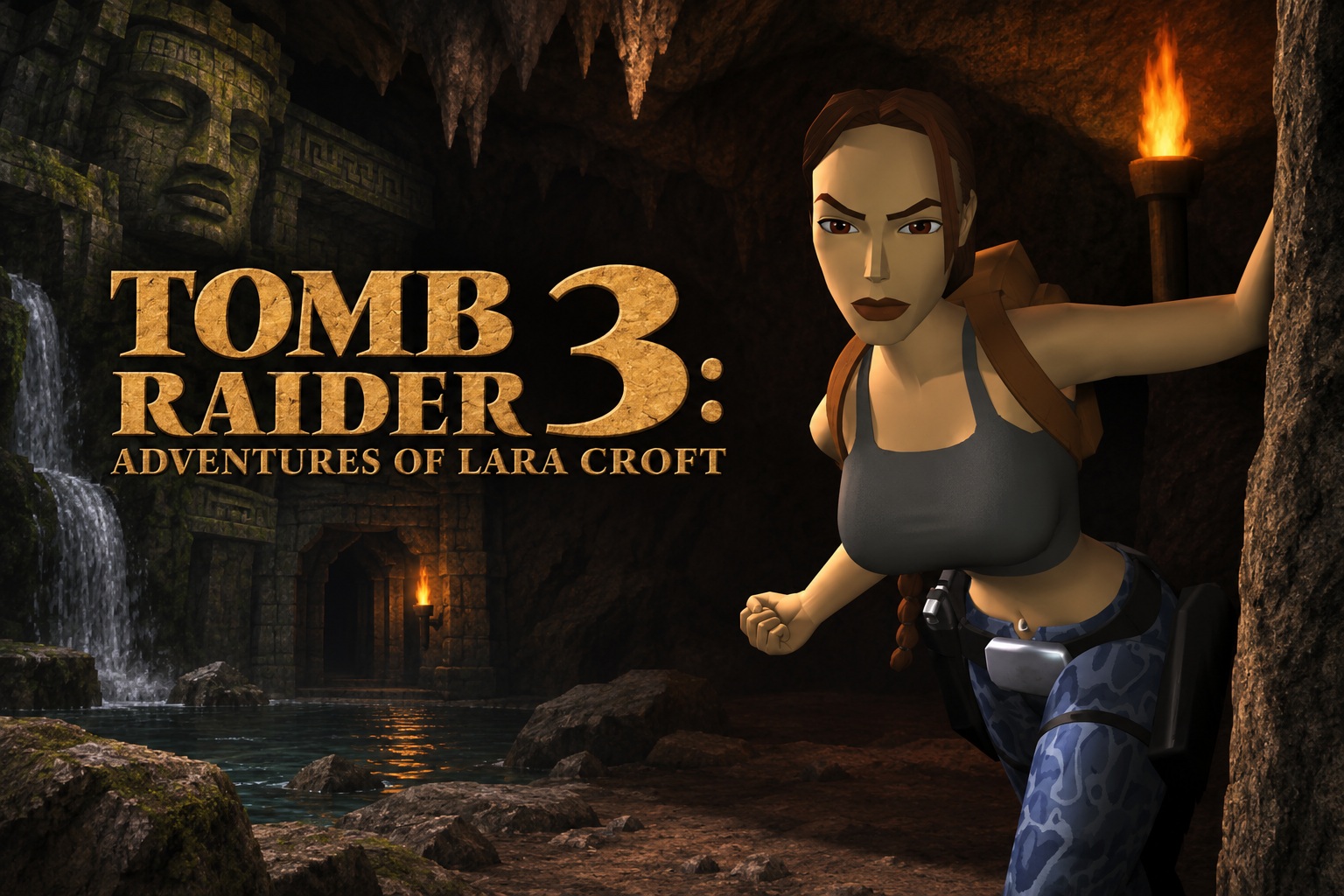
Tomb Raider III: Adventures of Lara Croft takes Lara Croft on one of her most demanding early expeditions, combining enormous environments, dangerous traps, complex puzzles, combat, vehicles, and globe-spanning exploration. Developed by Core Design and released in 1998, the game begins in the jungles of India after Lara investigates the remains of an ancient meteorite that struck Antarctica millions of years ago. Four artifacts created from the meteorite's unusual material have been scattered across the world, and Lara soon becomes involved in a race to recover them. What begins as another archaeological expedition gradually grows into a much larger mystery involving mutations, secret experiments, and the isolated wastes of Antarctica.
The game keeps the familiar exploration structure established by the first two Tomb Raider titles but greatly expands Lara's abilities and the complexity of the environments. She can now crouch, crawl through narrow spaces, sprint, hang from monkey bars, swim through dangerous underwater passages, and navigate terrain using several different vehicles. Levels are larger and often less obvious about where the correct route lies, encouraging careful observation rather than simply moving toward the next doorway. Tomb Raider III is also noticeably more difficult than its predecessors, with deadly traps, limited resources, hidden switches, and complicated paths capable of punishing players who rush ahead without studying their surroundings.
Now playable online through Lemon Web Games, Tomb Raider III: Adventures of Lara Croft brings its globe-spanning exploration, platforming, puzzles, combat, vehicles, secrets, environmental hazards, and classic Lara Croft adventure directly into the web browser. Players begin in India before gaining greater freedom over which major destination to explore next, including Nevada, London, and the South Pacific Islands. Each region has its own visual identity, enemies, puzzles, vehicles, and environmental challenges before the journey eventually leads toward Antarctica. For players who enjoy exploration games that reward patience and observation, Tomb Raider III remains one of the most substantial adventures from Lara's original PlayStation era.
A Meteorite Creates the Central Mystery
Millions of years before Lara's expedition, a meteorite crashes into Antarctica and leaves behind material with unusual properties. Ancient inhabitants discover pieces of the meteorite and turn them into powerful artifacts before abandoning the region.
Centuries later, those artifacts become the focus of Lara's latest adventure. Her search takes her across several continents as she gradually uncovers their connection to a modern research operation.
The premise gives Tomb Raider III a strong archaeological foundation while allowing the story to move into stranger territory later. Ancient history, science, mutation, and corporate ambition eventually become intertwined.
India Introduces the Adventure
Lara begins in the jungles of India, surrounded by ruins, waterfalls, caves, temples, dangerous wildlife, and elaborate traps. These opening levels immediately demonstrate that Tomb Raider III expects players to be comfortable with precision platforming.
The jungle is visually impressive but also deceptive. Paths are frequently hidden behind vegetation, underwater routes, or environmental details that can easily be overlooked.
India also introduces the artifact hunt that drives the rest of the game. By the time Lara leaves the region, it becomes clear that the expedition is much larger than a single archaeological discovery.
The Adventure Becomes Less Linear
After completing India, Lara gains freedom to choose between several major destinations rather than following one completely fixed route.
Nevada, the South Pacific Islands, and London can be tackled in different orders. Each contains multiple levels and eventually leads to one of the artifacts Lara needs.
This choice gives repeat playthroughs more variety. Players can change the order of the middle portion of the adventure while still eventually reaching the same final destination.
Nevada Brings Lara Into a Military Environment
Nevada replaces ancient ruins with desert landscapes, military installations, fences, security systems, and guarded facilities.
The region includes one of the game's most memorable situations when Lara loses much of her equipment and needs to rebuild her arsenal. This temporarily changes the usual rhythm because avoiding danger becomes more important than simply drawing weapons.
The Nevada levels also demonstrate how far Tomb Raider III moves beyond traditional tomb exploration. Lara may be an archaeologist, but her adventures increasingly place her inside modern and heavily guarded locations.
The South Pacific Offers a Completely Different Atmosphere
The South Pacific Islands provide colourful tropical scenery filled with cliffs, villages, caves, water, wildlife, and ancient structures.
These levels combine outdoor exploration with environmental dangers and some particularly unusual enemies. The bright scenery creates a strong contrast with the industrial locations found elsewhere in the game.
The region also uses water extensively, requiring players to think carefully about currents, underwater routes, and safe places to surface. Exploration can become dangerous very quickly when Lara is trapped beneath the water with limited air.
London Turns the Adventure Darker
London provides some of Tomb Raider III's most atmospheric environments.
Lara explores rooftops, underground areas, abandoned stations, industrial spaces, and other parts of the city under darkness. Visibility becomes part of the challenge, and the levels often feel more claustrophobic than the open jungles or islands.
The London section also contains some of the game's most complicated navigation. Finding the correct switch, platform, or hidden route can require careful observation.
Antarctica Brings Everything Together
The final portion of the adventure takes Lara to Antarctica, where the mystery surrounding the meteorite artifacts begins to reveal its full significance.
Frozen landscapes, research facilities, dangerous water, hostile creatures, and increasingly strange discoveries create an appropriately hostile final region. Exposure to freezing water can be especially dangerous, forcing players to leave it quickly before Lara suffers too much damage.
The Antarctic setting provides a strong conclusion because it connects directly back to the meteorite that started the entire story. The journey effectively circles back to the source of the mystery.
Lara Has More Movement Abilities Than Before
Tomb Raider III significantly expands Lara's movement system.
She can crouch and crawl beneath low obstacles, sprint across dangerous areas, climb certain surfaces, hang from overhead monkey bars, swim, jump between platforms, and perform the familiar running leaps of the earlier games. These additions allow Core Design to create much more complicated environments.
The expanded abilities also mean players need to consider more possible routes. A narrow opening that once looked like scenery may now be a crawlspace leading to an entirely new section.
Crawling Opens New Routes
The ability to crouch and crawl is especially important because many levels contain narrow passages that Lara could never have entered in earlier games.
These spaces are often used to hide switches, ammunition, secrets, or alternate paths. Players need to inspect the environment more carefully because the solution may be located close to the ground rather than directly ahead.
Crawling also changes the pace. Lara becomes slower and more vulnerable while inside confined areas, making it important to check for danger before entering.
Sprint Adds Speed When It Matters
Lara can now sprint when extra speed is required.
This is useful during timed sequences where a door may remain open only briefly or where an environmental threat needs to be escaped quickly. Sprinting also allows Lara to cover large spaces much faster.
The mechanic eventually becomes part of the puzzle design rather than simply a convenience. Some sections are deliberately built around reaching a destination before time expires.
Monkey Bars Expand Vertical Exploration
Certain ceilings and overhead structures allow Lara to hang and move across them.
These monkey-bar sections create routes that would otherwise be impossible to reach. They also force players to think about the environment above Lara rather than concentrating only on the ground.
Because hanging consumes time and leaves limited room for error, players need to plan where they are going before starting a long traversal.
Vehicles Constantly Change the Pace
Tomb Raider III includes several vehicles that provide completely different forms of movement.
Lara can ride a quad bike, navigate waterways in a kayak, travel in a mine cart, and use an underwater propulsion vehicle during specific sections. Each vehicle has its own handling characteristics and hazards.
These sequences help break up long periods of traditional platforming. They also allow the levels to become much larger because Lara can move through certain areas more quickly.
Combat Uses a Large Arsenal
Lara begins with her familiar dual pistols but can acquire considerably more powerful weapons during the adventure.
Shotguns, automatic weapons, explosives, and other firearms provide options for different situations. Stronger weapons are particularly valuable against tougher enemies, but ammunition is limited.
This makes resource management important. Using powerful ammunition against ordinary enemies may leave Lara poorly prepared for something much more dangerous later.
Wildlife, Guards and Stranger Enemies Stand in Lara's Way
Enemy variety reflects the diversity of the environments.
Wild animals appear in natural locations, while soldiers, guards, and armed opponents dominate modern facilities. Later stages introduce much stranger creatures connected to the artifacts and the experiments surrounding them.
Different enemies encourage different responses. Some are best engaged from a distance, while others can be avoided completely if Lara finds another route.
Puzzles Are Integrated Into Enormous Levels
Tomb Raider III rarely separates puzzles into obvious self-contained rooms.
A switch found in one area may change something much farther away, requiring players to remember earlier locations and understand how different parts of a level connect. Keys, buttons, pressure mechanisms, underwater passages, and environmental clues are frequently combined.
This can make the game demanding, but it also gives exploration a genuine sense of discovery. Solving a complicated section feels rewarding because the answer is often hidden within the environment rather than presented directly.
Traps Demand Careful Observation
Danger can appear almost anywhere.
Spikes, collapsing floors, boulders, fire, deep drops, environmental hazards, and timed mechanisms are capable of killing Lara very quickly. Some traps provide visual clues, while others are discovered through unfortunate experimentation.
Walking into unfamiliar spaces carefully is often safer than sprinting ahead. Tomb Raider III rewards players who study a room before committing to the next move.
Secrets Reward Thorough Exploration
Hidden secrets are scattered throughout the adventure.
Finding them often requires leaving the obvious route, examining suspicious areas, or performing difficult jumps. They may contain useful ammunition, health supplies, or other rewards.
Secret hunting adds significant replay value because many are easy to miss during a first playthrough. Players who already know the main route can return and concentrate on exploring every corner.
Saving Requires More Consideration
The PlayStation version uses Save Crystals, making saving another resource to consider rather than something that can be done without restriction.
This increases the tension during long or dangerous sections. Using a crystal too early may leave fewer available later, while refusing to save can result in losing substantial progress after a mistake.
The system contributes heavily to Tomb Raider III's reputation for difficulty. Careful saving becomes part of surviving the adventure.
Playing Tomb Raider III: Adventures of Lara Croft Online Today
Through Lemon Web Games, Tomb Raider III: Adventures of Lara Croft can now be played directly in your web browser with no downloads or setup required. Features of the web-based version include:
New players should avoid rushing through unfamiliar environments. Tomb Raider III regularly hides important switches, crawlspaces, and routes in places that initially appear unimportant, so carefully examining each area can save a great deal of confusion.
Saving resources and ammunition also matters. Powerful weapons are useful during difficult encounters, but Lara's unlimited-ammunition pistols are often sufficient for weaker enemies.
Who Should Play Tomb Raider III: Adventures of Lara Croft
Tomb Raider III is especially suited to players who enjoy figuring things out without constant guidance. Its enormous levels and complicated routes can be demanding, but discovering the correct solution is a major part of the satisfaction.
It is also an excellent choice for players who already enjoyed the first two Tomb Raider games and want a larger challenge. Lara's expanded movement abilities allow the game to create much more ambitious environments.
Play Tomb Raider III: Adventures of Lara Croft Online Now
Join Lara Croft as she travels from India to Nevada, the South Pacific, London, and ultimately Antarctica in search of mysterious artifacts connected to an ancient meteorite. Explore enormous environments, solve puzzles, survive traps, use vehicles, fight enemies, discover secrets, and uncover the truth behind the expedition.
Through Lemon Web Games, the original PlayStation adventure can be experienced directly in the browser as one of Lara Croft's most challenging early journeys. Every location introduces new dangers and mechanics, ensuring that the expedition constantly changes as Lara approaches Antarctica.
Final Thoughts
Tomb Raider III: Adventures of Lara Croft is ambitious, difficult, and sometimes unforgiving, but those qualities are also what make it memorable. Its huge environments, nonlinear middle section, expanded movement system, vehicles, secrets, traps, and challenging puzzles make it considerably more complex than a straightforward action game.
The journey also offers exceptional variety. Dense Indian jungles, Nevada military installations, tropical islands, dark London environments, and frozen Antarctic facilities all require different approaches while remaining connected by the central artifact mystery.
Through Lemon Web Games, Tomb Raider III remains an excellent adventure for players who enjoy exploration that demands patience. It represents a period when Lara Croft's adventures were willing to let players become genuinely lost, experiment with dangerous routes, and experience the satisfaction of finally discovering the way forward.











Comments 0