

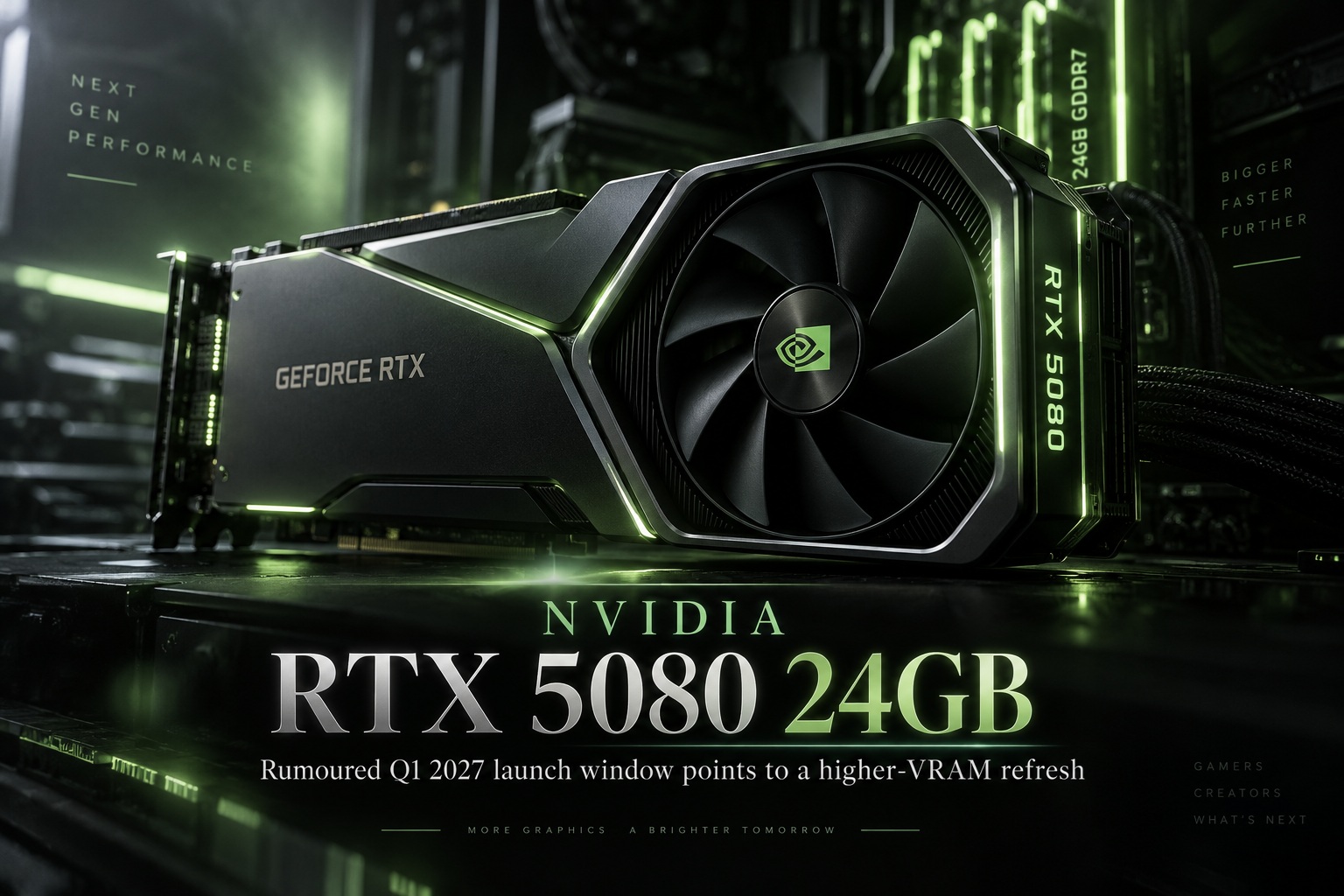
NVIDIA may be preparing a new 24GB version of the GeForce RTX 5080 for launch in the first quarter of 2027, according to the latest industry rumours. The report arrives shortly after claims that NVIDIA could be winding down production of the RTX 5090 and redirecting its high-end silicon towards professional RTX Pro products. If the latest information proves accurate, the upgraded RTX 5080 could become an increasingly important part of NVIDIA's enthusiast GeForce lineup.
The reported card is believed to feature 24GB of GDDR7 memory, a substantial increase over the 16GB available on the current RTX 5080. Although NVIDIA has yet to confirm the product or even acknowledge its existence, sources within the graphics card supply chain are now pointing towards an early 2027 release.
Board Partners Reportedly Being Prepared For The Card
According to Taiwanese technology outlet Benchlife, several NVIDIA add-in board partners have reportedly been told verbally that materials relating to the upcoming RTX 5080 24GB will be provided soon.
No firm launch date was apparently given to partners. However, the report claims NVIDIA is targeting the first quarter of 2027, placing March as the latest possible launch month if the current schedule holds.
As always with unreleased graphics cards, those plans could still move. GPU launches are often affected by component availability, manufacturing capacity and NVIDIA's broader product strategy, so the reported Q1 window should be treated as provisional rather than guaranteed.
Could This Actually Be The RTX 5080 Super?
The rumoured 24GB card closely resembles previous reports surrounding an RTX 5080 Super.
Earlier leaks suggested NVIDIA was preparing refreshed RTX 50 Super models before reportedly asking board partners to place those products on hold. One of the expected upgrades for the RTX 5080 Super was precisely the move from 16GB to 24GB of GDDR7 memory.
That makes it entirely possible that the newly rumoured RTX 5080 24GB and the previously leaked RTX 5080 Super are either the same product or closely related.
Whether NVIDIA ultimately uses the RTX 5080, RTX 5080 Super, or another branding remains unknown.
24GB Would Be A Significant Memory Upgrade
The current RTX 5080 uses eight GDDR7 memory modules with a total capacity of 16GB. The rumoured refresh is expected to move from 2GB modules to 3GB modules, while retaining eight memory packages.
That would increase total VRAM to 24GB without fundamentally changing the memory layout.
For gaming alone, 16GB remains sufficient for many current titles, even at high resolutions. However, larger memory capacities are increasingly useful for workloads involving AI, 3D rendering, high-resolution textures, video production and other content-creation applications.
An extra 8GB could therefore make the upgraded RTX 5080 much more attractive to users who need both strong gaming performance and workstation-like capabilities.
AI Workloads Are Making VRAM More Important
The rise of local generative AI is also changing what enthusiasts expect from graphics cards.
Running large language models, image-generation systems and other GPU-accelerated AI workloads locally can consume huge amounts of VRAM. A GPU may have enough raw processing performance for a model but still be unable to load it efficiently because it lacks sufficient memory.
Moving the RTX 5080 from 16GB to 24GB would significantly improve its usefulness for those workloads.
That does not turn it into a professional AI accelerator, but it gives enthusiasts and developers substantially more room to experiment with larger models without immediately stepping up to the extremely expensive RTX 5090 or RTX Pro hardware.
Current RTX 5080 Still Uses 16GB GDDR7
The existing GeForce RTX 5080 launched shortly after the RTX 5090 and currently sits as NVIDIA's second-highest consumer Blackwell graphics card.
Its core specifications include:
• 10,752 CUDA cores
• 16GB GDDR7 memory
• 2.3GHz base clock
• 2.62GHz boost clock
• 360W peak TDP
Interestingly, the RTX 5080 carries a higher listed boost clock than the RTX 5090, although that does not make it the faster GPU overall. The RTX 5090 contains substantially more processing resources and remains far ahead in raw performance.
Still, the RTX 5080 offers much of Blackwell's feature set at a substantially lower official launch price.
RTX 5080 Originally Cost Around Half The RTX 5090
At launch, NVIDIA positioned the RTX 5080 at approximately half the price of its flagship RTX 5090 sibling.
That made the card the more attainable enthusiast option, although real-world pricing has since become considerably less attractive.
Ongoing memory supply pressures and broader component costs have reportedly pushed many RTX 5080 models towards an average retail price of around RM8,500.
If a 24GB version arrives, its final pricing will therefore be especially important. A substantial memory upgrade would certainly justify some premium, but pricing too close to RTX 5090 territory could undermine its value proposition.
Memory Supply May Be The Biggest Complication
Memory availability has reportedly played a major role in NVIDIA's changing product plans.
Previous reports suggested the wider RTX 50 Super refresh was delayed because of memory supply constraints. Moving from 2GB to 3GB GDDR7 modules increases capacity, but it also means NVIDIA and its board partners need sufficient supplies of those higher-density chips.
The current memory market is under pressure from several industries simultaneously. AI accelerators, servers, high-end consumer GPUs and other computing products are all competing for advanced memory production.
That makes memory availability one possible reason why NVIDIA has yet to commit publicly to the refreshed lineup.
RTX 5090 Production Rumours Make The 24GB Card More Interesting
The timing of this rumour is particularly interesting because of recent claims that NVIDIA has stopped or is preparing to stop RTX 5090 production.
According to those earlier reports, the massive GB202 GPU used by the RTX 5090 could increasingly be redirected towards professional RTX Pro and data centre products.
If that happens, NVIDIA would need another card to sit at the top of its consumer GeForce range.
A 24GB RTX 5080 — particularly if branded as a Super model — could fill that position without requiring NVIDIA to dedicate valuable GB202 silicon to gaming.
NVIDIA Has Strong Incentives To Prioritise Professional GPUs
High-end GPU silicon has become extremely valuable because of the continuing expansion of AI infrastructure.
Gaming cards remain a major business for NVIDIA, but professional and data centre products can command much higher prices. Allocating premium silicon towards those markets can therefore generate significantly more revenue than selling the same manufacturing capacity through consumer GeForce products.
That could explain why NVIDIA might prefer to strengthen the RTX 5080 rather than continue manufacturing large quantities of RTX 5090 cards.
A higher-memory RTX 5080 would still give enthusiasts a premium option while allowing NVIDIA to reserve its biggest chips for more lucrative markets.
The RTX 5080 Super Rumours Have Been Around For Some Time
Reports of an RTX 50 Super refresh are not new.
The expected lineup had reportedly included upgraded memory configurations and potentially revised specifications across several models. The RTX 5080 Super was among the most frequently discussed cards because the jump to 24GB would represent an obvious improvement over the original version.
However, reports later suggested NVIDIA had asked board partners to hold off on the Super lineup.
The new Q1 2027 information may indicate that NVIDIA has either revived the project or restructured it into a simpler 24GB RTX 5080 release.
A Q1 Launch Could Mean CES 2027 Is Important
If the first-quarter launch window is accurate, early January immediately becomes an interesting possibility.
NVIDIA regularly uses major industry events at the beginning of the year to make product announcements, and a refreshed GeForce lineup would fit naturally into that schedule.
That does not mean the RTX 5080 24GB will necessarily be announced at CES or another specific event. The current information only points towards Q1 2027.
However, an early-year reveal followed by retail availability before the end of March would fit the reported timeline.
Existing RTX 5080 Owners May Not Need To Worry
Anyone already using an RTX 5080 should not necessarily feel that their card is suddenly obsolete.
The expected upgrade appears to centre heavily around memory capacity. Unless NVIDIA also changes CUDA core counts, clocks or other specifications, gaming performance could remain relatively close to the current model in workloads that do not exceed 16GB of VRAM.
The 24GB version would likely be more attractive to users running memory-intensive applications, AI workloads or future games that demand exceptionally large texture pools.
For conventional gaming, the improvement may depend heavily on the final specifications.
The Current 16GB Model Could Be Phased Out
Previous rumours have suggested the existing RTX 5080 16GB could eventually be discontinued once the higher-memory version arrives.
From NVIDIA's perspective, maintaining two cards with the same basic positioning but different VRAM capacities could complicate the product stack. Replacing the existing version entirely would create a simpler lineup.
It would also give NVIDIA an opportunity to refresh pricing.
Whether that would mean better value for consumers is another question.
RTX 60-Series Is Still Reportedly Far Away
Another reason an RTX 5080 refresh would make sense is the expected timeline for NVIDIA's next-generation consumer architecture.
Current rumours suggest Rubin-based RTX 60-series gaming cards may not arrive until late 2027 at the earliest, with some speculation pointing towards 2028.
If that proves accurate, NVIDIA has a significant gap to fill between the original RTX 50 launch and its eventual successor.
Refreshed Blackwell cards could extend the generation's life without requiring an entirely new architecture.
24GB Could Give The 5080 Much Better Longevity
One of the most compelling aspects of the rumoured card is simply longevity.
GPU performance tends to remain useful for years, but insufficient VRAM can become a limiting factor earlier than raw compute performance. High-resolution gaming, large texture packs, professional applications and AI workloads are all steadily increasing memory requirements.
Moving to 24GB would provide considerably more breathing room.
For enthusiasts who keep graphics cards for several years, that could make the refreshed model more attractive than the current 16GB version even if performance remains otherwise similar.
Pricing Will Determine Whether It Makes Sense
The most important unanswered question is price.
An RTX 5080 with 24GB would clearly be more capable than the existing model from a memory perspective, but the advantage becomes less meaningful if retailers price it dramatically higher.
The existing RTX 5080 already faces criticism because many real-world cards sell substantially above their original intended pricing.
If the 24GB version arrives around the current RM8,500 market level, it could offer noticeably better value. If pricing climbs far beyond that, buyers may again find themselves questioning the enthusiast GPU market altogether.
Nothing Has Been Confirmed By NVIDIA
Despite the increasing number of rumours, NVIDIA itself has not announced the RTX 5080 24GB.
The company traditionally does not comment on leaks or unreleased products, so the silence is unsurprising.
That means the reported specifications, Q1 2027 release window and potential RTX 5080 Super branding should all be treated as unofficial.
Board partner plans can also change quickly, particularly when component supply is involved.
Final Thoughts
The rumoured RTX 5080 24GB is becoming increasingly interesting as separate reports begin fitting together. Previous leaks pointed towards an RTX 5080 Super with higher-density GDDR7 modules, while more recent claims suggest NVIDIA could reduce RTX 5090 production and position a 24GB RTX 5080 as the new high-end GeForce option.
A Q1 2027 launch would give NVIDIA a refreshed enthusiast card while keeping the RTX 50 generation relevant ahead of the much later RTX 60-series. The jump from 16GB to 24GB would also significantly improve the card's appeal for AI workloads, creative applications and users concerned about long-term VRAM requirements.
For now, however, it remains a rumour. NVIDIA has confirmed neither the card nor its launch schedule, and memory supply constraints could still alter the plan. If the reports are accurate, we should begin hearing much more about the RTX 5080 24GB as early 2027 approaches.











Comments 0