

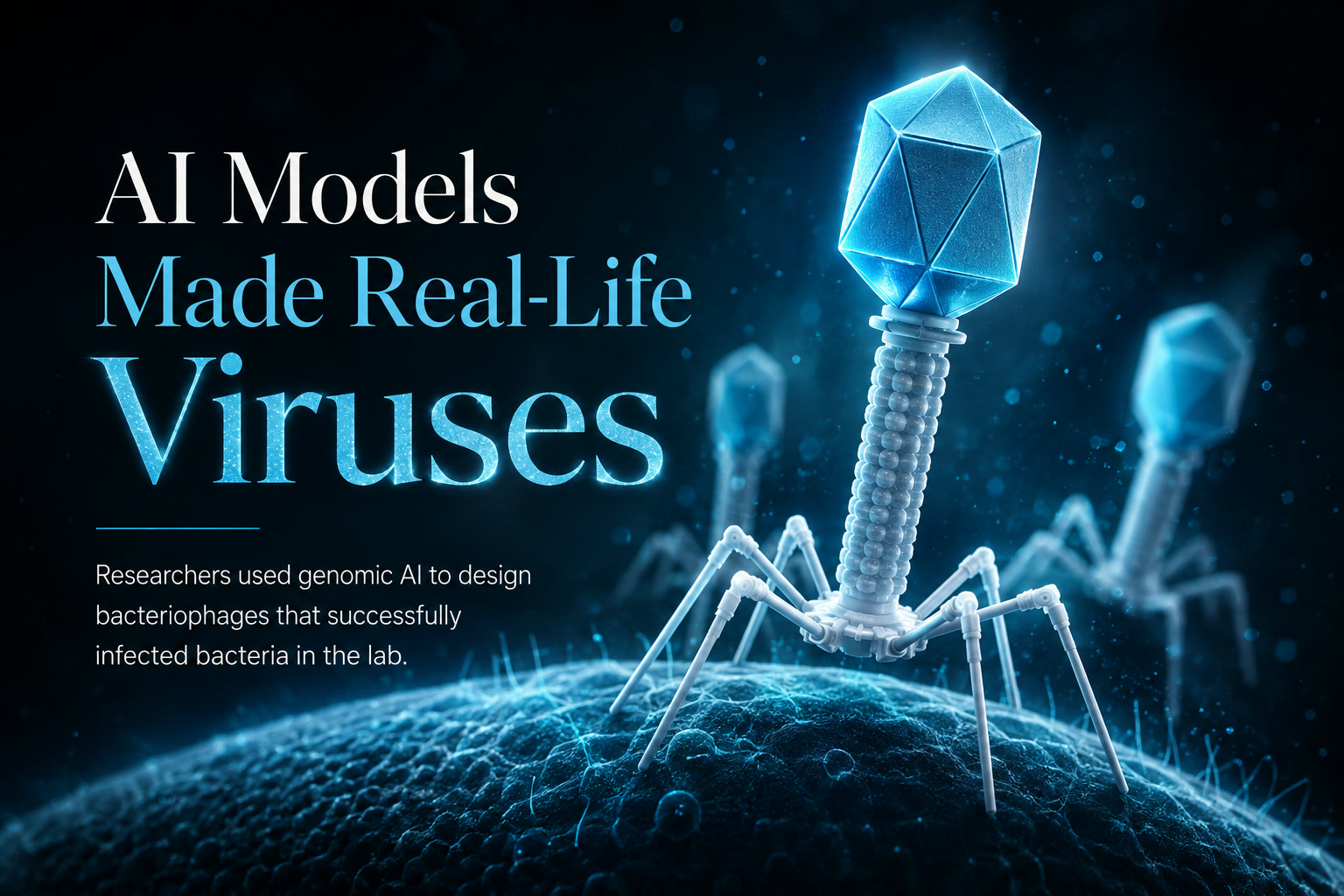
Artificial intelligence has already shown that it can write software, generate images, analyse medical data and even design proteins. Now researchers have pushed generative AI into another territory entirely: creating complete viral genomes capable of functioning in the physical world.
Before that sounds more alarming than it needs to, these were not viruses designed to infect humans. The work focused on bacteriophages, a class of viruses that specifically infect bacteria. Even so, the experiment represents an important milestone because it demonstrates that generative AI can move beyond predicting biological sequences and begin designing complete biological systems that actually work once synthesised in a laboratory.
The research, published in Science by scientists associated with the Arc Institute and Stanford University, used specialised genomic AI models known as Evo 1 and Evo 2.
Think Of ChatGPT, But Trained On DNA
Most people are familiar with large language models such as ChatGPT, which learn relationships between words, sentences and concepts by analysing enormous amounts of text.
Genomic language models operate on a similar basic idea, except their "language" is biological.
Instead of learning patterns in books, websites and conversations, models such as Evo are trained on DNA sequences and other genetic information. By analysing huge collections of genetic material, the models can begin recognising recurring patterns within biological sequences.
You could loosely think of this as learning the grammar and structure of genetic code.
Once the model understands enough of those patterns, researchers can ask it to generate new biological sequences that resemble natural ones while potentially performing particular functions.
Earlier work with these types of systems focused mainly on designing individual genes or proteins. The latest research took the concept considerably further by asking AI to help design an entire viral genome.
Researchers Started With One Of Biology's Simplest Viruses
The scientists deliberately chose a relatively simple bacteriophage as the foundation for the experiment.
The virus involved, commonly known as ΦX174, infects E. coli bacteria rather than humans. Because of its relatively small genome and long history of laboratory research, it provides scientists with a much simpler biological system to study than viruses capable of infecting animals or people.
The researchers used genomic information from ΦX174 and related bacteriophages to help the Evo models generate a large collection of potential artificial viral genomes.
Most of those AI-generated designs never became functioning viruses.
That is important because generative models can produce sequences that look biologically plausible without necessarily creating something that actually works inside a living system.
After narrowing down the candidates, researchers synthesised and tested a much smaller selection against bacteria.
And that is where things became particularly interesting.
Some Of The AI-Designed Viruses Actually Worked
Most of the synthetic candidates failed, which is hardly surprising given the complexity involved in making even a relatively simple biological system function properly.
But several designs successfully infected bacteria.
Researchers ultimately produced 16 functioning synthetic bacteriophages, demonstrating that at least some of the genomes designed with assistance from AI could behave like naturally occurring viruses.
Some were even reported to reproduce faster than the original virus used as the biological reference.
That makes the research significant for reasons extending far beyond this particular bacteriophage.
AI is no longer merely identifying patterns within biological data. Under carefully controlled laboratory conditions, researchers are beginning to show that models can help generate biological designs capable of functioning in the real world.
Why Bacteriophages Are Actually Extremely Useful
The word "virus" understandably carries negative associations, but bacteriophages can potentially be extremely useful.
Because they specifically attack bacteria, scientists have been investigating them for decades as possible tools for combating bacterial infections.
That field is known as phage therapy.
Interest in phage therapy has increased as antibiotic resistance becomes a growing global healthcare problem. Some bacteria are becoming increasingly difficult to treat using conventional antibiotics, creating demand for alternative approaches.
A bacteriophage capable of selectively targeting a harmful bacterial strain could theoretically destroy the unwanted bacteria while leaving unrelated organisms alone.
AI-designed bacteriophages could eventually give researchers another way to explore that possibility.
Instead of depending entirely on viruses found in nature, scientists might eventually be able to design phages with characteristics suited to specific medical, agricultural or industrial applications.
There Could Also Be Applications Beyond Treating Infection
Synthetic bacteriophages could potentially have uses outside conventional medicine.
Researchers could explore them as tools for controlling bacterial contamination, manipulating microbial communities or delivering genetic material into particular bacterial cells.
Artificially designed biological systems are also increasingly important in biotechnology.
AI models capable of understanding and generating genetic sequences could therefore become powerful tools for researchers working in synthetic biology, drug development and gene-related therapies.
The broader goal is not simply "creating viruses."
It is developing AI systems capable of understanding biological relationships well enough to help scientists design useful genetic systems that would otherwise require enormous amounts of experimentation.
But This Is Clearly Dual-Use Technology
The same capability that makes this research promising also makes it sensitive.
Biotechnology is full of what researchers call dual-use technologies—techniques that can provide enormous benefits when used responsibly but could potentially be misused.
The researchers appear to have recognised that risk.
The experiment deliberately focused on bacteriophages and avoided training the system for this work on viruses designed to infect humans, animals, plants or fungi.
That boundary is important.
Demonstrating that AI can assist with generating a functioning bacteriophage is scientifically impressive. Applying similar methods to biological agents capable of infecting humans would raise a completely different level of safety, ethical and regulatory concern.
AI Biology Will Need Stronger Safeguards
Generative biology is advancing surprisingly quickly.
AI systems are already being used to predict protein structures, design potential medicines, analyse genetic mutations and generate new biological molecules.
Designing complete genomes is a logical extension of that progression, but it also increases the importance of safeguards.
Future biological AI systems may need restrictions around what kinds of organisms they can design, what biological information they can access and how generated sequences are evaluated before they ever reach a laboratory.
There is also a growing argument for biological screening systems capable of identifying potentially dangerous synthetic DNA orders before they are manufactured.
As these technologies become easier to use, responsible oversight becomes increasingly important.
The Biggest Change Is AI Moving From Digital To Biological
Perhaps the most fascinating part of this research is the transition from digital generation to physical biology.
When ChatGPT generates an incorrect paragraph, the consequences usually remain inside a computer.
Biological AI is different.
A generated genetic sequence can theoretically become something physical once scientists synthesise it and place it inside an appropriate laboratory environment.
That means mistakes, unexpected behaviour and unintended consequences require considerably more careful consideration.
The technology therefore cannot simply follow the traditional software model of "generate first, fix later."
Biological systems require far more deliberate testing and containment.
Final Thoughts
AI-designed bacteriophages could ultimately become an extremely valuable biotechnology tool.
They may help researchers study bacterial infections, explore alternatives to antibiotics and build increasingly sophisticated synthetic biological systems.
At the same time, the experiment provides a glimpse of how quickly AI is expanding beyond purely digital applications.
The most important takeaway is not that an AI suddenly decided to create a virus. Researchers deliberately used genomic AI models inside controlled laboratory research to explore whether generated genetic designs could function biologically.
And some of them did.
That is scientifically remarkable—but it also makes responsible development increasingly important. As AI becomes capable of designing more complex biological systems, the challenge will be ensuring that the technology advances alongside equally sophisticated safety controls.











Comments 0