

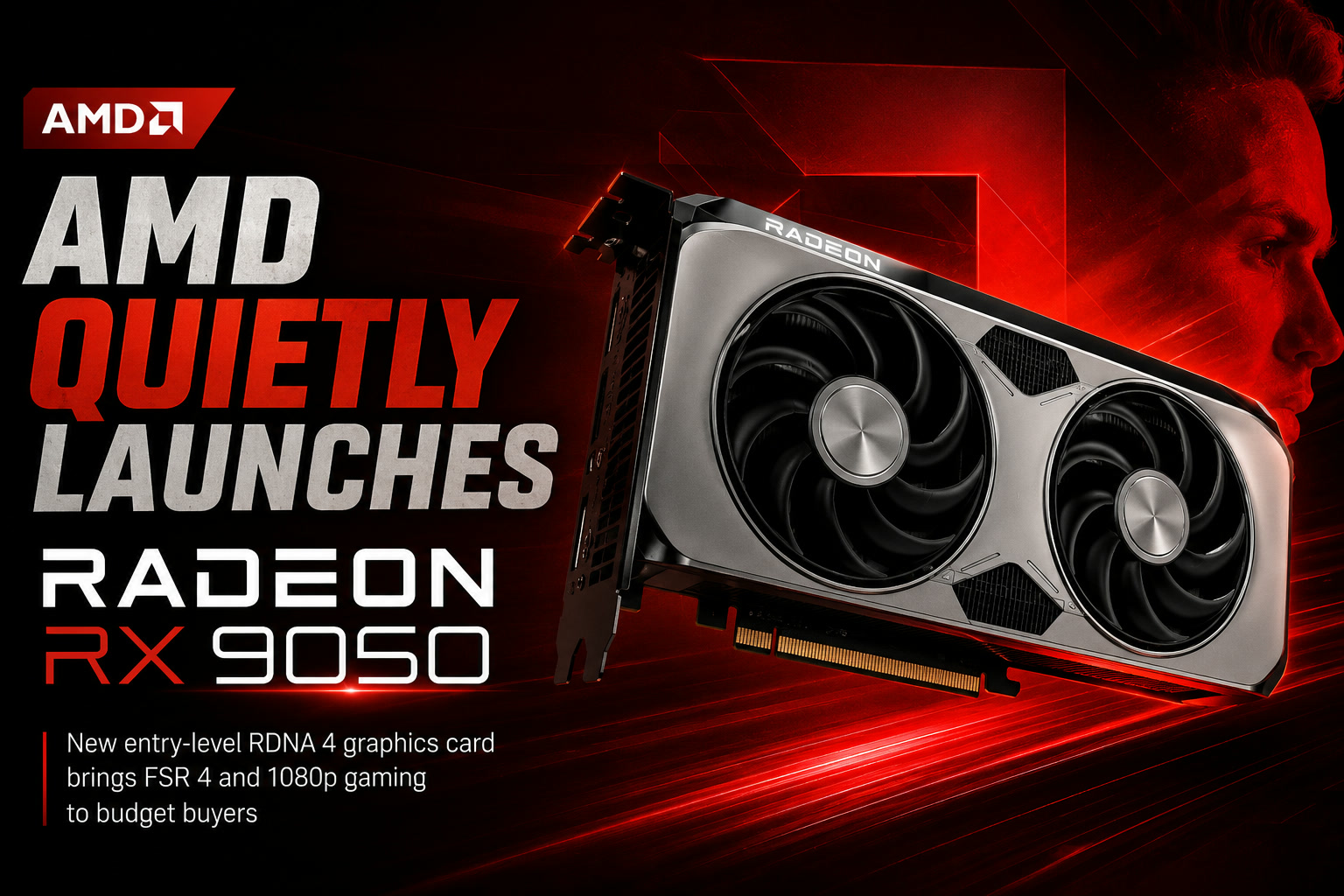
AMD has expanded its Radeon RX 9000 family with the Radeon RX 9050, a new entry-level graphics card aimed at gamers who want access to the company's latest architecture without paying for a higher-tier RX 9060 or RX 9070 model.
Unlike AMD's more prominent graphics launches, the RX 9050 arrived with little publicity. Its existence was effectively confirmed through AMD Software: Adrenalin Edition 26.7.1, which added official driver support for the card, while board partner ASRock published a full product page for its Radeon RX 9050 Challenger 8GB.
The quiet release may reflect the card's position in the product range. This is not intended to challenge premium GPUs or deliver uncompromised 4K gaming. Instead, the RX 9050 is designed as an affordable way to enter the RDNA 4 ecosystem, with its main focus placed firmly on 1080p gaming.
A Smaller Member of the Radeon RX 9000 Family
The RX 9050 is based on AMD's latest RDNA 4 architecture, which also powers the RX 9060 and RX 9070 series.
This gives the card access to modern Radeon capabilities including third-generation ray-tracing hardware, second-generation AI accelerators, DirectX 12 Ultimate support and AMD FidelityFX Super Resolution 4. FSR 4 uses machine-learning-assisted upscaling to improve image quality and performance in supported games.
However, the RX 9050 is substantially smaller than the cards positioned above it.
It includes:
ASRock's official specifications confirm the 16 Compute Units, 1,024 Stream Processors and clock speeds. This gives the RX 9050 exactly half the Compute Units and Stream Processors found in the RX 9060 XT.
That reduction makes its place in the lineup very clear. The RX 9050 is not a lower-clocked RX 9060 XT, as some earlier reports suggested. It is a much more heavily cut-down GPU designed around lower cost, lower power consumption and Full HD gaming.
Eight Gigabytes of Memory Is the Mainstream Version
The standard Radeon RX 9050 comes with 8GB of GDDR6 memory running at 18Gbps.
The memory is connected through a 128-bit interface, producing up to 288GB/s of bandwidth. The card is also reported to include 32MB of Infinity Cache, which helps reduce the need to access external memory for every operation.
Eight gigabytes should be adequate for many games at 1080p, particularly when textures and other demanding settings are kept at medium or high rather than maximum.
However, modern games are becoming increasingly demanding. Some titles can already exceed 8GB when using very high-resolution textures, ray tracing or poorly optimised settings.
The RX 9050 should therefore be viewed as a card for sensible 1080p configurations rather than one designed to run every new game at its highest preset.
The Memory Bandwidth Matches the RX 9060
One interesting detail is that the RX 9050's 8GB memory configuration provides the same 288GB/s bandwidth as the standard Radeon RX 9060.
Both cards use 18Gbps GDDR6 across a 128-bit bus. The major difference lies in the GPU itself: the RX 9060 has 28 Compute Units, while the RX 9050 has only 16.
This means memory bandwidth may not be the RX 9050's biggest limitation. Its lower shader, ray-tracing and AI hardware counts will more often determine performance.
The design could still prove useful in games where memory capacity and bandwidth matter more than raw compute power. It may also prevent the RX 9050 from being as severely restricted as some older entry-level cards that combined a weak GPU with an extremely narrow memory bus.
FSR 4 Could Be Crucial to Its Gaming Experience
The inclusion of RDNA 4 means the RX 9050 supports FSR 4 in compatible games.
This could be especially important for an entry-level GPU. Instead of rendering every frame at the display's full native resolution, FSR can generate the image from a lower internal resolution and reconstruct it to appear sharper.
The performance recovered through upscaling may help the RX 9050 maintain smoother frame rates in newer games.
Frame generation may provide an additional boost in supported titles by inserting AI-generated frames between traditionally rendered ones. However, frame generation works best when the GPU already produces a reasonably stable base frame rate.
It should not be treated as a complete substitute for native rendering performance.
FSR can make an affordable GPU considerably more useful, but buyers should still examine normal performance rather than relying only on heavily enhanced benchmark figures.
AMD Positions It as a 1080p Medium-Settings Card
AMD's published performance figures reportedly place the RX 9050 at around:
These results were presented at 1080p using medium graphics settings.
The figures suggest that the RX 9050 can deliver playable and, in several cases, smooth Full HD performance.
However, the testing conditions need to be considered carefully. It is not entirely clear from the headline results whether FSR, frame generation or ray tracing was enabled in every game.
That matters significantly, especially in Cyberpunk 2077. The game can produce very different results depending on its ray-tracing preset and upscaling configuration.
AMD's numbers are useful as an early indication, but independent reviews will be needed before the card's real position becomes clear.
Medium Settings Are Not Necessarily a Bad Target
Entry-level graphics cards are often criticised for testing at medium rather than ultra settings, but medium presets can provide a sensible balance.
Modern games at medium quality frequently look considerably better than older titles running at maximum settings. Many demanding options provide only subtle visual improvements while consuming a disproportionate amount of GPU performance.
Reducing shadow quality, reflection detail or volumetric effects can produce a large frame-rate improvement without dramatically changing the overall image.
For gamers using a standard 1080p monitor, the RX 9050 may therefore provide a reasonable experience when expectations are kept realistic.
It is not intended for someone who wants maximum ray tracing, ultra textures and extremely high refresh rates simultaneously.
The US$279 Price Creates Some Difficult Questions
The Radeon RX 9050 has reportedly launched at a suggested price of US$279, approximately RM1,140 using the conversion cited in the original announcement. Initial availability is said to cover parts of Asia-Pacific, Japan and Latin America, although pricing and availability may differ significantly by region.
At that price, the card sits in a challenging section of the market.
Entry-level buyers are often highly price-sensitive, and US$279 is not especially cheap for a GPU with 1,024 Stream Processors. The real value will depend on local street pricing and how close it sits to more powerful cards such as the RX 9060.
If the RX 9060 is available for only a modest additional cost, it may offer substantially better long-term value because it includes 28 Compute Units instead of 16.
The RX 9050 becomes more attractive when discounted, bundled inside an affordable prebuilt computer or sold in markets where higher-tier GPUs carry larger markups.
Local Malaysian Pricing Will Matter More Than the Conversion
A direct currency conversion rarely reflects the final Malaysian retail price.
Graphics cards may be affected by distribution costs, taxes, exchange-rate changes, retailer margins and promotional bundles. A US$279 product may therefore reach Malaysia above or below the rough RM1,140 conversion.
The card's value should be judged only after local board-partner pricing is confirmed.
At around RM1,000, it could appeal to budget-conscious gamers building a new system with modern features. At a price approaching an RX 9060, older discounted cards or stronger second-hand models may become more compelling.
The most important comparison will be the total cost of the complete computer, not just the graphics card. A buyer may need a suitable power supply, processor and monitor before the RX 9050 can deliver its intended experience.
Power Requirements Appear Reasonable
ASRock recommends a 450W power supply for its RX 9050 Challenger 8GB.
The card uses one standard eight-pin PCIe power connector and reportedly has a typical board power of approximately 92W.
That relatively modest consumption could make the RX 9050 useful for affordable or compact systems.
A 450W power supply is easier and cheaper to accommodate than the larger units required for premium graphics cards. Lower power consumption can also reduce heat, fan noise and electricity use.
However, the quality of the power supply remains more important than the number printed on the label. A dependable 450W unit from a reputable manufacturer is preferable to a poorly designed unit claiming a much higher capacity.
PCI Express 5.0 Is Included
The ASRock RX 9050 Challenger supports PCI Express 5.0 x16.
This gives the card a full physical x16 interface rather than the reduced link widths sometimes used on lower-end GPUs.
In normal 1080p gaming, PCIe 5.0 itself is unlikely to provide a major performance advantage over PCIe 4.0. The RX 9050 is not powerful enough to saturate the older interface under most workloads.
The broader compatibility is still welcome. The card should operate in PCIe 4.0 and many PCIe 3.0 systems, although performance should eventually be tested on older platforms.
Budget buyers frequently upgrade existing computers rather than building entirely new systems, so backward compatibility will be important.
There Is No AMD Reference Design
Like the other cards in much of the RX 9000 range, the RX 9050 is expected to reach customers primarily through board partners rather than an AMD-designed reference model.
ASRock has already revealed its Challenger edition with a dual-fan cooler, metal backplate, zero-RPM fan mode and three display outputs: two DisplayPort 2.1a connections and one HDMI 2.1b port.
Other partners may introduce their own coolers, clock settings and dimensions.
That means there may be meaningful differences between RX 9050 cards. A compact model could suit smaller systems, while a larger cooler may offer lower temperatures or quieter operation.
Buyers should check the exact board rather than assuming every RX 9050 will behave identically.
A 4GB Variant Also Exists
A second Radeon RX 9050 configuration with 4GB of GDDR6 memory has also surfaced.
The 4GB model reportedly retains 16 Compute Units and 1,024 Stream Processors but uses a much narrower 64-bit memory bus, reducing bandwidth to approximately 144GB/s.
That configuration is significantly less attractive for modern gaming.
Four gigabytes of video memory can become a major restriction even at 1080p. Newer games may experience texture-loading problems, stuttering or severe reductions in visual quality when the available memory is exhausted.
The narrow 64-bit interface also provides only half the bandwidth of the 8GB version.
Current evidence suggests the 4GB card is primarily appearing through OEM and prebuilt systems, while wider standalone retail availability and pricing remain unclear.
The 4GB Version Should Be Evaluated Carefully
A 4GB RX 9050 may still be useful for esports, older games, office work and basic media systems.
Titles such as competitive shooters often use less memory than visually demanding single-player releases. Lower texture settings can also reduce VRAM consumption.
Even so, purchasing a new 4GB gaming card in 2026 involves a substantial compromise.
The 8GB model should provide a much better experience and remain useful for longer. System builders should disclose the memory capacity clearly because casual buyers may see only the "RX 9050" name and assume that all versions perform similarly.
They will not.
The reduced memory capacity and bus width could create a significant difference between the two variants.
How It Compares with the RX 9060 XT
The RX 9050 and RX 9060 XT illustrate how aggressively AMD has reduced the entry-level model.
The RX 9060 XT contains 32 Compute Units and 2,048 Stream Processors, exactly twice the RX 9050's configuration. It also runs at much higher game and boost frequencies and uses faster 20Gbps memory.
This means the RX 9050 should not be expected to approach RX 9060 XT performance merely because both belong to the same generation.
RDNA 4 features are shared across the lineup, but the amount of hardware available to run those features differs considerably.
The RX 9050 provides access to the architecture. It does not provide the performance level of the stronger cards.
Ray Tracing Will Require Realistic Expectations
The RX 9050 includes 16 third-generation ray accelerators, allowing it to run games with hardware ray tracing.
However, ray tracing remains computationally expensive.
With only 16 accelerators and a modest overall GPU configuration, demanding ray-traced effects may reduce performance sharply. FSR upscaling and frame generation could help, but the most practical experience may involve using only limited ray-tracing settings.
For many buyers, conventional rasterised performance will remain more important.
The ability to enable ray tracing is useful, but it should not become the main reason to buy an entry-level card.
The RX 9050 Could Work Well in Small Gaming PCs
The combination of a relatively low power requirement, dual-fan partner designs and Full HD performance could make the RX 9050 suitable for compact desktops.
Small gaming systems often struggle to accommodate long, power-hungry graphics cards. A more efficient GPU can reduce the cooling demands inside a restricted case.
ASRock's Challenger model measures approximately 249mm long and occupies two slots, making it smaller than many high-performance cards, although not exceptionally tiny.
Future low-profile or single-fan designs could expand its appeal further.
The card may also appear frequently inside affordable prebuilt PCs, where manufacturers value predictable power and cooling requirements.
Independent Reviews Will Determine Its True Value
AMD's performance numbers and ASRock's specifications provide a useful first look, but several important questions remain unanswered.
Independent testing should examine:
The results will determine whether the RX 9050 is a genuinely useful entry-level option or a card that relies too heavily on upscaling to justify its price.
The US$279 launch figure sets a relatively high expectation. Buyers should receive more than merely acceptable medium-setting performance at that price.
Final Thoughts
The Radeon RX 9050 fills an obvious gap at the bottom of AMD's RDNA 4 desktop range.
It brings modern features including FSR 4, enhanced ray tracing, AI accelerators, DisplayPort 2.1a and PCI Express 5.0 to a more affordable class of graphics card. Its 8GB memory configuration and 288GB/s bandwidth also avoid some of the harshest limitations traditionally associated with entry-level GPUs.
However, the heavily reduced 1,024-core design means expectations should remain grounded. This is fundamentally a 1080p card intended for medium or carefully selected settings.
The 8GB version could make sense for a budget gaming build, particularly if local prices fall below the suggested launch figure. The 4GB variant is far harder to recommend for new AAA games and appears better suited to OEM systems, esports or less demanding workloads.
AMD has quietly introduced the RX 9050, but the card's value will not remain quiet for long. Once independent reviews and Malaysian pricing arrive, gamers will be able to judge whether it truly expands affordable RDNA 4 gaming—or simply sits too close in price to considerably faster alternatives.











Comments 0