

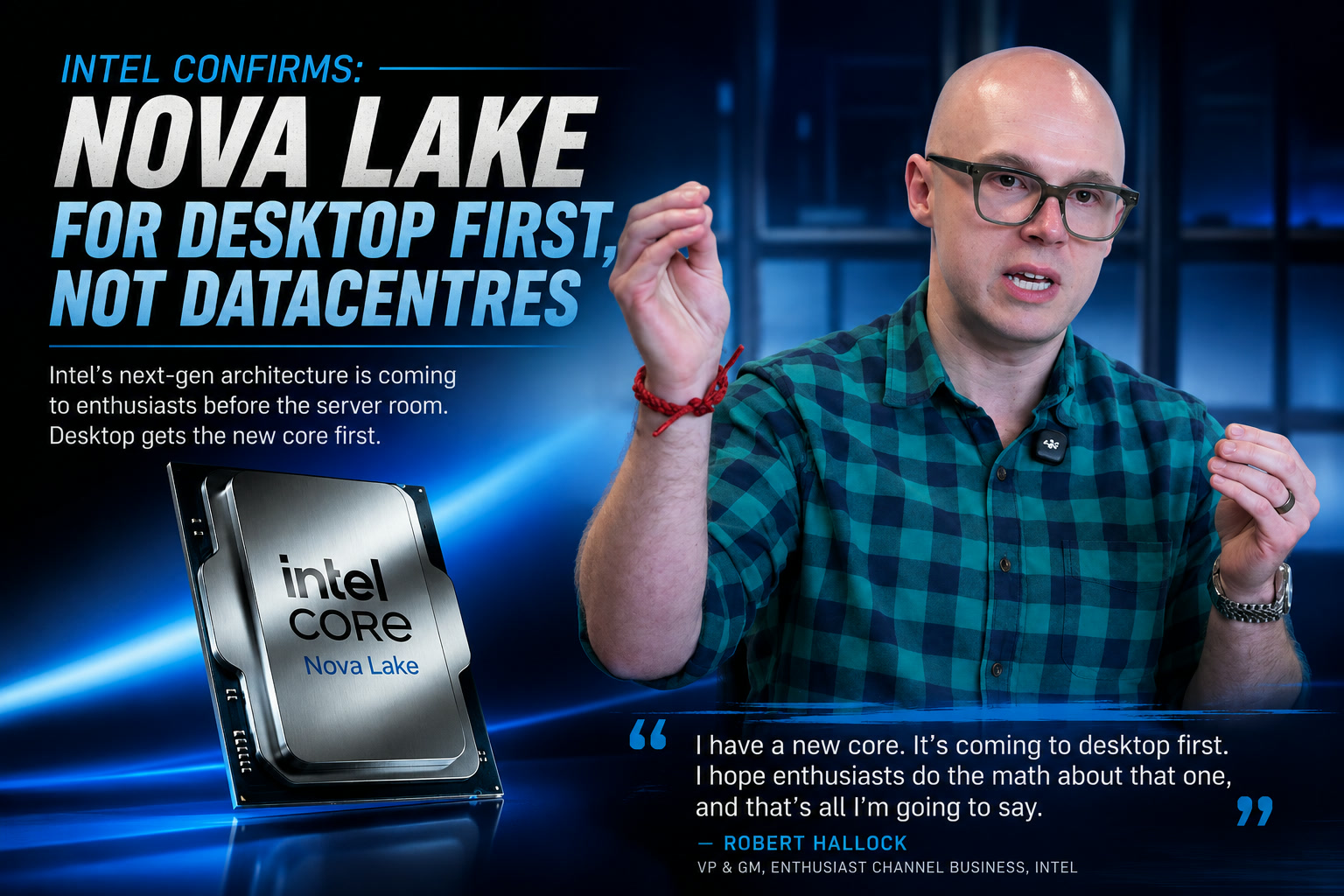
Intel is putting desktop enthusiasts near the front of the queue for its next-generation Nova Lake architecture, with the company confirming that its new CPU cores are expected to arrive on consumer desktops before making their way into datacentre products.
The comments came from Robert Hallock, Intel Vice President and General Manager of the Enthusiast Channel Business, during an interview with Tom's Hardware.
While rival AMD is taking a different route with Zen 6 by introducing the architecture first through its EPYC Venice server processors, Intel appears determined to prioritise desktop users with Nova Lake.
For PC enthusiasts who felt that Intel's recent desktop generations lacked the excitement seen on the company's mobile side, that could be an encouraging sign.
Intel Wants Enthusiasts to Get the New Architecture First
When asked about AMD's datacentre-first strategy for Zen 6, Hallock said Intel is "very serious" about delivering its new architecture to consumers first.
He stopped short of revealing specific products or specifications, but strongly hinted that Intel's upcoming CPU core would debut in its desktop lineup.
That is an interesting strategic contrast.
Datacentre processors can be extremely lucrative, so semiconductor companies often prioritise enterprise customers when introducing major architectural improvements. Intel, however, appears to see value in giving enthusiasts early access to Nova Lake.
If everything goes according to plan, desktop PCs could therefore become the first place consumers see what Intel's next major CPU generation can really do.
Nova Lake Has Plenty to Prove
The timing is particularly important because Intel's desktop processor business has had a difficult few generations.
The company's 13th and 14th Gen Core processors, based on the Raptor Lake architecture, were hit by widespread concerns involving instability on certain higher-end CPUs.
Some Core i9 processors reportedly experienced degradation linked to excessive operating voltages, with affected chips potentially suffering permanent damage.
Intel eventually introduced BIOS and microcode updates intended to address the problem and prevent similar degradation.
The episode nevertheless damaged confidence among some desktop enthusiasts, particularly those who had purchased expensive flagship processors expecting years of reliable performance.
Nova Lake therefore arrives with more pressure than simply delivering another performance increase.
Intel also needs to continue rebuilding trust.
Arrow Lake Took a Different Direction
Intel's follow-up desktop generation, Arrow Lake, avoided the same voltage controversy but created a different discussion.
Rather than chasing maximum gaming performance at almost any cost, Intel placed greater emphasis on performance-per-watt and efficiency.
From a technical perspective, that approach had obvious benefits.
Lower power consumption can mean less heat, quieter cooling requirements and potentially better long-term efficiency.
The problem was that desktop enthusiasts do not always evaluate processors purely by efficiency.
When upgrading an expensive gaming PC, many buyers want a clear performance improvement over the previous generation.
Arrow Lake's balance between efficiency and outright speed therefore received a mixed reception, particularly among gamers comparing Intel directly against AMD's strongest desktop processors.
Intel Has Been Stronger on the Mobile Side
Interestingly, Intel's laptop processor development has looked considerably more positive.
Architectures such as Lunar Lake demonstrated major improvements in efficiency, integrated graphics and battery-focused performance, while Panther Lake continues that broader push.
Intel has shown that it can build modern processors that deliver significant generation-to-generation improvements when power efficiency and integrated platform design are central to the product.
The challenge has been translating that momentum back into desktop CPUs.
Desktop enthusiasts typically care much less about extending battery life and much more about gaming performance, multicore workloads, overclocking potential and upgrade value.
Nova Lake will therefore need to satisfy a rather different audience.
The Core Ultra 200S Plus Chips Have Helped
There have already been signs that Intel is adjusting its desktop strategy.
The newer Core Ultra 200S Plus lineup, including processors such as the Core Ultra 7 270K Plus and Core Ultra 5 250K Plus, has helped improve the perception of Intel's current desktop offerings.
These refreshed processors provide stronger options for buyers who may have been disappointed with the original Core Ultra desktop lineup.
They do not completely reset Intel's position in the enthusiast market, but they give the company a better foundation heading into Nova Lake.
The real question is whether Nova Lake can deliver the kind of architectural leap enthusiasts have been waiting for.
Why Desktop-First Could Be Important
Launching Nova Lake on desktop first is about more than release timing.
It sends a message about where Intel wants to compete.
The enthusiast desktop market may be smaller than the enormous datacentre business, but it has considerable influence over Intel's reputation.
PC builders, reviewers, gamers and hardware enthusiasts tend to scrutinise every new processor generation closely.
A strong desktop launch can generate excitement around an architecture that later spreads into other product categories.
Conversely, a disappointing launch can create negative perceptions that follow the architecture for years.
By putting Nova Lake into desktops first, Intel is effectively allowing enthusiasts to be among the first to judge its next-generation CPU design.
That makes the launch considerably more important.
Intel and AMD Are Taking Different Paths
AMD's decision to introduce Zen 6 first through its server-focused EPYC Venice processors also highlights how differently the two companies are approaching their next-generation architectures.
AMD has been extremely successful in datacentres, making enterprise customers an obvious priority.
Intel appears to be signalling that its own new core architecture will first demonstrate its capabilities in consumer desktops.
Neither approach is inherently better.
They simply reflect different business priorities and product roadmaps.
For desktop PC enthusiasts, however, Intel's strategy is clearly the more exciting one because it suggests they will not have to wait for server products to launch before seeing Nova Lake in action.
What Enthusiasts Will Be Watching
Intel has not yet revealed all the details surrounding Nova Lake, but expectations are already building.
Performance will obviously be the biggest question, especially against AMD's next-generation desktop CPUs.
However, enthusiasts will also be watching several other areas closely:
That final point will be especially important after the problems surrounding some Raptor Lake processors.
Raw benchmark numbers alone may not be enough.
Intel will also need to demonstrate that Nova Lake is stable, reliable and worth investing in as a long-term desktop platform.
Final Thoughts
Intel confirming that Nova Lake's new CPU architecture is heading to desktop PCs before datacentres should be welcome news for enthusiasts.
The company's recent desktop history has been uneven, ranging from the Raptor Lake instability controversy to Arrow Lake's greater emphasis on efficiency rather than outright performance.
At the same time, Intel's stronger progress in mobile processors shows that the company is still capable of delivering meaningful architectural improvements.
Nova Lake could therefore become an important opportunity for Intel to bring that momentum back to desktop PCs.
If Intel can combine stronger performance with improved efficiency and rock-solid reliability, a desktop-first launch could give the company exactly the kind of enthusiast comeback it needs.
For now, Hallock is keeping the finer details quiet—but his message is fairly clear: when Intel's next major CPU core arrives, desktop users should be among the first to get it.











Comments 0