

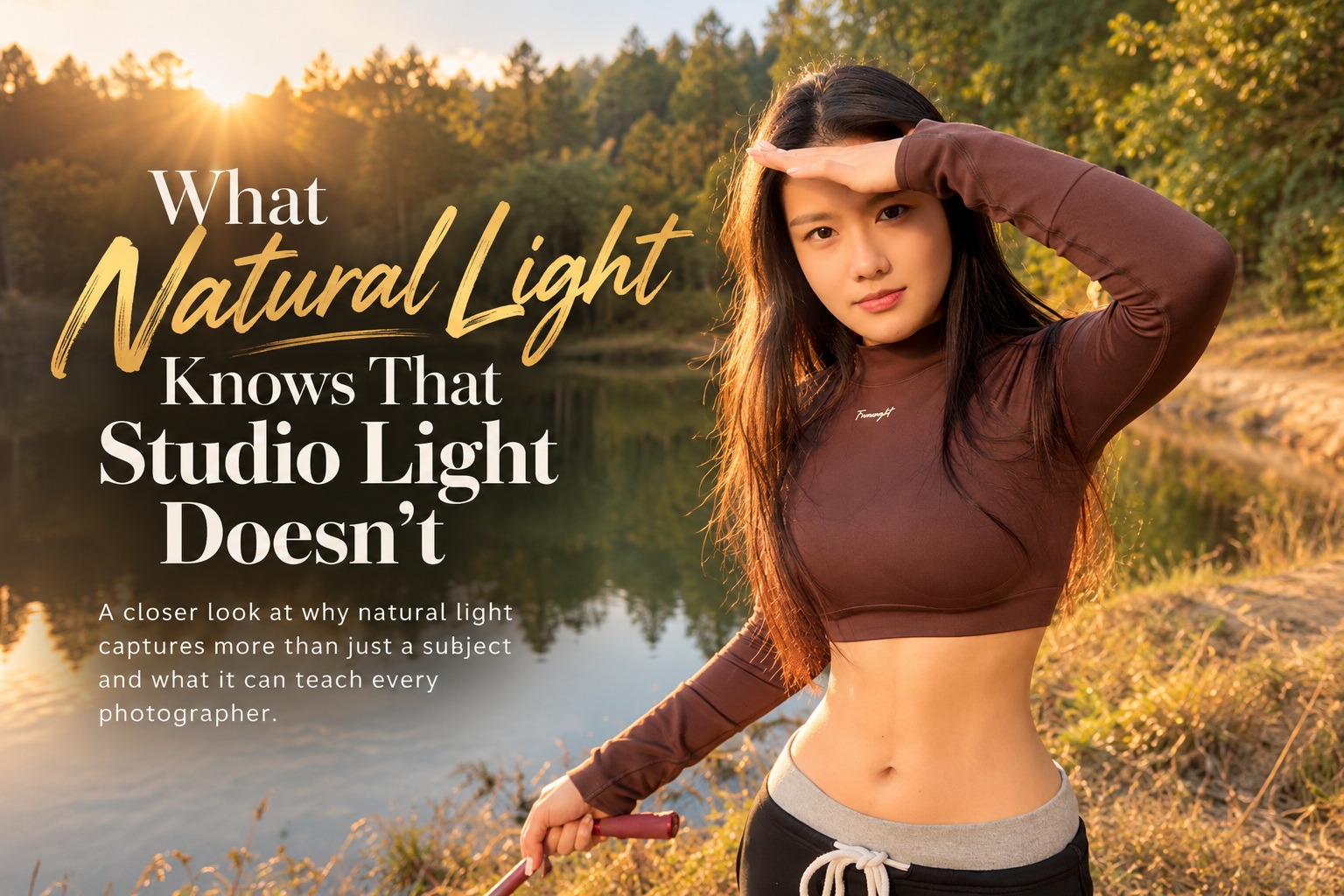
Studio lighting gives photographers something incredibly valuable: control. It can be positioned, softened, reflected, coloured and adjusted until almost every variable behaves exactly as expected. That level of precision is why studios remain essential for commercial photography, product shoots, portraits and any project where consistent results need to be reproduced again and again.
Natural light works completely differently. It changes constantly, ignores schedules and rarely behaves exactly as planned. Clouds move across the sun, shadows stretch across a room, reflections appear from unexpected surfaces and an entire scene can transform within minutes. Yet that unpredictability is also what gives natural light something studio lighting can struggle to reproduce: a genuine sense of place, time and atmosphere.
The Predictability Of Studio Light
Studio lighting is built around consistency. Once a softbox has been positioned and the exposure dialled in, the photographer can reproduce almost exactly the same look across dozens or even hundreds of images.
A strobe fires at a controlled intensity. Colour temperature remains relatively stable. Shadows fall where they are expected to fall, while modifiers allow the photographer to determine whether those shadows should be sharp, soft, dramatic or almost invisible.
That consistency is extremely useful, particularly in commercial photography. A brand photographing hundreds of products cannot afford to have every image look as though it was captured under completely different conditions.
Consistency Can Also Become A Creative Trap
The problem begins when predictability becomes the entire objective. If every image uses the same lighting setup, the results can eventually begin to feel interchangeable.
The photography may be technically excellent. Exposure is perfect, skin tones look accurate and every shadow sits exactly where it should.
Yet something can still feel missing.
When lighting becomes nothing more than a technical requirement, it stops contributing meaningfully to the photograph. The viewer sees a beautifully illuminated subject, but very little about the environment or moment that surrounded it.
Natural Light Never Repeats Itself Perfectly
Natural light does not offer that kind of consistency. Even when photographing in exactly the same location, the scene can look completely different depending on the time, weather and season.
Morning sunlight entering through a window may create long warm shadows. A few hours later, the same room could be filled with bright neutral light. When clouds arrive, everything becomes softer and more subdued.
None of those variations are necessarily better than the others. What makes them interesting is that they belong specifically to that moment.
The light becomes part of the photograph rather than simply something used to illuminate it.
Natural Light Responds To The Environment
One of the most beautiful characteristics of natural light is the way it interacts with its surroundings.
Sunlight passing through tree branches creates irregular patterns across a subject. Light reflecting from a painted wall can introduce a subtle colour cast. A nearby building may bounce sunlight into an alley that would otherwise remain completely dark.
These imperfections carry information about the place where the photograph was taken.
A studio photographer can certainly recreate similar effects using flags, gels, reflectors and carefully positioned lights. But natural light produces them organically because the environment itself becomes part of the lighting setup.
The Location Becomes Embedded In The Light
A portrait photographed beside a window contains more than the face of the person being photographed. The light quietly tells us something about where they are.
The direction of the window determines the highlights. The surrounding walls influence the colour. The weather outside affects the contrast, while the time of day determines whether the scene feels warm, neutral or cool.
Even when the background reveals very little, the lighting can still suggest the atmosphere of the location.
Natural light therefore carries context almost automatically.
Studio Light Often Removes Context
Studio lighting tends to work in the opposite direction. Its purpose is usually to isolate the subject from environmental variables and create a predictable visual result.
That can be extremely valuable when context is unwanted. Product photography, fashion catalogues and corporate portraits often benefit from lighting that remains neutral regardless of where or when the photograph was created.
The subject becomes the entire focus.
But removing environmental influence also removes some of the accidental character that makes certain photographs memorable.
Natural Light Carries Emotion
Light does not simply determine whether we can see something. It strongly influences how that thing feels.
Early morning light can feel peaceful and optimistic. Harsh midday sunlight can feel exposed and unforgiving. Golden-hour light often creates warmth and nostalgia, while blue shade can make the same environment feel quiet or distant.
These emotional qualities exist before the photographer even raises the camera.
Natural light already arrives with a mood attached.
The Same Portrait Can Tell Two Completely Different Stories
Consider photographing the same person in two different lighting conditions.
Place them beneath soft overcast light and the portrait may feel calm, introspective and gentle. Move them into hard direct sunlight and suddenly the image can become dramatic, energetic or confrontational.
Nothing about the person has changed. Their clothes may be identical, the camera may be identical and the location may even remain the same.
Only the light changed.
Yet emotionally, the photographs can communicate completely different things.
Studio Lighting Can Imitate Natural Conditions
Professional lighting can imitate almost every visual quality found in nature. A large diffuser can reproduce the softness of an overcast sky. Warm gels can simulate late-afternoon sunlight, while carefully placed hard lights can create convincing window shadows.
Skilled photographers can reproduce golden hour inside a studio long after the sun has disappeared.
Technically, the simulation may be extremely convincing.
But there remains a subtle difference between recreating the appearance of a lighting condition and photographing the actual conditions that created it.
Simulation Recreates Appearance, Not Circumstance
A warm studio light can reproduce the colour temperature of sunset, but it cannot make the sun actually be setting outside the frame.
That distinction matters because photographs are often interpreted emotionally as records of moments. The viewer may never consciously analyse where the light came from, but environmental lighting can help make an image feel connected to something real.
Artificial light can recreate the visual characteristics perfectly. What it cannot recreate automatically is the circumstance that gave those characteristics meaning.
The emotion is constructed rather than discovered.
Natural Light Forces The Photographer To Observe
Working without complete control changes how photographers behave.
Instead of deciding where the light should come from, they first need to understand where it is already coming from. They watch how it passes through windows, reflects from buildings and changes across faces as subjects move.
That process develops observational skills that cannot be learned entirely from lighting diagrams.
You begin noticing light before thinking about cameras.
Constraint Can Encourage Creativity
Natural-light photography is fundamentally an exercise in working with constraints. You cannot move the sun or ask a cloud to remain exactly where it is.
Instead, you move yourself.
You reposition the subject, find another angle, use a reflector or wait until the light changes. Sometimes the solution is simply walking ten metres until the background begins reflecting light differently.
Those limitations force creative problem-solving.
The Photographer Collaborates With The Light
Studio photography often involves commanding the light. Natural-light photography feels more like negotiating with it.
You might arrive with one photograph in mind and discover that the conditions make something entirely different possible. The sun disappears behind clouds, creating softer light than expected. A reflection suddenly appears on a wall. The subject moves into a patch of illumination you had not noticed before.
The best result may be something that was never included in the original plan.
That unpredictability is frustrating sometimes, but it is also where discovery happens.
Some Of The Best Natural-Light Photographs Are Found, Not Built
Certain images exist for only a few seconds.
A ray of sunlight passes through a gap between buildings. Someone steps into it at exactly the right moment. A cloud shifts, the contrast changes and suddenly the photograph appears.
You did not manufacture the lighting.
You noticed it.
That distinction can produce a very different relationship between photographer and image. Instead of constructing every element, you become attentive enough to recognise when the world has already created something worth photographing.
Natural Light Rewards Patience
Studio lighting lets photographers work largely according to their own schedule. Natural light frequently demands the opposite.
You may need to wait for the sun to move into position. A location that looks unremarkable at noon might become extraordinary near sunset. A cloudy morning can suddenly open into beautiful directional light for only a few minutes.
Learning to wait becomes part of learning to photograph.
That patience also changes how photographers observe their surroundings.
Weather Stops Being An Obstacle
New photographers sometimes divide weather into good and bad conditions. Bright sunshine is considered good, while clouds or rain are treated as problems.
Experience teaches something different.
Overcast skies create enormous natural softboxes. Rain produces reflective surfaces and deeper colours. Fog reduces contrast and creates separation between layers of a landscape.
Every condition offers a different type of light.
The challenge is learning what each one can do.
Window Light Is One Of The Best Teachers
You do not need dramatic landscapes to study natural light. A simple window can teach an enormous amount.
Move a subject closer and the light becomes softer relative to them. Rotate the face and shadows begin defining its shape. Add a white wall opposite the window and suddenly the shadow side becomes brighter through reflected light.
These are exactly the principles used in studio photography.
The difference is that nature demonstrates them without equipment.
Natural Light Teaches You To See Direction
Once you begin paying attention, light develops a visible direction everywhere.
One side of a building appears brighter because it faces the sun. A person's eyes become more defined when they turn towards a window. Shadows become longer as the afternoon progresses.
Understanding direction is one of the foundations of good lighting.
Natural light makes those relationships constantly available for observation.
It Also Teaches Quality Of Light
Not all light behaves the same way.
A tiny bright source creates hard shadows, while a large diffuse source creates soft transitions. Direct sunlight produces dramatically different results from the same sunlight filtered through clouds.
Watching these changes helps photographers understand why lighting behaves the way it does rather than simply memorising where a studio modifier should be positioned.
That understanding transfers directly into controlled lighting work.
Natural-Light Experience Improves Studio Photography
A photographer who becomes skilled at reading natural light often becomes better inside the studio as well.
They begin recognising which lighting qualities feel convincing because they have spent time observing real-world examples. They understand why window light looks different from direct sunlight and why reflected light often contains colour from its surroundings.
Instead of arranging lights according to formulas alone, they can recreate specific natural relationships intentionally.
The studio becomes less about equipment and more about understanding light.
Studio Lighting Is Still Essential
None of this means studio lighting is inferior. There are countless situations where controlled lighting is unquestionably the better tool.
Commercial clients often require repeatability. Products photographed months apart need to look consistent. Portrait sessions may take place at night or inside environments with poor natural illumination.
Studio lighting allows photographers to deliver predictable results regardless of external conditions.
That reliability is precisely why professionals depend on it.
Control Creates Possibilities Nature Cannot Provide
Artificial lighting also enables photographs that natural light could never create conveniently.
Lights can be placed behind, above or beneath a subject. Colours can be introduced independently. Multiple sources can be balanced with extreme precision.
A photographer can make midnight look like morning or create dramatic highlights that do not correspond with any real-world lighting condition.
Studio lighting is not merely an imitation of nature. It is its own creative language.
The Difference Is Intention
The real question should therefore not be whether natural or studio light is better.
The question is what the photograph needs.
If consistency matters most, controlled lighting may be the obvious answer. If atmosphere and environmental authenticity matter more, natural light may offer something difficult to reproduce.
A good photographer understands both and chooses intentionally rather than automatically reaching for whichever approach feels most familiar.
Natural Light Contains Time
Perhaps one of the most overlooked qualities of natural light is that it records time.
Morning does not look like afternoon. Winter does not look like summer. A storm approaching across the horizon creates a completely different atmosphere from one that has just passed.
A photograph made under natural light therefore contains subtle information about when it was created.
Light becomes part of the timestamp.
It Also Contains Place
Natural light interacts with every environment differently. Desert sunlight reflects differently from light inside a dense city. Tropical vegetation creates different patterns from bare winter trees.
Architecture influences reflections. Wall colours influence shadows. Humidity and atmosphere change how distant light appears.
The resulting photograph becomes connected not only to a subject but to a particular place.
That context is incredibly difficult to manufacture completely.
Imperfection Often Makes Images Feel More Real
Professional photography sometimes becomes obsessed with removing imperfections. Shadows are filled, highlights are controlled and every uneven element is corrected.
Natural light frequently does the opposite.
One side of a face may fall into shadow. A reflection might introduce unexpected warmth. Highlights may disappear behind passing clouds.
Technically, these variations might appear less perfect.
Emotionally, they can make the photograph feel much more alive.
Perfect Lighting Is Not Always Interesting Lighting
An image can be beautifully exposed and still say very little.
Lighting becomes interesting when it contributes to the story. Sometimes that means allowing part of the scene to remain dark. Sometimes it means letting the sunlight become almost too strong.
Technical perfection should serve the photograph rather than become the entire objective.
Natural light reminds photographers of this constantly because it rarely behaves according to textbook diagrams.
The Best Photographers Learn Both Languages
There is no reason to choose permanently between natural and artificial light. The strongest photographers understand both.
They can walk into a room and recognise what the existing light offers before unpacking equipment. If natural light is already doing something beautiful, they leave it alone.
If something is missing, they introduce artificial light carefully rather than replacing everything automatically.
The result can combine control with authenticity.
Artificial Light Can Support Natural Light
Many photographs described as natural-light images actually involve some additional help. A reflector may brighten the shadows, a small flash might provide subtle fill or a continuous light may strengthen the window illumination.
The goal is not necessarily to distinguish between natural and artificial sources.
It is to make the final image feel coherent.
When artificial light supports rather than overwhelms the environment, viewers may never notice that it was added.
Light Should Feel Like It Belongs
One of the most useful lessons natural light teaches is that good lighting feels connected to its surroundings.
A bright highlight makes sense because there is a window nearby. A warm glow seems believable because the sun is setting. Shadows fall in directions that correspond with the environment.
When studio lighting ignores those relationships, the photograph can begin feeling artificial even when the viewer cannot explain exactly why.
Studying natural light teaches photographers how to make artificial lighting feel believable.
Final Thoughts
Studio lighting gives photographers extraordinary control. It can be repeated, measured and adjusted until the result is almost exactly what was imagined. For commercial work and situations where consistency matters, that control is invaluable.
Natural light offers something different. It carries the weather, location and time of day inside the photograph. Its imperfections create context, while its constant changes force photographers to observe rather than simply control.
Working with natural light teaches patience because sometimes the right photograph requires waiting. It teaches awareness because the photographer needs to recognise opportunities before they disappear. Most importantly, it teaches that lighting is not merely a technical requirement for making something visible.
Studio light is a tool that lets photographers create.
Natural light is a teacher that shows photographers what light already knows how to do.
The photographer who learns from both ultimately gains the best of both worlds: the ability to control light when necessary and the judgement to recognise when the light that already exists is better left untouched.











Comments 0