

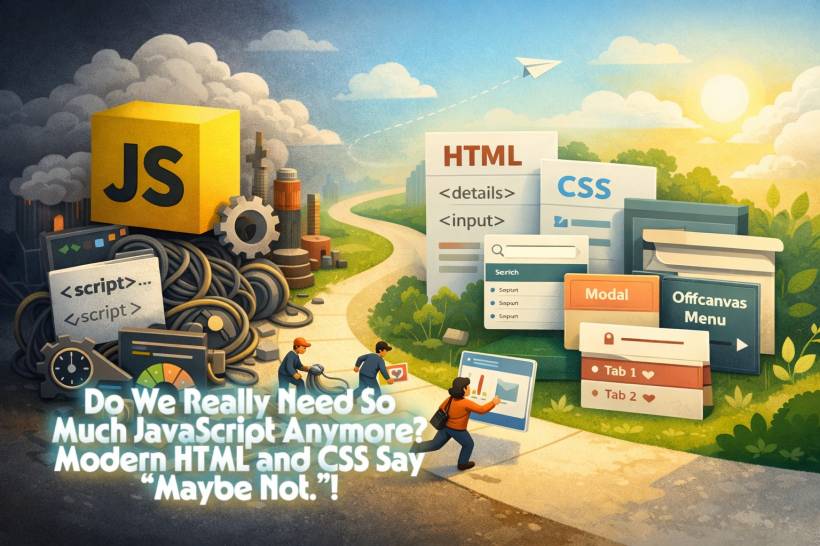
For years, JavaScript has been the hero of the web. Anytime HTML and CSS hit their limits, JavaScript stepped in and saved the day. Want interactive menus? Fancy accordions? Dynamic UI behavior? JavaScript has traditionally been the go-to solution, and it has undeniably driven the evolution of modern web experiences forward.
But the web keeps growing up. HTML and CSS have evolved dramatically, gaining capabilities that used to require complex scripts. That means many of the things we've been doing "the JavaScript way" now have simpler, faster, and more efficient native alternatives.
This isn't about hating on JavaScript. Far from it. JavaScript is powerful and essential. But maybe it doesn't need to waste energy managing dropdowns, menus, panels, and popovers when HTML and CSS can handle those jobs beautifully.
Why Reducing JavaScript Matters
Every JavaScript file you ship comes with a cost. It must be downloaded, parsed, executed, and often kept in memory to keep features running. Multiply that across every component on a page and the performance overhead becomes real, especially on slower networks or budget devices.
If we can hand off some of this work to native browser features, everyone wins:
Thanks to modern standards, we now have reliable, accessible, browser-native ways to replace several common JavaScript UI patterns. Let's look at some great examples.
1. Accordions and Expandable Panels — No Script Required
Remember building accordions with click events, toggle states, and custom logic? Those days are pretty much over.
The HTML <details> and <summary> elements make collapsible sections effortless. Out of the box, they handle:
You can:
In short, that "simple" accordion doesn't need JavaScript anymore — and that's a big win.
2. Smart Autofilter Inputs Without JavaScript
Autocomplete used to mean plugins, scripts, and event listeners. Now, the <input> element combined with <datalist> gives users instant filtering suggestions while they type. It works great for:
You can even pair it with number or time inputs for handy preset options. There are still a few limitations (Firefox is slower with some types, and mobile support can vary), but for many use cases, it's a lightweight, native solution that avoids additional scripts.
3. Modals and Popovers — Now a Native Browser Feature
Traditionally, modals and overlays meant layers of JavaScript: opening logic, closing logic, escape key support, backdrop handling, focus management, you name it. Today, the Popover API and dialog features allow browsers to handle that complexity for you. With a simple HTML attribute, you get:
- Controlled popovers
- Light-dismiss behavior (click outside to close)
- Different behavior modes (auto, hint, manual)
- Native accessibility handling
Support is still evolving, but it is quickly becoming a standard, and it drastically reduces the need for custom modal systems.
4. Slide-Out Navigation Without JavaScript
Side menus and off-canvas navigation are everywhere, especially on mobile. Historically, they required JavaScript to toggle visibility, animate transitions, and manage backdrops. With popovers and CSS transforms, you can now create slick offscreen menus using nothing but HTML and CSS. The browser takes care of:
Add CSS styling and you're done — no script needed.
So… Is JavaScript Going Away?
Absolutely not. JavaScript remains the backbone of rich web applications, complex interactions, real-time updates, and business logic. But just because it can do everything doesn't mean it should. The smarter approach today is:
he result? Faster pages, happier users, simpler maintenance, and cleaner codebases.
Final Thoughts
Modern web standards are evolving fast, and they're giving us powerful, elegant tools that reduce our dependency on heavy scripting. Replacing JavaScript where appropriate isn't about nostalgia or purism — it's about performance, accessibility, resilience, and respect for users' devices. If you haven't explored these newer capabilities yet, now is the perfect time. Your future self (and your users) will thank you.
Happy simplifying!











Comments 0