

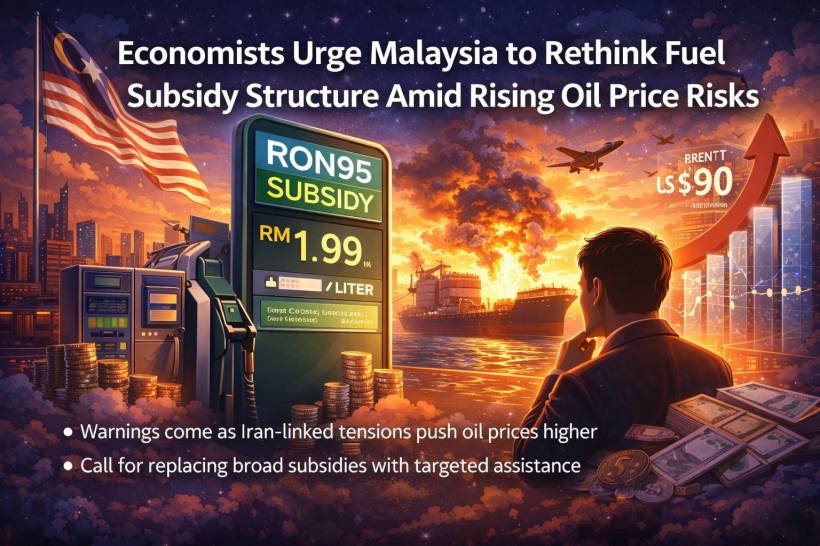
Malaysia's fuel subsidy debate is back in focus, and this time the pressure is coming from outside the country. Economists are warning that if the conflict involving Iran keeps global oil prices elevated, the government may need to rethink how it supports petrol prices, especially for RON95. The concern is not just about today's pump price, but about how long public finances can keep absorbing the gap if energy markets stay volatile.
Why the Current Subsidy Model Is Under Pressure
Right now, the government is trying to hold the subsidised RON95 price at RM1.99 per litre for Malaysians even as global oil markets react to Middle East tensions. Prime Minister Anwar Ibrahim said the government would try to maintain that price under the Budi Madani RON95 programme despite the uncertainty surrounding crude prices and the wider regional conflict.
That sounds reassuring in the short term, but economists are pointing out the obvious trade-off: when the retail price is fixed while global prices move higher, the difference has to be absorbed somewhere, and that "somewhere" is government spending. Carmelo Ferlito of the Center for Market Education argued that keeping a broad-based subsidy in place during a prolonged oil shock could squeeze the government's room to fund other social support programmes.
The Bigger Risk Is Fiscal Strain, Not Just Petrol Prices
This is where the discussion becomes more important than a simple weekly fuel-price story. A universal subsidy may feel fair on the surface because everyone sees the same pump price, but it also means the government is subsidising consumption across the board, including for households that are not the ones most in need.
Economists quoted in local coverage say that if oil prices remain high for longer, Malaysia could face rising subsidy costs at the same time it is trying to protect living standards through programmes such as Sumbangan Tunai Rahmah and Sumbangan Asas Rahmah. In that kind of environment, a blanket subsidy starts looking less like protection and more like a growing fiscal liability.
Why the Iran Conflict Matters So Much to Malaysia
Malaysia is not directly causing the oil shock, but it is exposed to the consequences. The Strait of Hormuz remains one of the world's most important energy chokepoints, with more than one-fifth of global oil flows moving through it. Disruption there quickly feeds into global crude prices, shipping costs, and inflation expectations.
That is why market watchers have been taking the conflict seriously. Reuters reported that Brent crude was heading for one of its sharpest weekly gains in years as Middle East tensions escalated, while local and regional reports cited forecasts that Brent could jump by as much as US$20 per barrel if risk premiums continue to rise.
Economists Are Not Calling for a Sudden Shock to Consumers
What is interesting here is that the economists raising concerns are not saying subsidies should be scrapped overnight. The message is more measured than that. The idea is to prepare for medium-term restructuring rather than wait until a prolonged oil rally forces a rushed response.
Ferlito suggested moving away from broad universal support and toward more targeted protection, such as vouchers or assistance aimed more directly at lower-income groups. His argument is that this would protect vulnerable households without turning a temporary geopolitical shock into a permanent structural burden on the budget.
A Tiered System Could Be a Middle Ground
Another economist, Geoffrey Williams, took a similarly pragmatic line. He reportedly said the government may still be able to sustain subsidies in the short run if the conflict proves temporary, but warned that the situation becomes harder if oil prices stay high for longer. He suggested a tiered fuel pricing structure based on monthly usage, where lower consumption receives stronger subsidy support while heavier use receives less.
That kind of model is politically easier to explain than an abrupt subsidy cut. It also fits the broader policy direction many governments are trying to follow now: support the people who genuinely need help, while reducing leakage and keeping the fiscal position manageable.
The Real Policy Question Is About Sustainability
This is really the heart of the issue. Malaysia may be able to maintain RM1.99 for now, and government leaders have made clear that they want to do so. But the longer oil-market volatility lasts, the harder it becomes to justify an open-ended universal subsidy without crowding out other forms of support.
That is why economists are calling for a rethink now rather than later. It is easier to redesign a subsidy system while the government still has policy space than when markets have already forced the issue. If the conflict cools and oil prices stabilise, the pressure may ease. But if the current tension turns into a longer period of elevated crude prices, Malaysia will likely need a more targeted, durable fuel subsidy framework.
Final Thoughts
The current fuel subsidy system was built to shield consumers from sudden pain, and in the short term it is doing exactly that. But geopolitical shocks have a way of testing whether a policy is merely helpful or truly sustainable.
What economists are arguing is not that Malaysians should suddenly be left to absorb higher petrol prices on their own. The bigger point is that a universal subsidy becomes harder to defend when global oil prices surge and fiscal obligations pile up elsewhere. If the Iran-linked tensions continue to keep energy markets on edge, Malaysia may have little choice but to move toward a more targeted and disciplined subsidy structure.











Comments 0