

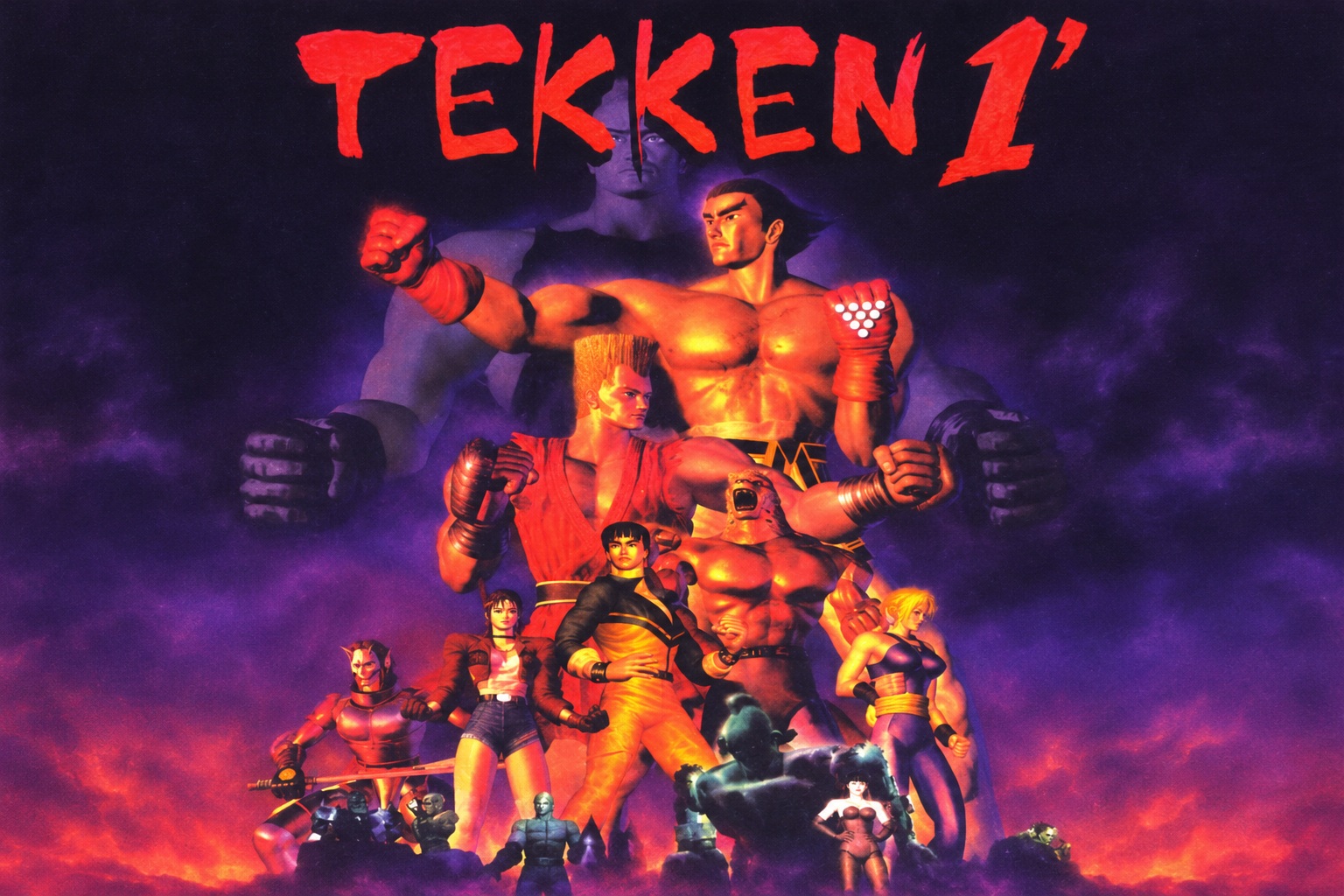
Tekken is the original entry in Namco's long-running 3D fighting series, bringing the first King of Iron Fist Tournament to the PlayStation in 1995. The game introduces many characters who would later become permanent parts of the franchise, including Kazuya Mishima, Heihachi Mishima, Paul Phoenix, Marshall Law, Nina Williams, King, Yoshimitsu, Michelle Chang, and Jack. At the centre of the story is Kazuya, who enters the tournament seeking revenge against his father after Heihachi threw him from a cliff during childhood. That brutal family conflict immediately gives Tekken a darker personality than many fighting games of the same era.
Combat is built around a distinctive four-button system in which each button controls one limb: left punch, right punch, left kick, and right kick. This creates an intuitive foundation for combinations while allowing each fighter to have a surprisingly large collection of unique attack strings, throws, launchers, and special techniques. Rather than relying mainly on quarter-circle motions and projectile attacks, Tekken encourages players to learn how sequences of punches and kicks connect together. The result is a fighting system that feels very different from the 2D fighters that dominated arcades during the early 1990s.
Now playable online through Lemon Web Games, Tekken brings its original King of Iron Fist Tournament, eight main fighters, unlockable sub-boss characters, four-button combat system, character-specific combinations, throws, launchers, and classic early PlayStation presentation directly into the web browser. Players can choose a fighter, battle through Arcade mode, unlock additional characters, discover individual endings, and experience the beginning of the Mishima rivalry that would eventually become the central storyline of the entire series. The graphics and movement are naturally more primitive than later Tekken games, but the core ideas are already clearly recognizable. For anyone interested in where one of the biggest 3D fighting franchises began, the first Tekken remains fascinating to revisit.
The Mishima Family Conflict Begins Here
The story of Tekken centres on Kazuya Mishima and his father Heihachi. Years earlier, Heihachi threw the young Kazuya from a cliff in a brutal test of strength, leaving him with both a physical scar and a powerful desire for revenge.
When Heihachi later organizes the King of Iron Fist Tournament, Kazuya sees the competition as his opportunity to confront his father. The tournament therefore becomes more than a simple contest for money or prestige.
This rivalry would eventually grow into one of gaming's longest-running family conflicts. Tekken introduces the foundation without overwhelming the player with complicated lore.
Kazuya Mishima Is the Central Fighter
Kazuya serves as the main protagonist of the original game and establishes many of the techniques later associated with Mishima-style combat.
His fighting style combines powerful punches, kicks, launchers, and attacks such as the famous Wind God Fist. He is capable of dealing heavy damage once the player learns how his moves connect.
Kazuya is especially important historically because so much of the later series continues to revolve around him and his family. Starting with the original Tekken gives players a clear view of where that storyline began.
Heihachi Mishima Is the Final Challenge
Heihachi is more than simply another fighter on the roster. As organizer of the tournament and Kazuya's father, he represents the central obstacle standing between Kazuya and revenge.
His powerful attacks and aggressive style make him an intimidating opponent. Fighting Heihachi at the end of the tournament provides a natural conclusion to Kazuya's story.
The confrontation also establishes the series tradition of using the Mishima family as both protagonists and antagonists. Their rivalry is never as simple as good versus evil.
Eight Main Fighters Create a Memorable Starting Roster
The original playable lineup consists of eight main characters, each representing a different fighting style and personality.
Paul Phoenix uses powerful martial arts strikes, Marshall Law relies on fast Jeet Kune Do-inspired techniques, Nina Williams combines rapid attacks with grappling, and King brings professional wrestling into the tournament. Yoshimitsu adds unpredictable sword-based techniques, while Michelle Chang and Jack provide entirely different approaches.
The roster may appear small compared with later Tekken games, but every character is visually and mechanically distinct. Many would become long-term favourites.
The Four-Button System Defines Tekken
Tekken's control scheme is one of its most important innovations.
Instead of assigning buttons simply to light, medium, or heavy attacks, each button corresponds to a specific limb. Players can therefore create combinations by pressing different sequences of punches and kicks.
The system is easy to understand but difficult to master. Random button presses can produce attacks, but deliberate combinations are far more effective.
Attack Strings Reward Practice
Every fighter has sequences of attacks that flow naturally into one another.
Learning these strings allows the player to maintain pressure and punish opponents who make mistakes. Some combinations are easy to perform, while others require much more precise timing.
This gives the combat depth beyond individual strikes. Experienced players begin thinking in complete attack sequences rather than isolated punches and kicks.
Launchers Create Combo Opportunities
Certain attacks can knock opponents into the air.
Once launched, the opponent becomes vulnerable to additional hits before landing, creating opportunities for stronger combinations. Even in the first Tekken, this concept already hints at the juggle-heavy combat that would become increasingly important in later entries.
Learning a reliable launcher can dramatically improve performance. It turns one successful opening into significantly more damage.
Throws Punish Defensive Opponents
Blocking is essential, but constantly defending creates opportunities for throws.
Each fighter has grappling techniques that can bypass conventional defence when used at close range. Characters such as King are especially dangerous once they get within grabbing distance.
Throws prevent matches from becoming completely passive. Players need to balance blocking with movement and counterattacks.
Different Fighting Styles Add Personality
Tekken draws inspiration from a wide range of martial arts and combat styles.
Law's fast striking feels completely different from King's wrestling, while Jack relies on heavy robotic strength and Yoshimitsu uses unconventional sword techniques. Nina focuses on speed, kicks, and grappling, while Paul delivers slower but extremely powerful blows.
These differences encourage players to experiment. The best character is often the one whose rhythm feels most natural.
Unlockable Sub-Bosses Add Replay Value
The PlayStation version expands the arcade experience by allowing several previously non-playable sub-boss characters to be unlocked.
Completing Arcade mode with specific fighters rewards continued play and gradually expands the available roster. This was an especially appealing feature during the early PlayStation era, when discovering hidden characters could feel like a major reward.
The unlocking system also encourages players to use fighters they might otherwise ignore. Completing the game once is therefore only the beginning.
Character Endings Give the Fighters More Identity
The PlayStation release adds individual ending sequences for the playable fighters.
Some provide story details, while others are humorous or intentionally strange. These endings create another reason to complete Arcade mode with every character.
They also help establish the exaggerated personality that would become increasingly important in later Tekken games. Fighting is the main attraction, but the characters are what make the series memorable.
The Early 3D Graphics Were a Major Attraction
Tekken arrived during a period when polygonal characters still felt technologically impressive.
The fighters are constructed from relatively simple 3D models, but seeing fully polygonal martial artists battling inside 3D environments was exciting on early PlayStation hardware. Camera angles and character animation also helped distinguish Tekken from traditional sprite-based fighting games.
The visuals are obviously primitive compared with modern releases, but that early polygonal appearance has become part of the game's retro identity.
Movement Feels Different From Later Tekken Games
Players familiar with newer entries may immediately notice that the original Tekken feels heavier and less refined.
Animations are stiffer, movement is more deliberate, and many techniques lack the smooth transitions introduced later in the series. The combat nevertheless contains the basic structure that later games would polish.
That makes the original especially interesting historically. Players can see how Namco's ideas evolved rather than encountering the finished formula immediately.
Arcade Mode Is the Main Experience
Arcade mode sends the selected fighter through a sequence of one-on-one battles before reaching the final confrontation.
Each opponent provides an opportunity to learn different attack patterns and character matchups. Completing the mode can also contribute toward unlocking additional fighters.
The structure is simple but effective. A full tournament run provides enough variety to make experimenting with another character worthwhile.
Two-Player Fighting Adds Lasting Appeal
Tekken becomes much less predictable when another player takes control of the opponent.
Human players can change tactics, bait attacks, use throws unexpectedly, and punish repeated patterns in ways the CPU may not. This transforms the same basic combat system into a much more competitive experience.
The straightforward controls also make the game easy to introduce to another player. Understanding the four limb buttons takes only moments, even if mastering them takes much longer.
Playing Tekken Online Today
Through Lemon Web Games, Tekken can now be played directly in your web browser with no downloads or setup required. Features of the web-based version include:
New players should choose one fighter and learn a few dependable combinations instead of trying to memorize the entire moveset immediately. Understanding several safe attacks, one reliable launcher, and a useful throw is enough to begin winning more consistently.
Blocking is equally important. Tekken rewards players who wait for an opponent to make a mistake and then respond with a strong combination rather than attacking constantly.
Who Should Play Tekken
Tekken is especially worthwhile for anyone familiar with later entries who wants to see where the series began. Many familiar characters, techniques, story elements, and gameplay concepts already exist in surprisingly recognizable form.
It is also a fascinating example of early 3D fighting design. The game may lack the refinement of its sequels, but the foundation is clearly visible.
Play Tekken Online Now
Choose Kazuya, Paul, Law, Nina, King, Yoshimitsu, Michelle, Jack, or one of the unlockable fighters and enter the original King of Iron Fist Tournament. Learn combinations, use throws, launch opponents, punish mistakes, and gradually discover the unique strengths of every fighter.
Through Lemon Web Games, the original PlayStation release can be experienced directly in the browser as the starting point of one of gaming's biggest fighting franchises. Long before Tekken became known for enormous rosters and cinematic storylines, everything began with this relatively simple tournament and a bitter conflict between Kazuya and Heihachi.
Final Thoughts
The original Tekken is rougher and simpler than the sequels that followed, but its historical importance is impossible to ignore. The four-button control system, character-specific combinations, launchers, throws, diverse fighting styles, and Mishima rivalry establish the foundation for almost everything the series would later become.
The PlayStation version adds enough unlockable characters and individual endings to make repeated tournament runs worthwhile. Its early polygonal graphics also provide a fascinating snapshot of a time when 3D fighting games were still discovering what worked.
Through Lemon Web Games, Tekken remains worth experiencing not only as a retro fighting game but as the beginning of an enormous franchise. For fans of Kazuya, Heihachi, classic PlayStation games, and the evolution of 3D combat, the first King of Iron Fist Tournament is where it all started.











Comments 0