

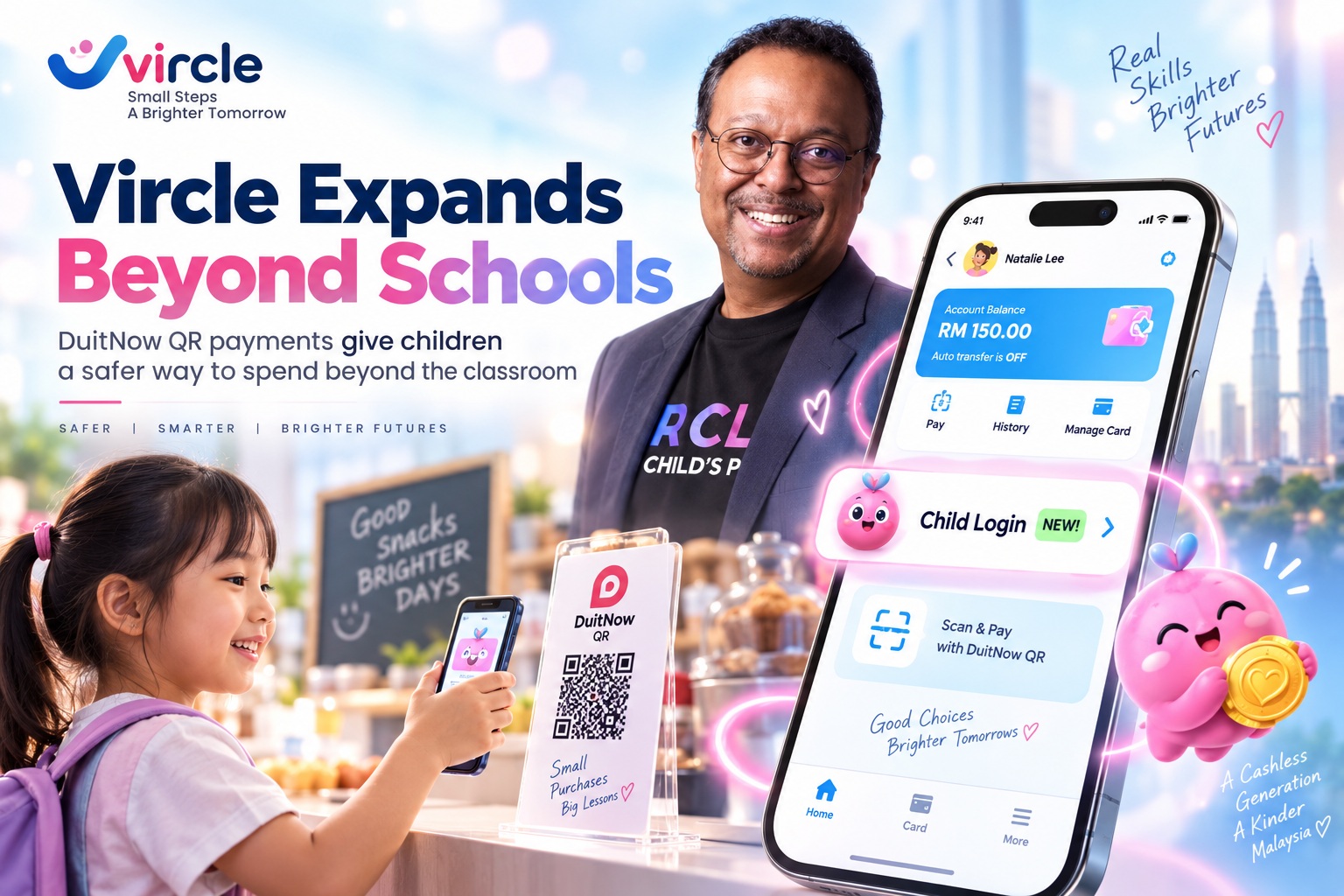
Vircle is expanding its children-focused payment ecosystem beyond school environments with the launch of Scan & Pay for Kids, a new feature that allows children to make payments using DuitNow QR through the Vircle app.
The feature gives young users a more practical way to spend digitally at participating merchants while keeping parents involved in how the account is managed. Unlike a conventional adult e-wallet adapted for younger users, Vircle is positioning the service as something designed specifically around children and parental oversight from the beginning.
Children Can Pay Using DuitNow QR
Once a parent creates and activates the child's Vircle account, the child can use the mobile app to scan DuitNow QR codes at supported merchants.
This extends Vircle beyond its original school-focused use case and allows children to make everyday purchases outside participating campuses. Since DuitNow QR is already widely accepted across Malaysia, the feature gives children access to a much broader payment network without needing a conventional adult banking or e-wallet account.
Vircle says use of Scan & Pay itself is free, with the company arguing that core safety features should not require an additional paid upgrade.
Parents Still Remain in Control
The child can make the payment, but the parent retains visibility and control from their own device. Parents can set spending limits, monitor transactions as they happen and freeze the child's account if necessary.
That gives children some independence while allowing parents to remain aware of how money is being used. Vircle founder and CEO Gokula Subramaniam said parents generally are not looking to approve every individual purchase, but they still want to remain involved in their children's digital spending.
The approach is therefore closer to supervised financial independence rather than complete parental control.
Money Can Also Be Sent Between Verified Children
Vircle also allows parents to transfer money directly into a child's account. Children can then use those funds for QR payments or send money to another verified child on the Vircle platform.
This could be useful in situations such as sharing the cost of a meal, repaying a friend or transferring small amounts between siblings. Restricting child-to-child transfers to verified Vircle accounts also helps keep the feature within the platform's controlled ecosystem.
For younger users, it provides some of the convenience adults already expect from digital wallets while maintaining additional safeguards around who can participate.
Early Usage Suggests Children Are Returning to the Feature
Vircle says 75% of children who completed their first transaction during the feature's month-long soft launch made another transaction the following week.
The company did not disclose how many children were included in that measurement, so the figure does not reveal the overall scale of the trial. Still, it suggests that a large proportion of the initial users continued using the feature after their first transaction.
That repeat usage may indicate there is demand for a payment option that sits somewhere between cash and a full adult e-wallet.
Vircle Already Has a Strong Presence in Malaysian Schools
Vircle is not starting from zero. The company says its Fasspay-powered wallet has been used in more than 100 Malaysian schools since 2020 and now serves close to 200,000 parents and students.
Its original model focused heavily on school payments, allowing children to make purchases without carrying cash while giving parents better visibility over spending.
The introduction of DuitNow QR represents a natural expansion of that concept. Instead of limiting the system to school cafeterias or participating campus merchants, Vircle can now follow the child into normal retail environments.
Its Prepaid Card Also Includes Merchant Restrictions
Vircle also offers a prepaid card designed for younger users. According to the company, the card blocks payments at categories such as vape shops and bars by default.
That kind of merchant-category restriction is another example of how Vircle differentiates itself from standard adult payment products. The objective is not simply to give a child access to digital money, but to build controls around how that money can be spent.
Combined with QR payments, spending limits, parental monitoring and account freezing, the platform is gradually becoming a broader financial tool for families rather than only a school payment solution.
Teaching Children to Manage Digital Money
One potential benefit of services like Vircle is that they give parents an opportunity to introduce financial responsibility while children are still using relatively small amounts of money.
Instead of handing over cash with little visibility afterward, parents can see where money is being spent and discuss those decisions with their children. A spending limit can also introduce the idea that digital money still has boundaries, even though there is no physical cash disappearing from a wallet.
As payments become increasingly cashless, children will likely need to learn these habits earlier.
Final Thoughts
Vircle's Scan & Pay for Kids expands the platform from a school payment solution into something children can use more broadly through Malaysia's DuitNow QR network.
The feature gives children greater independence while preserving parental controls such as spending limits, real-time transaction visibility and account freezing. Combined with child-to-child transfers and Vircle's existing prepaid card protections, the platform is clearly trying to create a digital wallet experience designed specifically around younger users.
The bigger opportunity may be educational as much as financial.
Children are going to encounter digital payments whether parents are ready or not. Giving them a supervised environment where they can learn how to spend, budget and manage money responsibly could make that transition considerably easier.











Comments 0