

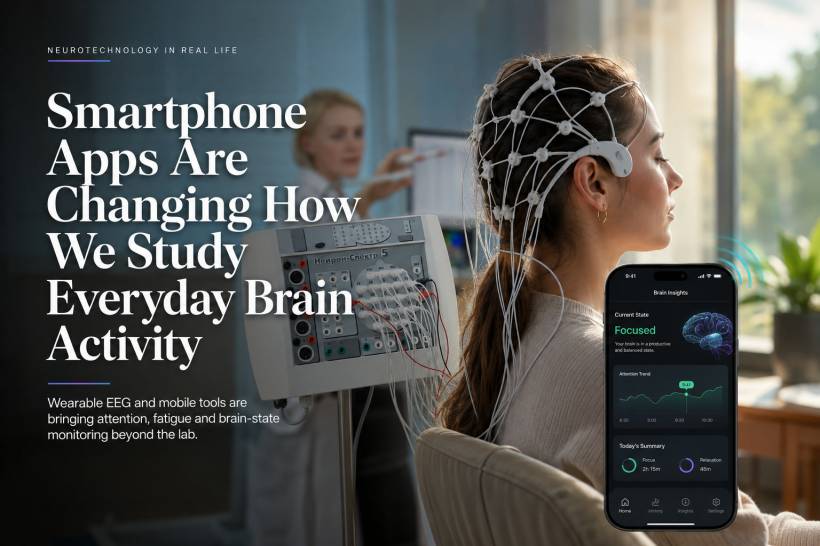
For decades, brain activity research has largely been confined to hospitals, clinics and laboratories. Electroencephalography, better known as EEG, has been an important tool for studying the brain's electrical activity, helping clinicians monitor neurological conditions and researchers understand how the brain responds to different tasks.
Traditionally, however, EEG testing has required specialised equipment, carefully controlled environments and multiple sensors attached to the head. That makes it highly accurate for clinical and research use, but less practical for understanding how the brain behaves during ordinary daily life.
That may be starting to change.
Newer wearable EEG devices, combined with smartphones and mobile apps, are making it increasingly possible to record and analyse brain activity outside the lab. Researchers describe this emerging approach as natural EEG: monitoring brain signals while people are studying, working, resting, listening to music or moving through their usual environments.
The idea is not to read thoughts or turn smartphones into medical diagnostic tools. Instead, the goal is to observe meaningful changes in brain activity over time, including possible signs of fatigue, reduced attention, mental workload or drowsiness.
Why Studying the Brain Outside the Lab Matters
Human attention is not constant.
A student may begin a lecture focused and alert, then gradually lose concentration after an hour. A worker may become mentally fatigued near the end of a long shift. A driver may become drowsy during a late-night journey even when they believe they are still awake enough to continue.
These changes are difficult to fully understand in an artificial laboratory setting.
Traditional EEG has been extremely useful because it can capture brain activity with millisecond-level precision. But laboratory studies often involve controlled tasks, limited movement and carefully managed conditions. Everyday life is much messier.
People blink, walk, speak, move their heads, react to notifications, listen to music and deal with changing surroundings. Natural EEG aims to study brain activity within that reality rather than separating people from it.
This could give researchers a better understanding of how attention, fatigue and engagement fluctuate in real-world situations.
Smartphones Are Becoming Part of the Research Toolset
Modern smartphones are surprisingly well suited to support this kind of work.
They already contain computing power, storage, cameras, wireless connectivity and sensors in a single portable device. When paired with a wearable EEG headset, a smartphone can help collect brain-signal data while also recording useful context about the person's surroundings.
An example of this is CameraEEG, an Android-based research application designed to synchronise EEG recordings with video captured from the phone's camera.
This combination allows researchers to study not only changes in brain activity, but also what was happening around the participant at the same time. For example, a researcher may be able to compare a change in attention levels with the person's environment, activity or visual surroundings.
That context is important because brain activity cannot be fully understood in isolation. The same signal pattern may mean something different depending on whether someone is studying, driving, exercising or listening to music.
The Biggest Challenge: Separating Brain Signals From Noise
Moving EEG out of the laboratory creates a major technical challenge: noise.
EEG signals are extremely sensitive. Eye blinks, facial muscle movement, body motion, head movement and electrical interference from the surrounding environment can all be picked up by sensors.
These unwanted signals are known as artifacts.
In a hospital or research laboratory, EEG systems may use dozens or even hundreds of electrodes. Having many sensors makes it easier to identify which signals are likely to come from the brain and which are caused by movement or other interference.
Wearable devices are far more limited. Many use only one or a few sensors, which makes separating useful brain signals from noise much harder.
This has long been one of the main barriers to reliable real-world EEG monitoring.
Recent research, however, suggests that it may still be possible to clean noisy signals even when only a small number of electrodes are used. Researchers are adapting signal-processing methods originally designed for larger clinical EEG systems so that they can work with more compact wearable devices.
This does not make wearable EEG perfect, but it is an important step towards making real-world monitoring more practical.
Wearable EEG Cannot Simply Be Treated Like Hospital EEG
Another challenge is that consumer-grade EEG devices and clinical systems are not built to the same standard.
Clinical EEG equipment is designed for high-quality recordings in controlled settings. Wearable devices are usually lighter, cheaper and easier to use, but they may have fewer sensors and produce noisier data.
Because of this, a model trained using hospital-grade EEG data may not automatically work well on a wearable device.
One approach researchers are exploring is called projection-based transfer learning. Rather than trying to make wearable EEG signals look exactly like clinical EEG recordings, this method focuses on identifying patterns that matter for a particular task.
For example, the system may not need to interpret every detail of a brain signal. It may only need to recognise whether a person is becoming more fatigued, less attentive or increasingly drowsy.
This allows models developed with higher-quality clinical data to guide predictions on simpler wearable devices without assuming that both systems produce identical raw signals.
Early research has shown potential for this approach in areas such as fatigue detection and motor rehabilitation.
Real-Time Brain Monitoring on a Smartphone Is Becoming More Feasible
Running EEG analysis on a smartphone creates further limitations.
Mobile devices have to balance processing power, battery life, storage and heat management. A system also needs to respond quickly enough to be useful in real time.
Despite these challenges, studies have shown that some pre-trained EEG models can operate on Android smartphones under mobile conditions. For instance, researchers have tested systems that identify whether a person's eyes are open or closed using wearable EEG data.
This may sound simple, but it demonstrates something important: brain-signal analysis does not always need to happen later on a powerful computer. In some cases, it can be processed directly on a mobile device while the user is carrying out normal activities.
That opens the door to more practical applications in education, workplace wellbeing, rehabilitation and human-computer interaction.
Possible Uses Beyond Hospitals
Natural EEG could support people with neurological or cognitive conditions by providing longer-term information about how they function during daily life.
Instead of relying only on short clinical assessments, doctors and researchers may one day be able to review patterns linked to fatigue, concentration, sleep quality or cognitive changes across different environments.
For healthy individuals, the technology may have other uses.
It could potentially help someone recognise when mental workload is becoming too high, when attention is declining during study sessions or when fatigue is affecting performance. In the future, adaptive systems could respond to those signals by adjusting a learning interface, suggesting a break or changing the difficulty of a task.
Gaming and interactive software may become early testing grounds for this technology because they already rely on real-time feedback and adaptive experiences.
A game, for example, could eventually adjust pacing or difficulty based on signs of cognitive overload. A study app might recognise when attention has dropped and suggest a pause rather than continuing to push more information.
Music, Emotion and Everyday Experiences
Researchers are also using natural EEG to explore how the brain reacts to ordinary experiences, including music.
In one example, CameraEEG was used to study brain activity while participants listened to Indian classical music under more natural listening conditions. The findings suggested that EEG could detect meaningful shifts in activity during passive listening.
This type of research may eventually support a better understanding of music perception, emotional response and therapeutic uses of sound.
The significance is not that an app can fully understand someone's emotions. It is that researchers may be able to observe relative changes in brain activity linked to different real-life experiences.
Privacy and Ethical Safeguards Will Matter Greatly
As brain-sensing technology becomes more portable, privacy must remain central.
Brain-related data can be highly personal, especially when it is combined with video, location information or behavioural patterns. Systems designed for natural EEG should avoid making exaggerated diagnostic claims and should clearly explain what the technology can and cannot interpret.
Where possible, processing should happen directly on the user's device rather than sending sensitive information to external servers. Users should also have clear control over what data is stored, shared or deleted.
This is especially important because wearable EEG is not mind-reading technology. It can detect patterns and changes, but it cannot reliably reveal someone's private thoughts, intentions or personality.
Responsible design will mean setting realistic expectations and preventing the misuse of highly sensitive data.
Final Thoughts
Natural EEG is still at an early stage. Most current systems remain research projects rather than everyday consumer products.
However, the direction is becoming clearer. Wearable sensors, smartphone apps and improved machine-learning methods are helping researchers move brain monitoring beyond the laboratory and into real-world settings.
The most promising role for this technology may not be diagnosing illness or decoding thoughts. It may be providing a practical way to observe changes in fatigue, attention, engagement and mental workload over time.
The question is no longer only whether brain activity can be recorded outside a clinic. It is whether these tools can be designed carefully enough to support wellbeing, learning and safety without compromising privacy or overstating what the data can tell us.











Comments 0