

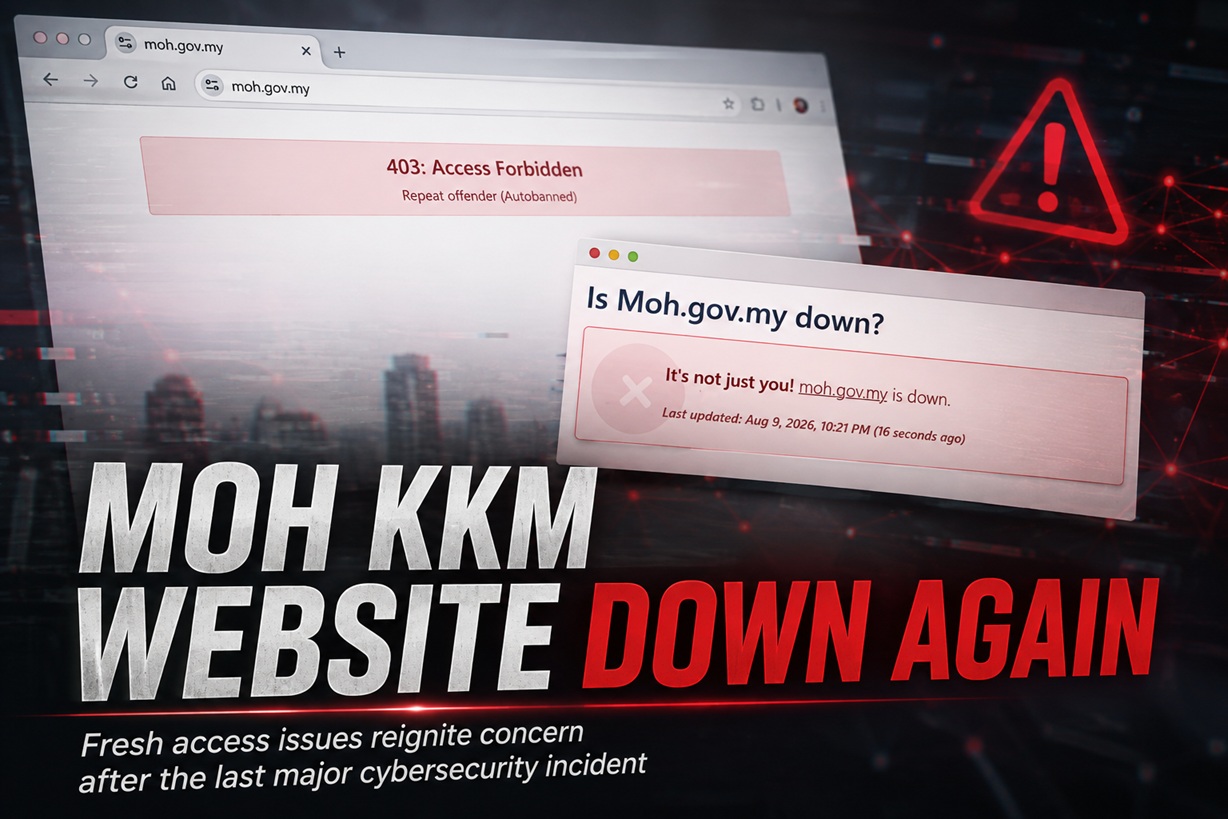
If you tried accessing the official Ministry of Health Malaysia (KKM/MOH) website recently and were greeted by a "403: Access Forbidden – Repeat offender (Autobanned)" message, you are probably not alone in wondering what is going on.

From an end-user perspective, the result is simple: the website cannot be accessed normally. And considering what happened to the MOH portal only a little over a month ago, seeing another access problem naturally raises concerns.
The important thing, however, is not to immediately assume that KKM has suffered another cyberattack. A 403 error is quite different from a website being hacked. Nevertheless, coming so soon after the major cybersecurity incident in June, it highlights an equally important issue: availability and reliability are part of cybersecurity too.
The MOH Website Is Once Again Inaccessible
As shown in the screenshot, visiting moh.gov.my currently results in:
Repeat offender (Autobanned)
That particular message suggests that a server-side security mechanism, Web Application Firewall, intrusion-prevention system or similar protection may have automatically blocked the requesting IP address or traffic pattern.
In other words, the server is responding—it simply refuses to serve the page.
Technically, therefore, this isn't necessarily the same thing as the entire MOH infrastructure being "down." In fact, portions of the MOH website are still being indexed and retrieved publicly.
But that technical distinction doesn't make much difference to an ordinary visitor.
If Malaysians cannot access the website when they need it, the service is effectively unavailable to them.
This Comes Shortly After the June Cybersecurity Incident
The timing is what makes this latest problem more noticeable.
On 27 June 2026, the Health Ministry confirmed that its official website had been hacked and said an investigation and recovery work were underway. The portal was inaccessible while the ministry dealt with the incident.
At the time, KKM advised the public not to access the compromised website and to rely on its other verified communication channels while remediation was being carried out.
Several Malaysian government websites were reportedly affected around the same period, prompting concerns about vulnerabilities affecting government web infrastructure.
NACSA also issued alerts around that period concerning critical unauthenticated remote-code-execution vulnerabilities affecting Joomla components, including Joomla Content Editor (JCE) and SP Page Builder. Such vulnerabilities can potentially allow unauthenticated attackers to execute code on vulnerable servers if the affected software has not been properly patched.
That history makes any subsequent disruption involving the MOH website understandably more sensitive.
There Is No Evidence Yet That This Is Another Hack
This point is important. The 403 Autobanned screen shown now does not prove that another cybersecurity breach has taken place.
In fact, it may indicate the opposite: security controls are actively blocking traffic that they consider suspicious.
There are many possible explanations. A Web Application Firewall could be applying rules too aggressively, an IP address could have been automatically blacklisted after repeated requests, rate limiting could have been triggered, or recently strengthened security settings could simply be generating false positives.
Without an official technical explanation from KKM, it would be irresponsible to describe this particular incident as another confirmed cyberattack.
But there is still a problem.
Good cybersecurity has to balance confidentiality, integrity and availability. Protecting the server is critical, but the service also has to remain accessible to legitimate users.
The Previous Incident Is Still Fresh in Everyone's Mind
Following the June attack, MOH later said that there was no evidence that sensitive data had leaked during the incident and explained that patients' medical records and health information were not stored on the affected public portal.
MOH also temporarily suspended access to the website while recovery and security work continued.
That was reassuring from a data-protection standpoint.
However, recovering from a cybersecurity incident isn't simply about restoring a website and putting it back online.
There is a much bigger question:
That is where cyber resilience becomes just as important as cybersecurity.
A Government Health Portal Isn't Just Another Website
The official KKM website is an important public information platform.
People use MOH online services and websites to find information relating to healthcare programmes, facilities, public-health initiatives, clinical guidance, announcements and various government health services. The ministry itself describes the portal as an official source for healthcare services, facilities, public-health programmes and national initiatives.
For an organisation of this scale, website availability shouldn't be viewed purely as an IT KPI.
It is a public-service continuity issue.
During normal periods, a few hours of website trouble might simply be inconvenient. During a disease outbreak, public-health emergency or major national announcement, however, the same outage could become significantly more consequential.
That is why high-availability architecture, disaster recovery, monitoring and cybersecurity cannot be managed as separate projects anymore.
Perhaps the Security Controls Have Become Too Aggressive
There is another possibility worth considering.
After experiencing a successful compromise, it would be entirely reasonable for an organisation to significantly tighten its web-security controls.
That might mean stronger firewall rules, more aggressive bot detection, IP reputation filtering, stricter rate limiting, additional intrusion detection and automated banning.
All of those measures can improve security.
But they also require careful tuning.
A system that blocks an actual attacker is doing its job.
A system that repeatedly blocks legitimate Malaysians simply browsing the MOH website has a different problem: false positives.
Modern web security therefore isn't about turning every protection setting to maximum. It is about understanding normal traffic, identifying abnormal behaviour and applying controls precisely enough that legitimate users remain unaffected.
KKM Needs More Than Recovery—It Needs Resilience
The June incident should ideally become an opportunity to strengthen the overall MOH web environment rather than simply repair the vulnerability that was exploited.
That means looking beyond patching.
The environment should include continuous vulnerability management, regular penetration testing, Web Application Firewall monitoring, secure configuration reviews, automated patch-management processes, centralised logging and SIEM monitoring, tested backups, disaster-recovery capabilities and real-time availability monitoring.
Just as importantly, there should be proper monitoring of user experience from outside the KKM network.
A server-monitoring dashboard might report that a website is technically "online" because the web server answers requests. But if external users receive 403 errors, timeout messages or security blocks, the service isn't really healthy.
That is why synthetic monitoring from multiple Malaysian networks and geographic locations can be extremely useful.
Transparency Would Help Restore Confidence
Following a major cybersecurity incident, communication becomes extremely important.
If the latest 403 issue is simply caused by a security rule or temporary configuration problem, a short official notice would immediately remove much of the uncertainty.
Something as simple as acknowledging intermittent access issues and confirming that technicians are investigating would help.
Otherwise, people naturally connect today's problem with what happened in June—even when the two events may have completely different causes.
That isn't necessarily because people are overreacting. It is because trust in digital services is built through both technical reliability and transparent communication.
Final Thoughts
Seeing the MOH KKM website inaccessible again so soon after June's confirmed cybersecurity incident isn't something that should simply be dismissed as another website error.
At the same time, the current 403 "Autobanned" message should not be treated as evidence that KKM has been hacked again. Based solely on what is visible, it looks more like a security control actively denying access than a traditional website outage or defacement.
But that creates another important conversation.
Cybersecurity isn't successful simply because attackers are blocked. A secure government digital service must also remain stable, available and usable by legitimate members of the public.
KKM's previous incident showed why protecting government web infrastructure matters. This latest accessibility problem—whatever its eventual cause—shows why cyber resilience matters just as much.
For one of Malaysia's most important government ministries, the goal shouldn't merely be getting the website back online whenever something goes wrong.
It should be keeping it secure, dependable and continuously accessible in the first place.











Comments 0