Please wait while we're digging into our systems to find what you want....
close
What’s on your mind..?
LOADING...
Preparing list of our web development services...
WEB DEVELOPMENT
E-COMMERCE Solutions
Turning a website into an online store involves far more than simply adding a Buy button. Products need to be organised clearly, customers need a straightforward shopping journey, orders must be recorded properly, inventory needs to remain manageable, and payment processing has to connect smoothly with the rest of the website.
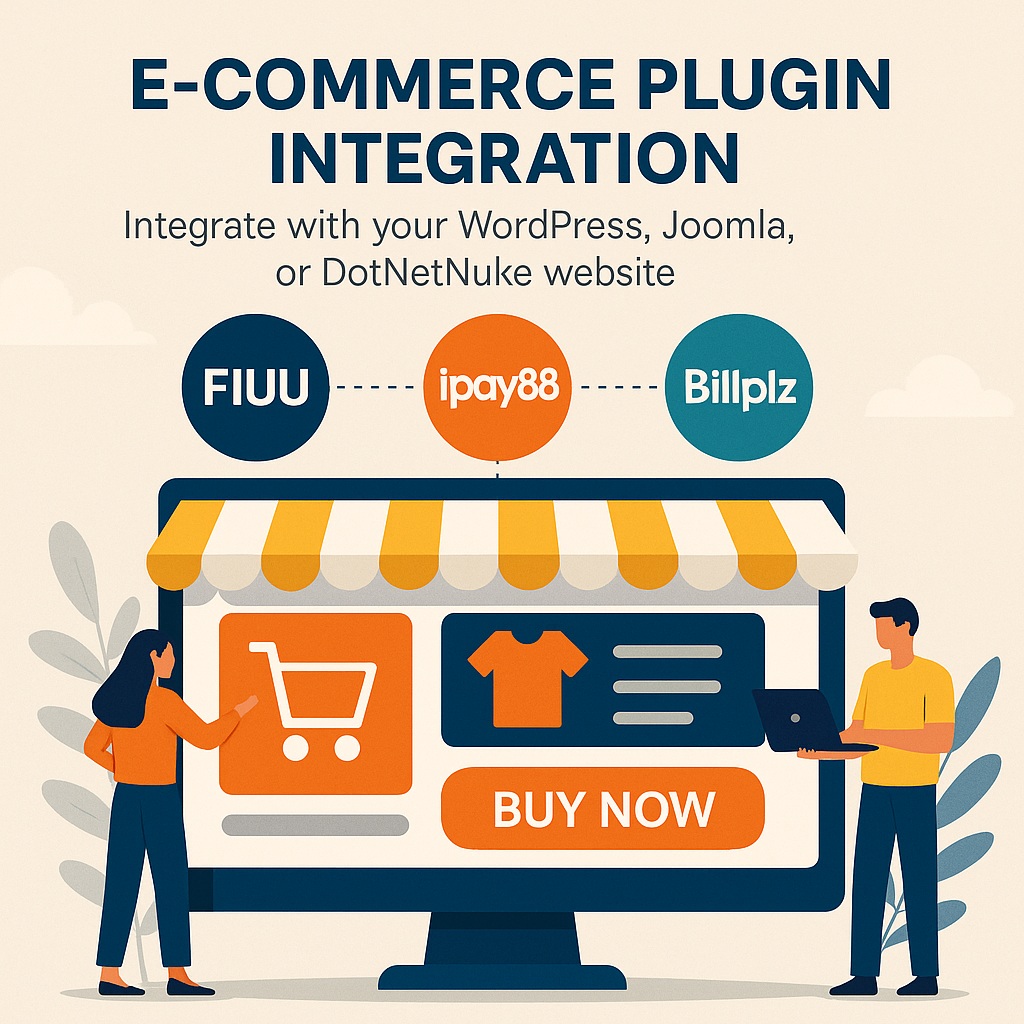
Lemon Web Solutions provides E-Commerce Plugin Integration for WordPress, Joomla, and DotNetNuke websites. We can configure the foundation of your online store including the product catalogue, shopping cart, order workflow, payment gateway integration, inventory handling, customer alerts, and responsive shopping experience.
For Malaysian businesses, e-commerce integrations can also connect the website with supported payment gateway services such as FIUU, iPay88, and Billplz. This allows the online store, shopping cart, payment process, and order workflow to operate as part of one connected customer experience.
Your website becomes more than an online catalogue. A properly integrated e-commerce solution connects products, customers, shopping carts, payments, orders, and inventory into a practical online sales workflow.
PLAN Your E-Commerce Store
Every online store is slightly different. Your existing CMS, the amount of product information you expect to manage, your preferred payment gateway, and the way inventory is handled all influence how the e-commerce integration should be structured. Answer four quick questions below and we will build a simple overview of your proposed store setup.
Question 1 of 4
Which CMS will power your online store?
Select your existing CMS or the platform you are considering for the e-commerce website.
What type of product catalogue do you expect?
This helps describe the amount of product organisation and catalogue management your store may require.
Which payment gateway are you considering?
Choose your preferred gateway if you already have one in mind, or select Not Sure if you would prefer to discuss the available options first.
How do you expect inventory to be managed?
Select the workflow that most closely resembles the way product stock needs to be maintained.
Your E-Commerce Integration Plan
Your Online Store
RM 5,500
for Installation
|
RM 1,500 per year for Payment Gateway & Support
Your selected requirements have been combined into a simple e-commerce integration plan below.
YOUR Selected Store Requirements
CMS Platform
-
Product Catalogue
-
Payment Gateway
-
Inventory Workflow
-
CORE E-Commerce Integration
Product Catalogue
Shopping Cart
Payment Processing
Order Workflow
Inventory Handling
Customer Alerts
Responsive Store
CMS Integration
CATALOGUE Your Products Clearly
A good online store begins with a product catalogue that customers can understand. Products need appropriate names, descriptions, imagery, prices, categories, and other information that helps visitors decide whether an item is right for them.
E-commerce integration provides a structured way to organise this information within your CMS. Products can be managed as part of the store rather than manually constructing a separate page for every item, making it much easier to expand and maintain the catalogue as your product range changes.
The shopping experience should guide a customer naturally from discovering a product to placing an order. Products are added to the shopping cart, the customer reviews their selection, proceeds through the payment process, and the resulting transaction becomes part of the store's order workflow.
Integrating these steps within the website creates a more consistent experience than treating products, payments, and orders as unrelated systems. It also gives the store administrator a clearer way to manage the activities taking place behind the customer-facing website.
Browse
Add to Cart
Pay
Order
PRODUCT
CART
PAYMENT
ORDER
PAYMENTS through Malaysian Gateways
Payment gateway integration connects your online store checkout with the payment service used to process the customer's transaction. Lemon Web Solutions can integrate supported e-commerce implementations with Malaysian payment gateway services including FIUU, iPay88, and Billplz, depending on the requirements of the project and the selected e-commerce platform.
FIUU
Integrate an eligible online store checkout and payment workflow with FIUU as the selected payment gateway.
PAYMENT GATEWAY INTEGRATION
iPay88
Connect the e-commerce checkout process with iPay88 where it is selected as the store's payment gateway.
PAYMENT GATEWAY INTEGRATION
Billplz
Integrate the website's payment workflow with Billplz as part of a suitable e-commerce implementation.
PAYMENT GATEWAY INTEGRATION
INVENTORY That Stays Connected
Inventory is one of the most important parts of running an online store. The website needs to know what is being offered and, where appropriate, how available stock should be represented to customers and administrators.
Depending on the project, inventory may be managed directly through the e-commerce system or synchronised with another source of stock information. A connected approach reduces the need to maintain the same information manually in several different places and allows the store to operate as part of a broader business workflow.
Product Stock
Synchronisation
Connected Data
Better Visibility
AUTOMATION behind Every Order
The customer sees a relatively simple process: select products, place an order, make payment, and receive confirmation. Behind that experience, several different activities may need to take place so the order can be recorded and handled correctly.
E-commerce integration helps connect those activities into a more coherent workflow. Orders, payment information, inventory activity, and customer alerts can be coordinated through the store rather than relying entirely on separate manual processes.
Order Tracking
Payment Workflow
Inventory Activity
Customer Alerts
STORE
RESPONSIVE Shopping Across Devices
Customers may begin shopping from a desktop computer, browse products from a tablet, or place an order using a smartphone. An e-commerce website therefore needs to remain practical across different screen sizes rather than treating mobile shopping as an afterthought.
Product information, shopping carts, forms, buttons, checkout elements, and other important parts of the store should adapt to the available display. A responsive layout helps maintain a more consistent shopping experience regardless of the device being used.
Desktop
Notebook
Tablet
Smartphone
INCLUDED in Your E-Commerce Integration
The e-commerce implementation brings together the major components required to transform a supported CMS website into an online store. The exact configuration depends on the products, selected platform, payment gateway, inventory workflow, and other project requirements.
Product Catalogue
Structured presentation and management of products within the online store.
Shopping Cart
Configure the cart workflow used by customers while preparing their purchase.
Payment Processing
Integrate the online store with the selected supported payment gateway.
Order Tracking
Organise customer orders as part of the store's operational workflow.
Inventory Integration
Configure inventory handling or synchronisation according to project requirements.
Customer Alerts
Incorporate customer-facing notifications within the online store workflow.
Responsive Design
Ensure important store components remain practical across different screen sizes.
CMS Integration
Integrate e-commerce functionality with WordPress, Joomla, or DotNetNuke.
RM 5,500
for Installation
RM 1,500 per year
Payment Gateway & Support for the integrated e-commerce solution.
PROCESS from Store Planning to Launch
Building an online store requires several parts of the website to work together. We begin by understanding the products, CMS platform, payment requirements, inventory workflow, and customer experience before configuring the e-commerce integration.
01
Understand
Discuss your products, CMS, payment requirements, inventory process, and expected shopping experience.
02
Plan
Organise the catalogue, store structure, shopping workflow, payment integration, and supporting functionality.
03
Build
Configure the e-commerce components, product catalogue, shopping cart, order workflow, and responsive store interface.
04
Integrate
Connect the selected payment gateway together with the required inventory and customer workflow.
05
Launch
Review the integrated store, complete the required testing, and prepare the e-commerce website for customers.
START Your E-Commerce Project
Whether you are adding online shopping to an existing CMS website or planning a new e-commerce presence, the first step is understanding how your products, payment process, orders, inventory, and customers need to work together.
Tell us about the website platform you are using, what you plan to sell, how your products are organised, which payment gateway you are considering, and how inventory is currently managed. We can then determine how those requirements can be brought together into a practical e-commerce solution.
Modern Web Development: Fast, Accessible, Built to Scale
We design and ship robust web experiences—from rapid front-end interfaces to secure APIs and edge-optimized delivery.
Clean code, Core Web Vitals, and maintainable architectures—without sacrificing speed or UX.
Responsive UX & UI
Performance & CWV
API & Microservices
Auth, WAF & Security
Edge/CDN Optimization
SEO & Analytics
Live Code
Build Test
Core Web Vitals
LCP
INP
CLS
Fast UX
CI → CDN → Browser
CI/CD Edge
ABOUT LEMON
Experienced webmaster specializing in functional, visually appealing web design since 2008, with a strong focus on programming and innovation.