

UMEDIC Group Bhd may no longer be enjoying the same strong investor excitement it saw after its initial public offering, but the company's story is not simply about a weaker share price. Behind the softer market performance, the Penang-based medical device group has continued to build the foundation for a more resilient business. Instead of relying on one product line or one market segment, UMediC is expanding across several areas: medical consumables manufacturing, exports, specialised healthcare technologies, ambulance supply and post-acute care.
The group is best known for its HYDROX pre-filled humidifiers and nebulisers, which are used in oxygen therapy. However, UMediC is now preparing for a broader role in the healthcare sector. With a newly completed manufacturing plant in Batu Kawan and growing ambitions in higher-value medical technologies, the company is positioning itself for a more sustainable long-term growth phase.
As alternate director Ng Sze Hui explains, UMediC is not the type of business that delivers sudden explosive growth. But because its products are tied to essential healthcare needs, demand is expected to remain relevant across different economic cycles.
"We are not an explosive growth kind of business, but in good times or bad, there will always be demand for our products," she says.
A Bigger Manufacturing Base in Batu Kawan
One of UMediC's biggest recent milestones is the completion of its second manufacturing plant in Batu Kawan, Penang.
The new facility increases the group's manufacturing and warehousing space to about 50,000 sq ft, compared with less than 30,000 sq ft previously. This gives UMediC a larger production footprint and better ability to support future demand, especially from export markets.
The plant includes ISO 7 and ISO 5 clean rooms, which are important for producing medical consumables in controlled environments. These clean rooms support the production of HYDROX pre-filled humidifiers and nebulisers, which remain the group's core manufacturing products.
UMediC has also implemented the Water for Injection standard, commonly known as WFI. This prepares the company for future pharmaceutical-related products and more demanding regulatory requirements.
Earlier this year, UMediC secured additional industrial land from the Penang Development Corporation. The land is intended for future manufacturing of solution-based consumables, with production expected by the end of 2027.
This expansion gives UMediC several advantages:
• Better support for larger export orders
• Improved readiness for higher-value medical consumables
• Stronger positioning for future regulatory requirements
In other words, the new plant is not just about producing more of the same products. It is also about preparing the company for the next stage of product development.
Why Medical Consumables Take Time to Scale
Medical consumables may look simple from the outside, but the business is not easy to scale quickly.
For UMediC, securing new customers can take years. This is because medical products usually need regulatory approvals, distributor development, hospital evaluation and procurement acceptance before they can generate meaningful revenue.
However, once a product is approved and adopted, the relationship can become very sticky. Hospitals do not usually change suppliers unless there are major issues involving quality, pricing or delivery reliability.
This gives companies like UMediC a stronger long-term position once their products are accepted in a market. The process is slow, but the customer relationships can become durable.
UMediC usually works with one distributor per country. However, exclusivity is not granted immediately. Distributors must first prove that they can commit to sales and properly develop the market.
In healthcare, trust and reliability matter a lot. Hospitals and distributors need to know that the product quality is consistent and that deliveries will arrive as promised.
"In medical devices, confidence is very important. If you promise six weeks, then it must arrive in six weeks," says Ng.
Exports Remain a Key Growth Driver
Exports are central to UMediC's manufacturing business. More than 90% of its core manufacturing products are exported.
The group's pre-filled humidifiers are used in oxygen therapy to humidify oxygen delivered to patients. This is a specialised respiratory consumable segment with relatively limited global competition. According to management, there are fewer than five manufacturers globally producing pre-filled humidifiers at scale.
That gives UMediC a more defensive position compared with businesses selling highly commoditised medical products. It operates in a niche where quality, regulatory approval and delivery reliability are very important.
UMediC currently exports to more than 30 countries. Europe remains one of its key markets because of its strict quality standards and stronger pricing structure. The company is also expanding further into Eastern Europe, where management sees rising demand for respiratory consumables.
Another important market is Brazil. UMediC recently secured a Brazilian customer that is expected to place monthly container orders. If this relationship grows steadily, it could become a meaningful contributor to export revenue.
The United States could also become a major opportunity. UMediC is currently registering its products to comply with US Food and Drug Administration standards. Management expects approval within the next 12 months, which could open the door to a much larger export market.
The New Plant May Deliver Stronger Results Next Year
Although UMediC now has a larger manufacturing base, management does not expect the financial impact to appear immediately.
A new factory does not automatically translate into higher revenue overnight. The company still needs time to ramp up production, onboard customers, introduce redesigned product configurations and coordinate delivery schedules.
"You cannot install machines today and expect revenue to jump tomorrow," says Ng. "This year is more about market penetration and customer onboarding. The stronger revenue impact should become clearer next year."
This means UMediC is currently in a transition phase. It is building capacity and preparing for larger opportunities, but the stronger earnings contribution may only become clearer later.
In the near term, margins may still be affected by depreciation and logistics costs. However, management says underlying demand remains healthy.
Ng says the company has many orders, but the main challenge is managing delivery timing because customers are also trying to control freight costs.
Softer Earnings Have Weighed on Investor Sentiment
UMediC's share price has weakened significantly from its post-listing high.
The stock reached a high of 90 sen in April 2023, but later declined to around 31 sen, below its 32 sen IPO price in July 2022. This weaker performance partly reflects investor concern over softer earnings.
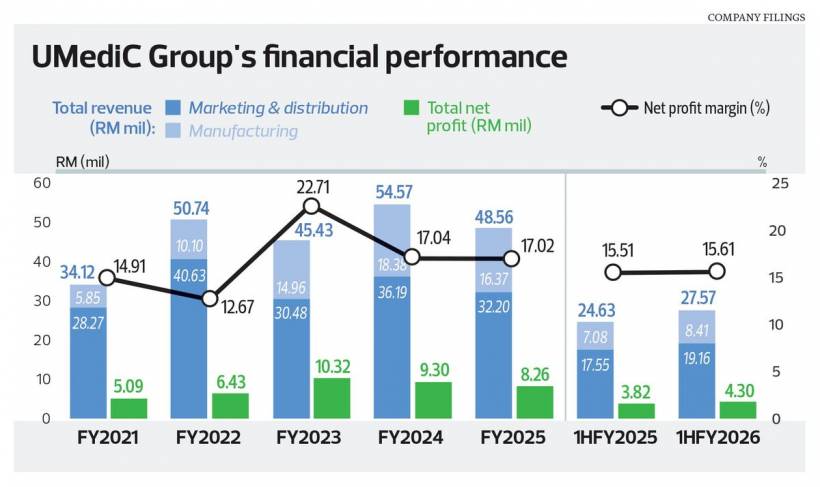
The group's net profit declined from RM10.32 million in FY2023 to RM8.99 million in FY2024, and then to RM8.13 million in FY2025. Revenue rose from RM45.43 million in FY2023 to RM54.57 million in FY2024, before easing to RM48.56 million in FY2025.
Part of the earnings weakness came from slower government hospital procurement in the domestic distribution segment. CEO Eric Lim Taw Seong says this affected the group's performance.
To reduce dependence on government hospital orders, UMediC has been growing its private hospital business. Private hospitals now contribute more than half of the group's distribution revenue.
Export revenue has also improved over the longer term. It increased from RM5.85 million in FY2021 to RM18.38 million in FY2024, before easing slightly to RM16.37 million in FY2025.
According to Ng, the moderation was partly deliberate. UMediC consolidated its distributors in Spain to avoid unhealthy price competition, which may help protect long-term pricing discipline.
A First-to-Market Strategy in Specialised Healthcare
Beyond manufacturing, UMediC is trying to build a more differentiated medical distribution business.
Instead of focusing only on standard hospital equipment, the group is pursuing a first-to-market strategy in specialised healthcare technologies. These products may take longer to commercialise, but they can create deeper relationships with doctors, hospitals and patients.
One key example is Ateria Medika Sdn Bhd, a 90%-owned company established in 2024. Ateria Medika distributes neurostimulation technologies used in the treatment of Parkinson's disease and epilepsy.
This is not a simple trading business. It requires close collaboration with neurologists, neurosurgeons and hospitals. UMediC sponsors overseas specialist training, develops key opinion leaders and helps create awareness among doctors and patients.
"We invest in doctors and training because this kind of business needs ecosystem development first," says Lim.
This approach may take longer to generate revenue, but it can create a stronger competitive advantage over time. Once doctors are trained on a particular platform and hospitals build treatment protocols around it, switching suppliers becomes more difficult.
For implant-based and neurostimulation technologies, UMediC is involved in surgical workflows, technical support and after-sales clinical services. This makes the relationship with hospitals much deeper than ordinary equipment distribution.
It also explains why margins for specialised medical technologies can exceed 40%, which is significantly higher than conventional medical equipment distribution.
Building a Wider Healthcare Ecosystem
UMediC is also expanding into ambulance supply and post-acute healthcare services as part of its broader healthcare ecosystem strategy.
The ambulance business targets government hospitals, university hospitals and private healthcare providers. Management estimates that Malaysia has annual domestic demand of around 200 to 300 ambulance units.
Meanwhile, the group's post-acute care centre in Batu Kawan focuses on rehabilitation, elderly care and transitional recovery services. These services are designed for patients who have been discharged from hospital but are not yet ready to return home independently.
This is an important gap in the healthcare journey. Many patients no longer need hospital admission, but they still need professional care, rehabilitation or monitoring before they can safely return home.
"We want to close the gap between hospital care and home care," says Ng.
UMediC's broader healthcare ecosystem now includes several connected areas:
• Export distribution
• Specialised medical technologies
• Ambulance supply
• Post-acute and rehabilitation care
This shows that the company is trying to build a business that is not dependent on just one revenue stream. Instead, it wants to participate across different parts of the healthcare value chain.
A Main Market Company Still in Build-Up Mode
UMediC was transferred to Bursa Malaysia's Main Market in April 2024, marking an important milestone in its corporate journey.
The group remains in a net cash position, with cash holdings of RM9.5 million against short-term loans of RM3.22 million and long-term borrowings of RM3.19 million.
At around 31 sen per share, UMediC has a market capitalisation of about RM116 million and a trailing price-earnings ratio of 14.2 times.
There are currently three analysts covering the stock. Two have "hold" recommendations, while one has a "buy" call. The consensus target price is 35 sen, implying a potential upside of 12.9% from the recent share price.
The Bigger Picture for UMediC
UMediC's growth story is not a fast-moving one. The company operates in healthcare segments where regulatory approvals, hospital adoption, doctor training and distributor development take time.
That can make earnings appear uneven in the short term. However, once products are approved, distributors are established and hospitals become familiar with the company's offerings, the business can become more resilient.
The next stage of growth will depend on several factors coming together. These include higher utilisation of the Batu Kawan plant, stronger export momentum, possible US FDA approval, growth in specialised healthcare technologies, and execution in ambulance supply and post-acute care services.
For now, UMediC remains in investment and market-building mode. The market may be focused on the weaker share price and softer recent earnings, but the company is laying the groundwork for a broader and more diversified healthcare business over the longer term.











Comments 0