

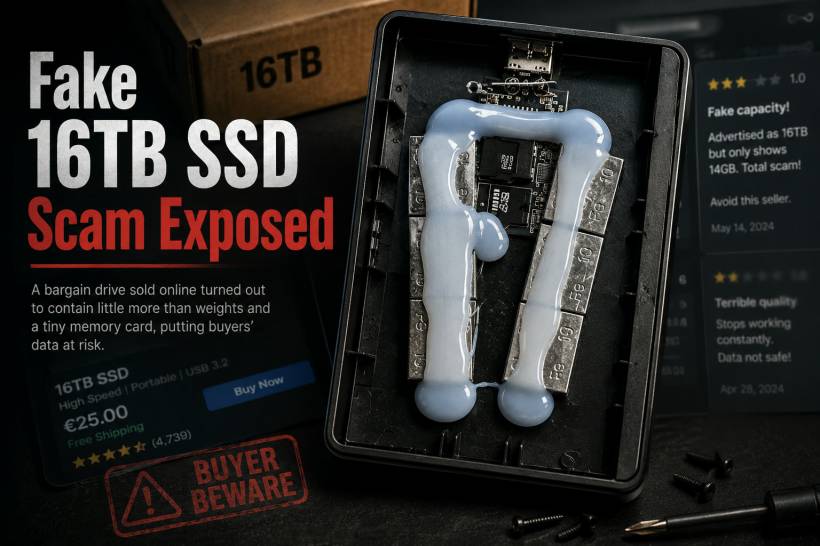
A suspiciously cheap "16TB SSD" sold on eBay has been exposed as little more than a plastic enclosure containing a small circuit board, a 60GB microSD card and several weights glued inside to make the device feel genuine.
The drive reportedly cost less than US$30, or around RM122, a price far below what any legitimate 16TB solid-state drive would normally sell for. After opening the enclosure, the buyer discovered that the advertised high-capacity storage was entirely fake.
Rather than delivering terabytes of usable space, the device relied on a basic memory card and manipulated storage information to convince a computer that far more capacity was available.
A Buyer Deliberately Hunting for Fake Storage Devices
The discovery was shared by Reddit user u/Hartkralle, who explained that purchasing suspicious storage products has become something of a personal project.
Instead of buying these drives by accident, the user actively looks for questionable listings that advertise enormous capacities at unrealistic prices. The goal is to test the products, document the fraud and report sellers using misleading descriptions.
Because the purchases are made through platforms with buyer-protection policies, the money can often be recovered after the product is proven to be counterfeit or significantly different from what was advertised.
The seller, meanwhile, risks receiving account restrictions, removal from the marketplace or further action if enough complaints are submitted.
Why Disrupting Scam Sellers Still Matters
Some commenters questioned whether reporting fraudulent sellers makes a meaningful difference, since scammers can often return under another account.
That concern is valid. Online marketplace fraud is difficult to eliminate because creating a new storefront can be relatively easy, especially when sellers operate across multiple platforms.
However, even temporary disruption can reduce the number of people affected.
Removing one account may prevent further sales, interrupt the seller's cash flow and create a record that helps the marketplace identify repeated behaviour. Detailed reports also give other buyers evidence that these extremely cheap high-capacity drives are not harmless bargains.
Even when the scammer eventually returns, forcing them to rebuild listings, payment arrangements and customer reviews creates additional cost and effort.
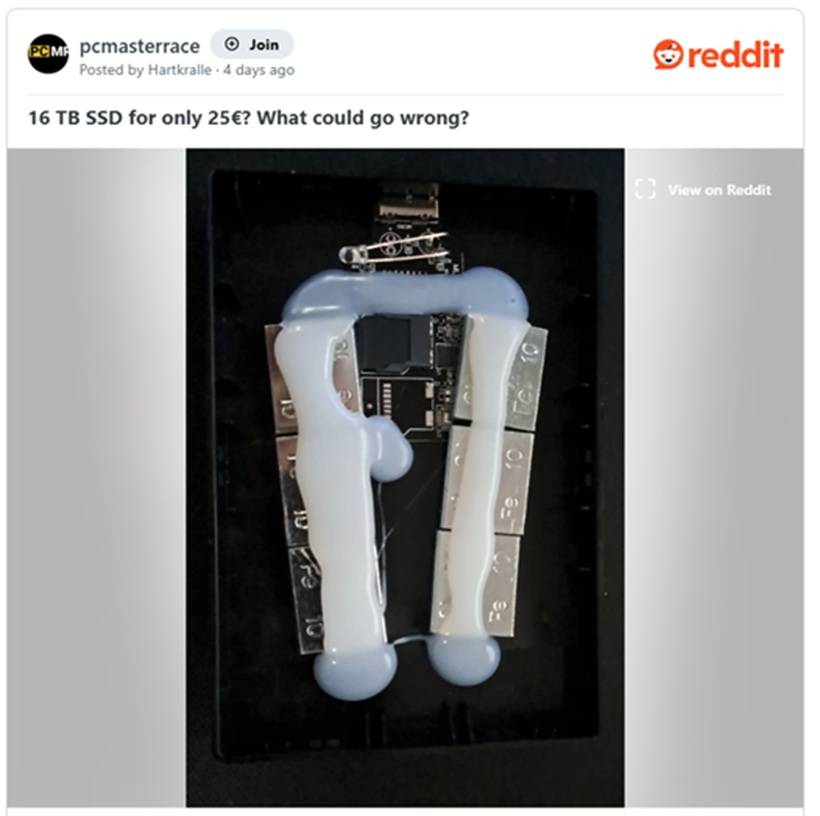
The SSD Was Mostly Empty Space and Added Weight
The fake device used a simple but effective physical trick.
Inside the enclosure was a small board connected to a microSD card. Additional metal or weighted pieces had been hot-glued into the casing so that the product would not feel unusually light when handled.
A genuine high-capacity SSD contains multiple NAND flash-memory packages, a controller, power-management components and other electronics. Even without opening the enclosure, an extremely light device might immediately appear suspicious.
Adding weights helps the counterfeit product feel more substantial and reduces the chance that an inexperienced buyer will question it before connecting it to a computer.
The deception is not technically sophisticated, but it does not need to be. Many buyers will only check whether the device appears in Windows and reports the advertised capacity.
How a 60GB Card Can Pretend to Be 16TB
The most dangerous part of these scams is not the physical enclosure. It is the way the controller reports storage capacity to the operating system.
A counterfeit drive can be programmed to claim that it contains several terabytes of space even though the actual memory is only a few dozen gigabytes.
The computer may initially display the full fake capacity, allowing the user to create folders and begin copying files. Everything can appear normal until the genuine storage limit is reached.
Once the available physical memory is exhausted, the device may begin overwriting earlier data, corrupting new files or falsely reporting that transfers completed successfully.
This can continue without obvious warning, particularly if the user does not immediately reopen and verify every copied file.
The Real Cost Is Often Lost Data
Recovering the purchase price does not necessarily undo the damage.
A buyer may use the fake drive to store family photographs, schoolwork, business documents, videos, backups or other important files. If the device claims to accept the data, the user may delete the original copies believing that everything is safely stored.
When the fake capacity is eventually exposed, files beyond the true limit may already be corrupted or permanently lost.
In the reported example, the so-called 16TB SSD contained only a 60GB microSD card. That means almost all data written beyond the first portion of the drive could have been at risk.
This makes fake storage devices more dangerous than many other counterfeit products. A fake accessory may simply stop working, but fraudulent storage can create the illusion that valuable information has been saved when it has not.
Fake Storage Scams Have Existed for Decades
Counterfeit capacity claims are not new.
Long before SSDs and USB flash drives became common, sellers exaggerated the recording length and quality of storage media such as cassette tapes, floppy disks and VHS tapes.
One commenter recalled buying low-quality VHS tapes in the 1990s that were advertised as holding far more footage than they could actually record.
The technology has changed, but the scam follows the same basic formula: promise more capacity than the physical media can provide, rely on buyers not testing it immediately and disappear before complaints begin to accumulate.
Modern digital storage makes the deception easier because the reported capacity can be manipulated through firmware.
Some Counterfeit SSDs Are Becoming More Convincing
The drive opened by u/Hartkralle was a relatively crude example. Other counterfeit products are far more polished.
Some now imitate the branding, packaging and appearance of well-known models, including popular Samsung SSDs. Fake labels, copied serial numbers and near-identical enclosures can make them difficult to identify through appearance alone.
A counterfeit may even report a believable model name when connected to a computer.
This is particularly concerning during periods of high memory prices or limited supply, when buyers are more likely to search for discounts and lesser-known sellers.
The more realistic the packaging becomes, the more important it is to verify the drive through software and performance testing.
Warning Signs Buyers Should Not Ignore
The clearest warning is an unrealistic price.
A genuine 16TB SSD requires a large amount of NAND flash memory and cannot realistically be sold for the price of a basic memory card. No clearance sale, warehouse promotion or direct-from-factory claim can overcome the underlying cost of the storage components.
Other warning signs include:
Buyers should be especially careful when a product claims to offer multiple terabytes of storage for the cost of a small USB flash drive.
How to Check Whether a Drive Is Genuine
Software tools can help reveal whether a storage device is reporting false information.
CrystalDiskInfo can display details such as the reported model, firmware, interface, health information and SMART data. A fake drive may provide incomplete, inconsistent or obviously generic information.
However, checking the model name alone is not enough. Some counterfeit controllers can imitate legitimate product names.
A full write-and-verify test is more reliable.
Utilities such as H2testw on Windows or F3 on macOS and Linux can write data across the entire reported capacity and then confirm whether it can be read back correctly. This process may take many hours on a large drive, but it can expose fake capacity before important files are trusted to it.
Buyers should complete these tests while the return or dispute period is still active.
Performance Can Also Reveal a Counterfeit
A real SSD should deliver performance consistent with its advertised interface and model.
A device marketed as a modern external SSD but operating at microSD-card speeds is highly suspicious. Very slow writes, unstable transfer rates or repeated disconnections may indicate low-grade flash memory hidden inside a fake enclosure.
The drive's behaviour should also be compared with independent reviews and manufacturer specifications.
A product claiming to be a premium NVMe SSD should not perform like an inexpensive USB 2.0 memory stick.
While poor performance does not prove that the capacity is fake, it is a strong reason to stop using the drive until it has been properly tested.
Marketplace Protection Has Limits
Buyer-protection programmes are helpful because they can refund the purchase price when an item is counterfeit or significantly misrepresented.
However, they should be treated as a financial safety net rather than a complete solution.
A refund cannot restore corrupted files, recover lost work or erase the time spent investigating the problem. It may also take several days or weeks to complete a dispute.
Buyers should therefore avoid relying on the idea that there is no risk because the marketplace offers refunds.
The most valuable thing stored on a drive is often not the hardware itself, but the data placed on it.
Keep Important Files in More Than One Place
Even genuine drives can fail, so no single storage device should be trusted as the only copy of important information.
A basic backup strategy should include multiple copies stored in different locations. For example, one copy might remain on the main computer, another on a verified external drive and a third in a reputable cloud service.
New or unfamiliar storage devices should never be used as the sole backup until they have been fully tested.
This is especially important for unusually cheap drives purchased from unknown sellers.
Final Thoughts
The fake 16TB SSD is a clear example of how an attractive bargain can create a much larger problem than the money lost on the purchase.
The enclosure looked like a storage device, the computer may have displayed the advertised capacity and the added weights helped it feel convincing. Yet inside was only a small memory card with a fraction of the promised space.
The greatest danger was not disappointing performance. It was the possibility that buyers could trust the drive with valuable files and only discover the fraud after those files were corrupted or lost.
When storage prices appear impossibly low, caution is essential. Buyers should purchase from reputable sellers, verify model details and run full capacity tests before using any new drive for important data.
In storage, a deal that seems too good to be true is often not a discount at all. It may simply be an expensive lesson hidden inside a cheap enclosure.











Comments 0