

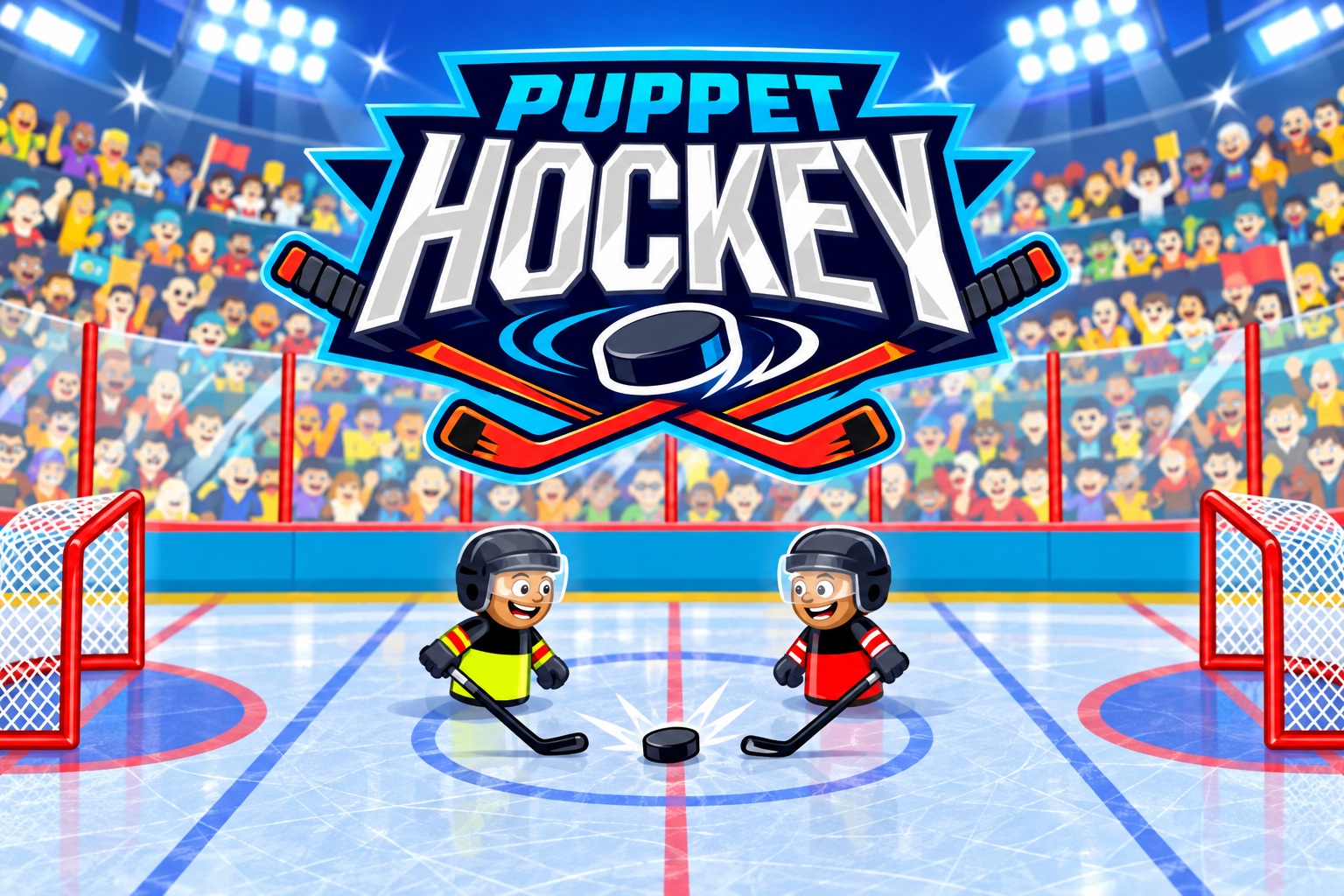
Puppet Hockey Battle turns the intensity of ice hockey into a compact arcade contest built around quick reactions, direct controls, and constantly changing possession. Instead of managing an entire squad, players control a single oversized puppet hockey player who must handle attacking, defending, puck control, and goal protection almost entirely alone. The rink is deliberately small, keeping both players close to the action and making every rebound potentially dangerous. Matches are short, energetic, and easy to understand from the first face-off.
The exaggerated puppet presentation gives the game a much lighter personality than a traditional hockey simulation. Players can choose from different national teams and compete in rapid one-on-one matches where timing matters more than complicated tactics or realistic formations. Skating into the correct position, jumping to intercept the puck, striking it before the opponent can react, and protecting the goal all happen within seconds of one another. That simplicity makes Puppet Hockey Battle immediately accessible while still leaving enough room for players to become noticeably better with practice.
Now playable online through Lemon Web Games, Puppet Hockey Battle brings its fast arcade hockey matches directly into the web browser, allowing players to select a national team, skate onto the ice, challenge opponents, and chase goals without requiring a separate installation. The browser-based format suits the game especially well because matches begin quickly and rarely demand a large time commitment. A single game can provide a quick break, while repeated matches naturally encourage players to improve their positioning and shooting accuracy. For anyone looking for straightforward sports gameplay with an energetic cartoon style, Puppet Hockey Battle delivers exactly that.
A Very Different Kind of Hockey Game
Traditional ice hockey games usually place the player in control of an entire team. They involve passing, formations, line changes, defensive positioning, power plays, and numerous tactical decisions. Puppet Hockey Battle strips almost all of that away and concentrates on the simplest possible competition: one player, one opponent, two goals, and one puck.
That change completely alters the rhythm of the sport. There is no teammate waiting to receive a pass and no defender available to cover a mistake. If the opponent gets behind the player, the same character needs to recover immediately and defend the goal. Every action has consequences because there is nobody else to compensate for poor positioning.
This makes matches much easier to follow while remaining competitive. Players always know where the puck is and who is responsible for stopping it. The simplicity also makes victories feel personal because every successful shot and defensive save comes directly from the player's own movement and timing.
Big-Headed Puppet Characters Give the Game Its Personality
The puppet design is one of the game's most recognizable features. Players have oversized heads and compact cartoon bodies, exaggerating every movement and making collisions look intentionally humorous. The visual style immediately communicates that this is an arcade game rather than a realistic hockey simulation. Even intense matches retain a playful tone.
Large character sprites also make it easy to track both competitors on the rink. Players can quickly see where the opponent is positioned and judge whether there is enough space for a shot. The exaggerated proportions make jumps and sudden movements visually clear. This is especially useful during fast exchanges near the goals.
The style also makes international teams feel more colorful. National uniforms and recognizable color combinations give players an easy way to choose a side without requiring detailed team management. The result is simple, readable, and well suited to short competitive matches.
Choose a National Team and Enter the Ice
Puppet Hockey Battle lets players represent different countries rather than fictional clubs. This gives each match an international tournament atmosphere even though the gameplay itself remains simple. Selecting a country provides an immediate sense of identity before the puck is dropped. Players can choose a familiar favorite or simply pick a team based on its colors and appearance.
The national-team approach works particularly well with the puppet presentation because the game does not need detailed licensing or realistic rosters to establish competition. The emphasis remains on country-versus-country matchups. A game can immediately feel like a small international showdown without requiring complicated setup.
Changing teams also adds visual variety between sessions. The core mechanics remain consistent, but different uniforms help repeated matches feel less identical. It is a small feature that suits the streamlined arcade structure.
One Player Has to Do Everything
The biggest strategic difference from normal hockey is that one puppet needs to attack and defend simultaneously. Moving aggressively toward the opponent's goal creates scoring opportunities, but it also leaves the player's own net exposed. Staying too defensive may prevent easy goals but gives the opponent more control over the puck. Finding the correct balance becomes one of the main skills.
Every attack therefore contains risk. A powerful shot that misses can rebound toward the opposite side of the rink and immediately create a counterattack. Players need to decide whether to chase the rebound or retreat toward their own goal. The decision often has to be made almost instantly.
This constant switching between offense and defense keeps matches active. There is rarely a moment when the player can completely stop thinking about positioning. Even after scoring, another dangerous exchange begins almost immediately.
The Small Rink Keeps the Pressure Constant
Puppet Hockey Battle uses a compact playing area that places both competitors and both goals relatively close together. This dramatically reduces the quiet space commonly found in larger sports games. The puck can move from one goal to the other in only a few seconds. Players must remain alert from the beginning of the match until the timer expires.
The small rink also makes rebounds much more important. A blocked shot can bounce off a wall or character and immediately become another scoring chance. There is often not enough room to calmly regain possession. Quick reactions are essential.
Because of this compressed design, even apparently safe positions can become dangerous quickly. One unlucky bounce can send the puck toward an open goal. Matches frequently change direction faster than expected.
Simple Controls Make the Game Easy to Start
Puppet Hockey Battle does not ask players to memorize complex combinations before they can enjoy a match. Movement, jumping, and shooting form the core control system. These actions are enough to handle most situations. The challenge comes from using them at the right moment rather than remembering difficult commands.
New players can therefore understand the game within only a few rounds. Move toward the puck, line up with the goal, shoot, and try to stop the opponent from doing the same. The basic objective is immediately obvious. This accessibility makes it suitable for quick casual sessions.
More experienced players eventually begin using the same controls in more deliberate ways. A small movement can position the puppet perfectly for a rebound, while a carefully timed jump can block what looked like a guaranteed shot. Simple controls do not prevent deeper skill from developing.
Jumping Is More Important Than It First Appears
Jumping can be used for more than simply moving around the opponent. A well-timed jump can intercept the puck, block an incoming shot, or allow the player to strike it from a better angle. Because the characters are large compared with the rink, vertical positioning can dramatically change the outcome of an exchange. Players who never jump give up an important defensive tool.
Timing matters because jumping at the wrong moment can leave the puppet unable to react immediately afterward. An opponent may simply wait for the character to come back down before taking the shot. Jumping therefore needs to be purposeful rather than constant. The best players learn when it creates an advantage.
It can also become useful during aggressive play near the opponent's goal. A bouncing puck may rise into a position where a normal ground-level shot would miss. Meeting it in the air can produce unexpected scoring opportunities.
Shot Timing Can Decide the Match
The shooting mechanic appears simple, but the timing of each strike matters greatly. Hitting the puck too early may send it in the wrong direction, while waiting too long gives the opponent an opportunity to interfere. The best moment is usually when the puppet is properly aligned and the puck is within a clean striking position. Accuracy becomes more important than simply hitting as often as possible.
Shots can also become more dangerous when taken from favorable angles. A direct attack toward an open goal is obviously valuable, but rebounds and awkward deflections can sometimes be equally effective. Players quickly learn that not every goal needs to come from a perfect straight-line strike. Chaos can be useful.
As the match continues, players begin recognizing which positions produce reliable shots. That knowledge gradually improves scoring consistency. What initially feels unpredictable starts becoming more controlled.
Positioning Matters More Than Constant Movement
New players often chase the puck continuously, following it around the rink without considering what happens next. This can work occasionally, but it also creates opportunities for the opponent. A player who is always moving toward the puck can easily be drawn away from the goal. Better positioning often produces stronger results than constant pursuit.
Standing between the opponent and the goal can block a large portion of the available shooting angle. From that position, the defender can react to the puck without needing to recover from the opposite side of the rink. This makes defense much more reliable. The opponent is forced to work harder for a clean opening.
Good positioning also helps offensively. Waiting in the correct area for a rebound can create an easier shot than chasing the puck into a crowded corner. The game rewards anticipation.
Rebounds Create Some of the Best Scoring Opportunities
The puck rarely stays under perfect control for long. Shots can bounce off walls, players, or the edges of the goal, sending it back into open space. These rebounds are among the most dangerous moments because both players need to react immediately. Whoever reaches the puck first often gains a major advantage.
A missed shot does not necessarily mean the attack has failed. If the rebound remains near the opponent's goal, the attacking player may receive another opportunity almost immediately. Staying alert after shooting is therefore important. Players should be ready to strike again rather than assuming the play is over.
Defenders face the same problem. Blocking the first shot is only part of the job. If the puck drops directly in front of the net, another attack can follow instantly. Clearing the puck away from danger becomes just as important as stopping the initial attempt.
Counterattacks Can Happen in Seconds
Because the rink is so small, attacking aggressively can immediately become dangerous if possession changes. A missed shot may send the puck directly toward the other goal, leaving the attacking player behind. The opponent can then turn defense into offense almost instantly. This creates some of the most exciting moments in a match.
Players eventually learn not to commit too far forward without considering what could happen if the shot fails. Maintaining enough room to recover can prevent easy counterattack goals. This creates a subtle balance between aggression and caution.
The constant possibility of a reversal means no lead feels completely safe. Even a player controlling most of the match can concede several quick goals after a few mistakes. Puppet Hockey Battle remains unpredictable until the final seconds.
Defense Can Be Just as Satisfying as Scoring
Although goals naturally attract most of the attention, good defensive play can be equally rewarding. Blocking a shot that appeared certain to score can completely change momentum. A successful save often creates an immediate opportunity to attack the opposite goal. Defense naturally flows into offense.
Players can defend by positioning themselves directly between the puck and the net, jumping to intercept higher shots, or striking the puck away before the opponent can complete an attack. Each method requires different timing. There is rarely one perfect defensive solution.
Strong defenders also learn when not to chase the puck. Protecting the goal can sometimes be more important than winning possession immediately. Making the opponent take a difficult shot may be safer than risking an aggressive interception.
The Match Timer Keeps Games Short and Intense
Puppet Hockey Battle uses short matches rather than lengthy simulated hockey periods. This keeps every game focused and encourages quick decisions. There is little time to spend waiting for the perfect opportunity. Players need to attack while still protecting themselves from sudden counters.
The timer also increases tension near the end. A player who is behind may become much more aggressive during the final seconds, creating openings at both ends of the rink. Someone protecting a narrow lead may instead concentrate on defensive positioning. The same match can therefore change style completely as time runs out.
Short rounds make rematches easy. Losing does not require a huge time investment before trying again. This supports the game's arcade personality perfectly.
Comebacks Are Always Possible
The fast pace and compact rink make it possible to score several goals in a short period. A player who falls behind early is not necessarily out of the match. One good sequence of rebounds and counterattacks can quickly close the gap. This keeps games interesting even when the score becomes uneven.
The possibility of a comeback also prevents leading players from becoming careless. Moving too aggressively while ahead can give the opponent exactly the opening needed to recover. Protecting a lead requires just as much concentration as building one.
These sudden reversals are part of what makes Puppet Hockey Battle entertaining. Matches rarely feel completely predictable. Momentum can shift almost instantly.
The Arcade Approach Keeps Hockey Accessible
Real hockey includes complex rules such as icing, offsides, penalties, face-offs, substitutions, and tactical formations. Puppet Hockey Battle avoids almost all of these systems and focuses instead on the basic excitement of moving a puck into a goal. This makes it far easier for players who do not follow professional hockey. Understanding the sport deeply is unnecessary.
The simplified approach also allows matches to remain constantly active. There are fewer interruptions and no lengthy tactical menus. The puck stays in play, and the players remain close together. Everything is designed around action.
Fans of realistic hockey games may find the structure extremely simplified, but that is precisely the point. Puppet Hockey Battle aims for quick entertainment rather than simulation. Its appeal comes from immediacy.
The Game Rewards Fast Reactions
The puck can change direction suddenly after almost any collision. Players need to react quickly when a shot rebounds or an opponent unexpectedly gains possession. Hesitating even briefly can create an open goal. Reaction speed therefore becomes increasingly important as players improve.
The most difficult situations often occur directly in front of the goal. Several rapid deflections can happen within seconds, leaving both players jumping and shooting almost continuously. These chaotic exchanges can look messy, but quick reactions still provide an advantage. Players who recognize the puck's new direction first usually gain control.
Practice gradually makes these situations easier to read. The puck no longer appears completely unpredictable. Experienced players begin anticipating likely rebound directions before they occur.
Anticipation Eventually Becomes More Important Than Reflex Alone
Pure reaction speed helps, but better players eventually begin predicting what the opponent is likely to do. Someone approaching from a particular angle may be preparing a shot toward a specific part of the goal. Recognizing that intention early provides more time to block it. The game gradually becomes about reading behavior.
The same concept applies offensively. If the opponent always jumps when the puck approaches, waiting slightly longer before shooting may create a better opening. If they defend very close to the goal, striking the puck from an unusual angle may be more effective. Observation can produce advantages that speed alone cannot.
This gives repeated matches additional depth. Players begin adapting to one another instead of simply repeating the same movements. Even a mechanically simple game can develop interesting mind games.
Aggressive Players Need to Control Their Momentum
Constant pressure can overwhelm inexperienced opponents, but aggressive play also creates risk. Moving too close to the opposite goal leaves more space behind. If possession changes, the attacker may need to cross the entire rink before being able to defend. The small playing area makes that transition fast but still dangerous.
Successful aggressive players learn to recognize when an attack is no longer favorable. Instead of continuing to chase a poor rebound, they retreat early and prepare for the counterattack. This keeps pressure high without completely sacrificing defense. Knowing when to stop attacking becomes an important skill.
The best moments often come from alternating between these styles. A player may defend patiently for several seconds, then immediately rush forward after gaining possession. This constant shift keeps opponents uncertain.
The Cartoon Style Makes Every Match More Entertaining
Puppet Hockey Battle does not take itself too seriously. The exaggerated proportions and bouncing characters make collisions and goals look amusing even when the competition becomes intense. This visual humor helps prevent losses from feeling overly frustrating. The game remains lighthearted.
The puppet presentation also works well with short matches. There is no need for elaborate realism when the objective is immediate arcade fun. Large heads, simple uniforms, and exaggerated movement communicate everything the player needs to understand quickly.
This gives the game broad appeal. Hockey fans can enjoy the sporting theme, while players with little interest in realistic sports simulations can still enjoy the competitive mechanics. The visual style makes the experience approachable.
National Matchups Add Replay Variety
Switching between different national teams provides a small but enjoyable reason to replay matches. Players can represent a favorite country or create imaginary tournament matchups between different teams. The game does not need complex international competition systems for these selections to feel meaningful. The visual identity is enough.
Repeated play also encourages players to experiment with different matchups simply for variety. Even if the underlying gameplay remains consistent, seeing different uniforms on the ice helps keep sessions fresh. This works particularly well in a game designed around short rounds.
Players can also create their own personal goals, such as winning with several different countries. The simplicity of the system leaves room for informal challenges. Not every form of progression needs to be built into menus.
Short Matches Encourage Immediate Rematches
One of the strongest aspects of Puppet Hockey Battle is how naturally one match leads into another. A narrow defeat often creates the feeling that the result could easily have gone the other way. Instead of leaving the game, players are likely to start another round immediately. The short duration makes that decision easy.
Even victories can encourage rematches. A player may want to improve the score difference or test another team. Because the game has almost no setup overhead, restarting feels effortless. The focus stays on the competition.
This rapid cycle is particularly effective in browser play. Players can open the game, complete several rounds, and stop whenever they want. The experience adapts easily to available time.
Personal Skill Is the Main Progression System
Puppet Hockey Battle does not need a complicated upgrade tree to provide a sense of improvement. Players become better through experience. They learn how far the puppet can move, how shots behave, where rebounds are likely to go, and when jumping provides an advantage. Progress happens in the player's own understanding.
This makes victories increasingly satisfying because they reflect genuine improvement. A player who initially struggles to defend may eventually learn to control the goal effectively. Someone who rarely scores can begin recognizing better shooting angles. The mechanics remain the same while performance changes dramatically.
Skill-based progression also keeps matches fair and understandable. There is no need to wonder whether an opponent won because of stronger equipment. Success comes primarily from better decisions and execution.
A Good Entry Point for Arcade Sports Games
Players who normally avoid sports games may find Puppet Hockey Battle easier to approach because it removes so many traditional systems. There are no complex formations, management screens, statistics, or lengthy matches. The game concentrates entirely on scoring and defending. It feels closer to an arcade duel than a sports simulation.
This can make it a good introduction to competitive sports games in general. Players immediately understand the relationship between offense and defense. The rules are intuitive because the objective is simply to score more goals than the opponent.
At the same time, hockey fans can appreciate familiar concepts such as shooting, rebounds, goal protection, and quick counterattacks. The game simplifies the sport without completely losing its identity.
Why Puppet Hockey Battle Works So Well in Short Sessions
The best short-session games need to become enjoyable almost immediately. Puppet Hockey Battle accomplishes this by eliminating lengthy introductions and complicated controls. Within moments, the puck is moving and both players are already competing for the first goal. There is very little downtime.
Short matches also create natural stopping points. Players can finish one round and decide whether to continue without losing campaign progress. This makes the game suitable for quick breaks or longer sessions. The same mechanics work equally well in both situations.
Most importantly, each match can develop its own story. One game may be dominated by defense, while another becomes a high-scoring exchange of constant rebounds. The small rink and unpredictable puck movement create enough variation to keep repeated rounds interesting.
Playing Puppet Hockey Battle Online Today
Through Lemon Web Games, Puppet Hockey Battle can now be played directly in your web browser with no downloads or setup required. Features of the web-based version include:
Playing Puppet Hockey Battle through a browser makes it easy to jump into a match whenever a quick sports challenge sounds appealing. New players can understand the controls almost immediately, while stronger players gradually improve their positioning and timing. The compact rink ensures that there is very little waiting between important moments. Every possession can quickly become a scoring opportunity.
The game is particularly enjoyable when approached as an arcade contest rather than a realistic hockey simulation. Moving intelligently, blocking shooting lanes, reading rebounds, and knowing when to retreat are more important than understanding professional hockey strategy. The simplified format keeps the action accessible. Yet the difference between careless and skilled play becomes obvious after only a few matches.
Who Should Play Puppet Hockey Battle
Puppet Hockey Battle is particularly suitable for players who want the excitement of a sports game without the complexity of a full simulation. There are no large rosters to manage or complicated tactical systems to memorize. The entire match revolves around controlling one character effectively. That simplicity makes the game immediately enjoyable.
It also works well for players who enjoy games where improvement comes from practice. Better positioning leads to stronger defense, better shot timing produces more goals, and improved anticipation makes rebounds easier to control. The mechanics are simple enough for anyone to understand but demanding enough to reward repeated play.
Play Puppet Hockey Battle Online Now
Puppet Hockey Battle takes the basic idea of ice hockey and compresses it into a quick, energetic one-on-one arcade contest. Players choose a national team, control a single big-headed hockey puppet, chase the puck, defend their goal, jump to intercept shots, and attack whenever an opening appears. The small rink ensures that possession can change instantly, while rebounds regularly create unexpected scoring opportunities. Every match becomes a rapid exchange between offense and defense.
Through Lemon Web Games, players can experience Puppet Hockey Battle directly in a modern browser without waiting through lengthy setup or installation. The simple controls make it easy to begin immediately, while positioning, timing, and anticipation provide enough depth for players who want to improve. Short matches encourage repeated attempts, especially after close losses or dramatic comebacks. Whether played casually or competitively, the game delivers fast hockey action with very little downtime.
Final Thoughts
Puppet Hockey Battle succeeds because it reduces ice hockey to its most immediately enjoyable elements: chase the puck, protect the goal, and score before the opponent does. The one-on-one format removes almost every complication associated with realistic sports games while making each player's decisions more important. There is nowhere to hide after a mistake because the same puppet responsible for attacking also needs to recover and defend. That creates constant pressure despite the simple controls.
The compact rink, quick rebounds, short match timer, and exaggerated characters give every round an energetic arcade rhythm. Players can understand the game within moments but still spend much longer improving their positioning and shot timing. Jumping at the right moment can prevent a certain goal, while one poorly judged attack can immediately produce a dangerous counterattack. Those small decisions give the matches more depth than the cartoon presentation initially suggests.
Through Lemon Web Games, Puppet Hockey Battle can be enjoyed directly in the browser whenever a quick competitive sports game sounds appealing. Its big-headed characters keep the tone playful, while the constant movement and rapid scoring opportunities make each match exciting from beginning to end. For players who prefer fast arcade hockey over complicated simulation, Puppet Hockey Battle offers a simple formula that remains surprisingly addictive.











Comments 0