

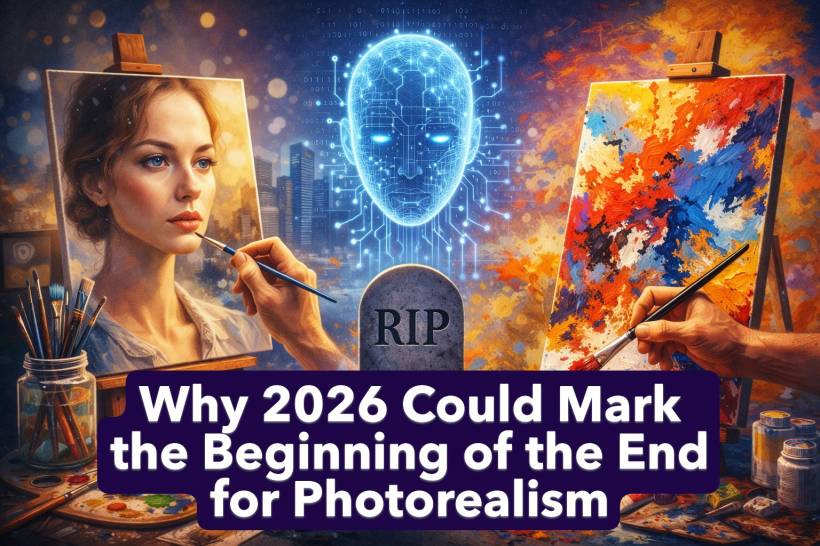
Photorealism has always been a bit like a magic trick in the art world. You walk up to a painting, stare at it for a few seconds, and your brain insists, "That has to be a photograph." The entire charm of the style lies in its almost obsessive dedication to recreating reality exactly as a camera sees it — reflections, shadows, imperfections and all. For decades, that level of technical precision has been both fascinating and deeply respected.
But the art landscape is changing fast… and photorealism may be running out of reasons to exist.
A Movement Born from Rebellion
To understand why photorealism was once a big deal, you have to rewind to the late 1960s and early 1970s. The art world back then was consumed with explosive expression and bold ideas. Abstract Expressionism had splashed emotion across canvases, while Pop Art had turned consumer culture into bright, iconic statements.
In came artists like Chuck Close, Richard Estes and Ralph Goings — who decided to do something completely different. Instead of chaos, they opted for clarity. Instead of emotional strokes, they chose razor-sharp precision. They took everyday scenes — cars, diners, city streets, still life compositions — and recreated them with such perfection that they almost felt unreal.
Critics weren't always impressed, but nobody could deny one thing: the sheer skill required was mind-blowing.
The Appeal Has Changed — Because the World Has Changed
Fast forward to today, and the conversation around photorealism feels very different.
We live in an age where digital tools and AI can generate hyper-detailed faces, intricate landscapes and perfect lighting effects instantly. What once required intense craftsmanship and months of effort can now be produced in seconds — with reflections, lens blur, and depth-of-field baked in automatically.
That "wow" factor photorealism relied on? It's no longer rare.
In fact, it's becoming background noise.
AI Has Become What Photography Once Was: A Disruptor
Photorealism originally gained relevance because it challenged photography while borrowing from it. Ironically, AI is now doing the same thing to photorealism.
Where the movement once showcased patience, precision and superhuman technical discipline, AI casually delivers the same results without breaking a sweat. It's faster, cheaper, endlessly repeatable — and brutally efficient.
So instead of looking miraculous, painstaking hand-painted realism is starting to feel… unnecessary.
Not less talented, not less admirable — but less essential.
Where Art Is Headed Instead
If anything, today's creative world seems far more interested in emotion, texture and imperfection. Messiness has value again. Expression, personality, and human unpredictability are becoming more interesting than pixel-perfect accuracy.
Art that feels human now matters more than art that merely looks real.
So while photorealism will always have a place in history — and will always command respect for its technical brilliance — it's becoming harder to argue that it represents the future.
If 2026 does "kill" photorealism, it won't be because it failed.
It'll be because the world moved on… and machines simply beat it at its own game.











Comments 0