

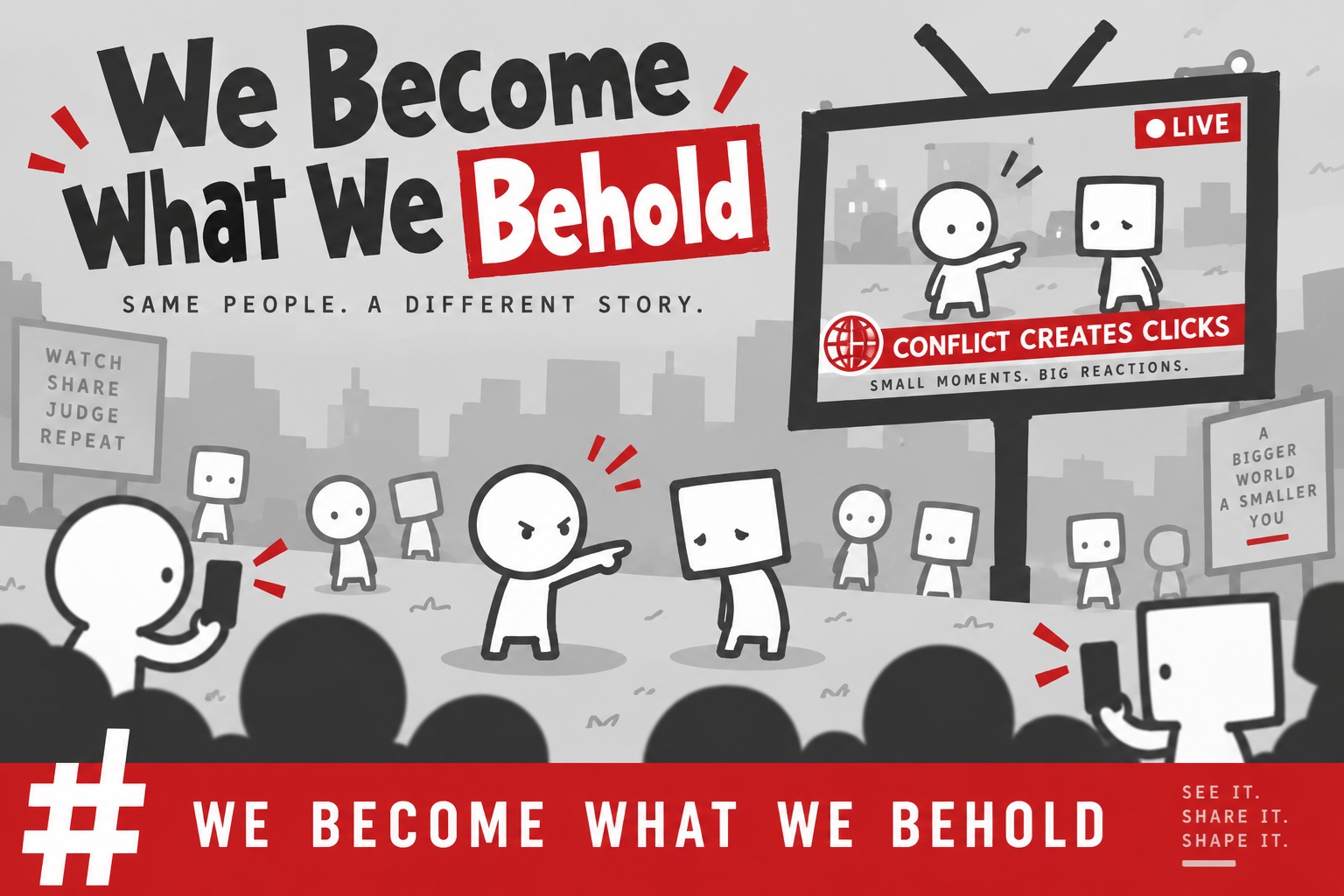
We Become What We Behold is a short point-and-click social commentary game built around one extremely simple idea: take photographs of what is happening on screen and watch how those images influence everyone around you. Rather than controlling a traditional hero, fighting enemies, or solving conventional puzzles, the player becomes an observer with a camera. The moments you choose to capture are broadcast publicly, and those broadcasts gradually affect how the small society behaves.
What begins as a playful experiment quickly develops into something much darker. Photograph an unusual character, an argument, a frightened reaction, or an aggressive encounter, and the image can become part of the public narrative. As increasingly dramatic moments receive attention, those behaviors begin spreading through the population. The game turns a simple camera mechanic into a sharp demonstration of how repeated attention can amplify fear, conflict, stereotypes, and social division.
Now playable online through Lemon Web Games, We Become What We Behold can be experienced directly in your web browser as part of a growing collection of indie, experimental, narrative, point-and-click, social commentary, and browser-playable games. Its short length makes it easy to experience in one sitting, but the ideas behind it can remain in your mind much longer than the actual play session. With only a camera frame, a group of simple characters, and a large television screen, the game manages to explore surprisingly complicated questions about media and human behavior.
A Game Built Around Watching Rather Than Fighting
Most games give players direct control over a character. We Become What We Behold does something very different by asking players to watch other characters instead.
The people on screen move around independently, interacting with one another while the player observes through a movable camera frame. Your main action is deciding what deserves to be photographed. That sounds almost trivial, but the consequences of those photographs gradually become the entire game.
Instead of asking whether you can defeat an enemy, the game asks a more unusual question: what happens when the things you choose to show become the things everyone else starts noticing?
The Camera Is Your Main Tool
The camera frame can be moved around the screen and positioned over characters or events. Clicking captures the moment inside the frame, and the resulting image appears on the large television screen.
That television is important because everyone in the world can see what has been broadcast. The picture is no longer simply something the player has observed privately. It becomes public information that influences how other characters understand their surroundings.
This creates the central feedback loop of the experience. You observe behavior, photograph it, broadcast it, and then watch the population react to what you have chosen to emphasize.
Ordinary Moments Are Not Always Newsworthy
One of the game's cleverest ideas is that peaceful or ordinary moments often fail to create the same reaction as unusual or dramatic ones. Characters can walk around happily, behave normally, or simply coexist without generating much attention.
Conflict, fear, anger, and strange behavior are different. These moments attract interest and are more likely to become significant once broadcast.
The game uses this contrast to make a broader point about attention. What gets noticed is not always what happens most often; sometimes it is simply what appears most dramatic.
The Television Shapes the Entire Crowd
Once a photograph appears on the television, it becomes part of the shared experience of everyone on screen. Characters begin reacting not only to what is happening around them, but also to what they have been shown.
This creates a powerful feeling despite the game's extremely simple presentation. The player is not directly commanding anyone, yet the society begins changing because of the images being selected and repeated.
The television essentially acts as an amplifier. A single event can become more important than it originally was simply because it has been broadcast.
Attention Changes Behavior
As certain types of behavior receive more attention, they begin appearing more frequently. Characters can become increasingly suspicious, frightened, or aggressive as the cycle continues.
This is where the title We Become What We Behold starts becoming meaningful. People see certain behavior presented repeatedly, react to it, imitate it, and eventually create more examples of the same behavior.
The player then photographs those new examples, reinforcing the cycle even further.
A Feedback Loop Slowly Develops
The game's central mechanic can be understood as a feedback loop. Something happens, the player records it, everyone sees it, behavior changes, and new events emerge from those reactions.
At first the process is subtle. A single photograph might only create a small shift in the crowd.
Later, however, the effects become much more obvious. Once fear and hostility begin spreading, each new broadcast can accelerate the situation.
Fear Becomes Contagious
One frightened character can influence another. Once fear itself becomes newsworthy, the population starts responding to the idea that danger is everywhere.
The game shows how emotional reactions can spread even when the original incident was relatively limited. Characters begin interpreting others through the expectations created by what they have already seen.
This is one of the reasons the game becomes increasingly uncomfortable despite its cartoon-like visual style.
Conflict Generates More Conflict
Aggression follows a similar pattern. Once hostile behavior receives attention, other characters begin responding defensively or aggressively themselves.
The problem then becomes self-reinforcing. More conflict produces more dramatic photographs, and those photographs produce even more conflict.
The player is technically doing nothing more than taking pictures, yet the world deteriorates because of what those pictures encourage everyone to focus on.
The Player Is Part of the System
We Become What We Behold is effective because it does not allow the player to remain completely detached from what happens.
You are the person deciding what gets photographed. You choose which moments become visible to everyone else.
That creates an uncomfortable sense of responsibility. Even though the characters make their own decisions, the player helps determine which behaviors receive attention and which are ignored.
The Game Rarely Needs Traditional Instructions
The controls are extremely easy to understand. Move the camera, frame something interesting, and click.
Instead of relying on lengthy tutorials, the game teaches through reactions. Players quickly learn that different photographs produce different responses.
This makes experimentation part of the experience. You naturally begin testing what happens when certain characters or events are shown on the television.
Minimalist Visuals Keep the Message Clear
The game uses an extremely simple black-and-white visual style with basic shapes and expressive faces. Characters are mostly represented as circles and squares with simple bodies and recognizable emotions.
This simplicity is important because it prevents visual detail from distracting from the behavior being studied. Players can immediately recognize fear, anger, affection, surprise, or hostility.
The minimalist presentation also gives the game an almost cartoonish charm at first, which makes the darker developments more surprising.
Circles and Squares Become Social Groups
The use of circular and square characters creates obvious visual categories without requiring complicated backstories or identities. Players instantly understand that different groups exist.
As tension increases, those differences become more significant. Characters begin reacting to one another based less on individual behavior and more on group identity.
This allows the game to explore prejudice and division in an abstract way without tying the story to one specific real-world culture or conflict.
Simple Shapes Carry Complicated Ideas
Using basic geometric characters is one of the game's strongest design decisions. Because the people are so abstract, players can focus on the pattern rather than specific personalities.
The game becomes less about one particular character behaving badly and more about how groups can gradually become suspicious of one another.
That abstraction gives the experience a broader message while keeping the gameplay easy to follow.
Humor Makes the Beginning Feel Harmless
The early sections contain playful moments and visual jokes. Strange characters, exaggerated reactions, and simple animations can make the game feel lighthearted.
This humor lowers the player's guard.
Because the game begins in such a playful way, the later escalation becomes much more striking. The same world that initially seemed silly eventually becomes tense and hostile.
The Tone Gradually Changes
The shift in tone happens slowly enough that players may not immediately realize how much the environment has changed.
At the beginning, everyone moves around relatively peacefully. Later, expressions become more nervous, confrontations become more frequent, and the general atmosphere becomes increasingly uncomfortable.
The transition mirrors the game's broader message: social deterioration does not always happen instantly. Sometimes it develops through repeated small reactions that gradually reinforce one another.
You Cannot Simply Photograph Happiness Forever
Players may naturally try to find peaceful moments and promote them instead. That instinct becomes part of the experiment.
However, the game is deliberately structured around what gains attention and how sensational events dominate the cycle. Calm interactions do not always generate the same response as fear or confrontation.
This creates frustration, but that frustration is part of the commentary. Positive behavior can exist everywhere and still receive less attention than something dramatic.
Sensationalism Becomes a Gameplay Mechanic
Rather than explaining sensationalism through text, We Become What We Behold turns it into a mechanic.
The player discovers through experimentation that dramatic images often produce stronger reactions. Once that pattern becomes obvious, there is a temptation to keep photographing increasingly extreme situations because those are the events that appear to matter.
This makes the player experience the incentive directly instead of merely reading about it.
The Game Shows How Narratives Can Be Built
Individual events may be relatively small, but repeated broadcasts can create the impression of a larger pattern.
Once the public starts expecting certain behavior, they begin interpreting new situations through that expectation.
The game demonstrates how a narrative can become powerful enough to influence reality. What people believe is happening can affect what they do next, which can eventually make the narrative appear even more accurate.
Everyone Starts Watching Everyone Else
As fear spreads, characters become more aware of the people around them. Encounters that once seemed ordinary become suspicious.
The population begins reacting before anything significant has even happened.
This is where the game's social commentary becomes particularly effective. Expectations themselves can change behavior, creating tension even before a real conflict begins.
Stereotypes Develop Through Repetition
When certain types of characters repeatedly appear in negative situations on television, other characters begin associating those groups with danger.
The game demonstrates this without lengthy dialogue or explicit explanations. The pattern emerges naturally through repeated observation.
Because the player participates in creating those broadcasts, the message feels more personal than it would in a passive story.
The Audience Becomes Part of the Story
The characters watching the television are not simply background decoration. Their reactions are central to how the game progresses.
They watch, react, change their behavior, and then create new situations for the player to photograph.
This turns the audience into participants in the same feedback loop as the media. The broadcaster, the viewers, and the events themselves all influence one another.
A Very Small Game With a Large Subject
We Become What We Behold can be completed relatively quickly, yet it deals with ideas that could easily fill a much longer game.
Media incentives, fear, prejudice, attention, imitation, group behavior, and social escalation are all explored through one simple mechanic.
The short length actually strengthens the experience because the entire cycle can unfold quickly enough for players to see the cause-and-effect relationship clearly.
There Is Almost No Traditional Storytelling
The game does not depend on lengthy dialogue, character biographies, cinematic scenes, or written exposition.
Instead, the story emerges from behavior.
Players watch the society transform and understand what is happening through facial expressions, interactions, broadcasts, and increasingly dramatic events.
This makes the experience easy to understand even without complex language.
The Player Learns Through Experimentation
At first, players may photograph whatever seems interesting. Over time, they begin recognizing patterns.
Certain images create excitement. Others create fear. Some are ignored. Some dramatically alter the behavior of the crowd.
That discovery process is important because the game's message is not simply delivered as a statement. Players reach many of the conclusions themselves by observing the consequences of their choices.
There Is No Conventional Victory
We Become What We Behold is not designed around winning in the traditional sense.
There is no high score to chase, no enemy boss to defeat, and no ideal strategy that produces a perfect ending through mechanical skill.
The goal is really to experience the cycle and understand what happens.
This makes the game closer to an interactive thought experiment than a conventional arcade challenge.
The Ending Is Intentionally Uncomfortable
As the situation escalates, the playful atmosphere disappears and the consequences become increasingly severe.
The ending is designed to leave players thinking about how the situation reached that point.
Importantly, the escalation does not begin with a huge catastrophe. It develops through repeated small choices about what receives attention.
That progression gives the conclusion much of its impact.
The Title Explains the Entire Concept
"We Become What We Behold" summarizes the game's central idea extremely well.
People observe the world around them, but what they observe can also shape how they think and behave. If certain behaviors are repeatedly presented as important, common, or threatening, those behaviors can influence the audience.
The audience then creates more of the same behavior, producing new material that appears to confirm the original narrative.
It becomes a cycle of observation and imitation.
The Game Also Examines the Role of the Observer
The player is not merely documenting reality objectively.
Choosing where to point the camera means choosing which part of reality everyone else gets to see.
Two completely different situations may be happening simultaneously, but only one can occupy the television screen.
That simple limitation turns selection itself into power.
What Is Ignored Matters Too
The game is not only about what gets photographed. It is also about what does not.
Peaceful interactions may continue somewhere outside the camera frame while the player concentrates on conflict.
Those positive moments effectively disappear from the public narrative because nobody sees them on the television.
This demonstrates how omission can influence perception just as strongly as what is actively shown.
The Mechanic Encourages Self-Reflection
At some point, many players begin noticing their own behavior.
Why did you photograph that angry character instead of the peaceful couple nearby? Why was the confrontation more interesting? Why did you wait for something dramatic to happen?
The game does not need to accuse the player directly. The mechanic itself encourages those questions.
That self-reflection is a major reason such a small game can feel surprisingly memorable.
It Works Because the Player Understands the Incentive
If the game simply told players that sensational content attracts attention, the message would be easy to dismiss.
Instead, players experience the incentive themselves. Dramatic events are more interesting to photograph because they create visible reactions and move the game forward.
This creates an uncomfortable parallel between the fictional media system and the player's own desire to see what happens next.
A Social Simulation Hidden Inside a Tiny Browser Game
Although the game is mechanically simple, it functions like a miniature social simulation.
Characters observe one another, respond to television broadcasts, form expectations, and change their behavior based on what they believe about the world.
The simulation is intentionally exaggerated and simplified, but that simplicity helps reveal the feedback loop clearly.
Players can watch an entire society transform within minutes.
Why the Game Is Still Discussed
We Become What We Behold remains memorable because its central idea is easy to understand yet difficult to forget.
The game does not require advanced graphics or complicated systems to communicate its message. One camera, one television, and a crowd of simple characters are enough.
Its themes also remain broadly relevant because people continue debating how attention, media, social platforms, algorithms, and repeated narratives influence public behavior.
It Is More Thought Experiment Than Traditional Game
Players looking for deep combat systems, exploration, character progression, or long campaigns will not find those things here.
The value comes from the experiment itself.
The game asks players to participate in a system and then observe how that system changes the world.
Its short length makes it ideal for this purpose because the entire process can be experienced without unnecessary filler.
Replay Value Comes From Understanding the Process
A second playthrough feels different because the player already knows where the escalation is heading.
Instead of simply reacting to events, you may begin watching closely for the first moments when behavior starts changing.
You may also experiment with different photographs or attempt to delay the progression.
Even when the broader outcome is familiar, understanding how each stage develops can make repeat sessions interesting.
Why We Become What We Behold Still Feels Effective
We Become What We Behold remains effective because its gameplay and message are inseparable. The camera is not merely a convenient interface; it represents the process the game wants players to think about.
Every click becomes a decision about attention. Every broadcast changes perception. Every reaction creates new material for the next broadcast.
That consistency gives the game a clarity that many much larger narrative games struggle to achieve.
Playing We Become What We Behold Online Today
Through Lemon Web Games, We Become What We Behold can now be played directly in your web browser with no downloads or setup required. Features of the web-based version include:
• Browser-based play for quick access
• No installation required
• Simple point-and-click camera controls
• A reactive population influenced by the images you broadcast
• Minimalist visual storytelling built around circles, squares, emotions, and social behavior
• A short interactive experience exploring media, sensationalism, fear, conflict, and group behavior
• Accessible play through Lemon Web Games
The browser format suits We Become What We Behold particularly well because the experience is short, immediately understandable, and designed around simple interaction. Players can begin experimenting within seconds without learning complicated controls, yet the ideas revealed through those interactions are considerably deeper than the mechanics initially suggest.
Who Should Play We Become What We Behold
• Players who enjoy experimental indie games
• Fans of short narrative and social commentary experiences
• Players interested in media, psychology, group behavior, and social influence
• Fans of point-and-click games with unusual mechanics
• Players who enjoy games that communicate ideas through interaction rather than lengthy dialogue
• Anyone looking for a browser game that can be completed quickly but still leave something meaningful to think about
We Become What We Behold is especially suitable for players who appreciate games that experiment with what interactive storytelling can do. It is also an excellent example of how a very small mechanical system can communicate complicated ideas without requiring a long campaign, complex controls, or detailed graphics.
Play We Become What We Behold Online Now
We Become What We Behold is now available to play online through Lemon Web Games, giving players an easy way to experience this memorable social commentary game directly in the browser. Its web-based format allows the entire experience to begin immediately, placing the camera in your hands and asking you to decide which moments deserve everyone's attention.
For players exploring the Lemon Web Games library, We Become What We Behold offers something very different from a conventional action, strategy, or platform game. Instead of testing reflexes or combat ability, it challenges players to observe a tiny society and consider how their own choices contribute to its transformation. The mechanics remain simple throughout, but the consequences become increasingly uncomfortable.
Whether approached as an experimental browser game, interactive narrative, social simulation, or short piece of media criticism, We Become What We Behold delivers an experience where every photograph matters. The world changes not because the player directly commands it, but because the player decides what everyone else gets to see.
Final Thoughts
We Become What We Behold is a powerful example of how game mechanics can communicate an idea more effectively than a long explanation. The player takes photographs, those photographs become news, the public reacts, and those reactions create new events worthy of being photographed. Within a remarkably short period, this simple loop demonstrates how attention can amplify fear, stereotypes, hostility, and conflict.
Its minimalist presentation is equally important. Circles and squares, simple faces, a camera frame, and one television screen are enough to create an entire social experiment. The lack of complicated graphics or dialogue keeps attention focused on behavior and makes the escalation easy to understand. What begins as a playful little browser game gradually becomes a much darker observation about how people influence one another.
Through Lemon Web Games, We Become What We Behold remains easy to experience directly in the browser. For players who enjoy unusual indie games, social commentary, experimental storytelling, and interactive ideas that continue resonating after the game ends, it offers something genuinely distinctive. It may only take a short time to complete, but its central message is simple enough to remember: what we repeatedly choose to watch can eventually influence what we become.











Comments 0