

Artificial intelligence has reached a point where generated images can look remarkably close to real photographs. Lighting, facial details, textures and even complex backgrounds have improved dramatically, making it increasingly difficult for the average person to immediately tell whether an image was captured by a camera or created by an AI model.
Because of that, companies developing generative AI tools have been experimenting with different ways to identify synthetic content. Google has been one of the more prominent examples, often placing a small visible Gemini watermark or logo on media created using its AI tools.
That visible branding, however, is no longer mandatory in many cases.
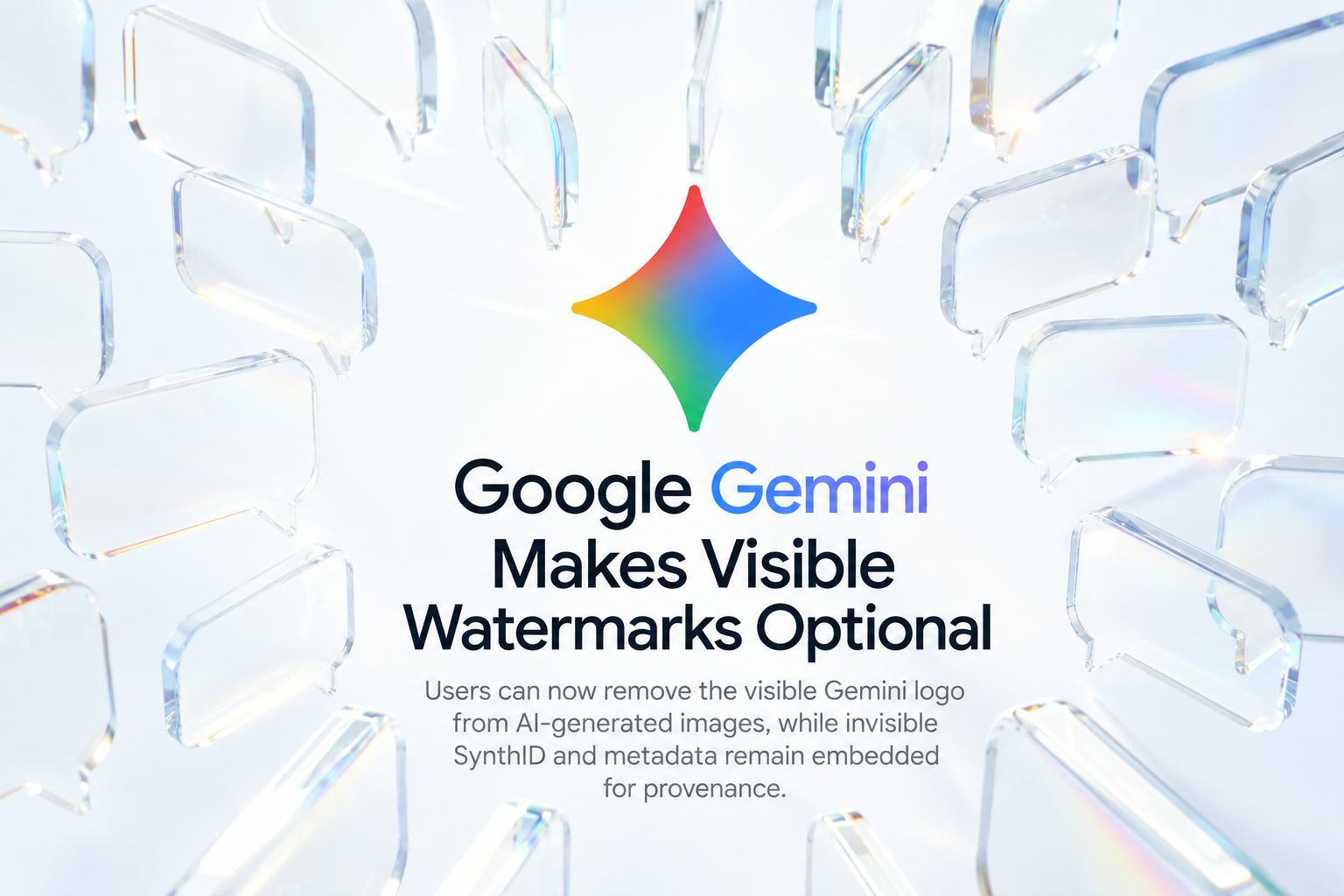
Google is introducing a new option that allows users to turn visible watermarks off, giving creators considerably more control over how their AI-generated content appears when it is published or shared.
Visible Gemini Watermarks Are Becoming Optional
The change was revealed by Google Labs Vice President Josh Woodward, who explained that users will now have access to a setting that controls whether Google's visible AI watermark appears on generated content.
Rather than automatically placing Google's branding on every creation, users will be able to toggle the watermark on or off.
The feature is being introduced across Gemini and Flow, with Google also planning to extend similar functionality to AI Mode in Google Search.
For creators who regularly generate artwork, concept images, promotional graphics or other visual material with Gemini, this is a fairly significant quality-of-life improvement.
Previously, anyone wanting a completely clean image might have needed to crop the picture, edit the watermark manually or use another image-editing application after generation. Having the option built directly into Google's AI tools removes that extra step.
The Change Goes Beyond AI Images
Interestingly, Google isn't limiting the setting to still images.
According to Woodward, Google's approach covers several types of generative media produced through its AI ecosystem, including images created using Nano Banana, AI-generated videos and music generated using Google's Lyria technology.
Essentially, Google appears to be moving toward a broader policy where visible AI branding becomes optional rather than something permanently stamped onto every generated piece of media.
There is one important exception, though.
Google says visible watermarks may continue to be required in countries or regions where local laws require AI-generated content to carry visible identification.
That means the feature may not behave identically everywhere.
Removing the Logo Doesn't Remove Google's AI Tracking
Perhaps the most important point is that removing the visible watermark does not mean the image becomes completely untraceable as AI-generated content.
Google still uses technologies such as SynthID, which places an invisible digital identifier inside AI-generated media.
Unlike the small Gemini logo that people can see on an image, SynthID is designed to remain hidden within the content itself. Google can use this signal to help determine whether a particular piece of media was generated or modified using its AI systems.
Google is also continuing to support C2PA-based content credentials and metadata, which can provide additional information about the origin and editing history of digital media.
So while someone scrolling through social media might no longer see an obvious Gemini symbol on an image, there can still be machine-readable information indicating that AI was involved in its creation.
In other words, Google is separating visible branding from digital provenance.
Why Google Is Making the Change
From a creative perspective, the decision makes plenty of sense.
People increasingly use generative AI for more than experimental images or amusing social-media posts. AI-generated visuals are now being incorporated into website designs, presentations, advertisements, concept artwork, product mock-ups, blog graphics and professional creative projects.
A permanent logo in the corner of every image can be inconvenient in those situations.
By allowing creators to disable visible watermarks, Google is treating AI-generated content more like a finished creative asset rather than something that must permanently advertise the tool that produced it.
At the same time, keeping invisible identification technologies such as SynthID gives Google a way to maintain some level of accountability without interfering with the appearance of the final image.
Google describes the overall approach as a balance between creative freedom and responsible AI deployment.
There Is Still a Transparency Problem
The downside is fairly obvious.
Visible watermarks provide an immediate clue that an image may have been artificially generated. Removing them means viewers can no longer rely on the Gemini logo as a simple visual indicator.
That becomes increasingly important as AI image generators become better at reproducing realistic people, news-like photographs, locations and events.
Someone unfamiliar with generative AI might see a convincing image without any watermark and naturally assume that it is genuine.
Of course, visible watermarks were never a foolproof solution. A determined user could often crop them out, cover them or remove them using image-editing software.
Still, having them displayed by default offered at least a small amount of additional transparency.
Google's new approach effectively shifts more of that responsibility toward invisible verification systems and AI-detection tools rather than something immediately obvious to the viewer.
Google Isn't Alone in Taking This Approach
Google's decision also brings Gemini closer to how some competing AI platforms already handle generated images.
Services from companies including OpenAI and Meta can produce AI-generated imagery without placing a prominent permanent logo across the finished picture.
Behind the scenes, however, AI companies are increasingly experimenting with metadata, provenance systems and invisible signals that allow generated material to be identified without compromising the presentation of the media itself.
This may ultimately become the more common model across the industry: clean-looking content for creators, with identification technology embedded underneath.
Visible Watermarks May Matter Less in the Future
The bigger story here isn't simply that Gemini users can remove a logo.
It reflects a broader change in how technology companies are thinking about AI-generated media.
Visible watermarks are relatively easy for humans to understand, but they're also relatively easy to remove. Invisible systems such as SynthID and content credentials potentially offer a more sophisticated way of tracking where media came from without permanently altering how it looks.
As generative AI becomes increasingly integrated into normal creative workflows, that distinction will become important.
Creators understandably want images and videos that look professional without unnecessary branding. At the same time, platforms, governments and the public still need reliable ways to determine when AI has played a role in creating something.
Google's latest change attempts to accommodate both sides.
Final Thoughts
Giving users the ability to disable Gemini's visible watermark is likely to be welcomed by anyone using Google's AI tools for legitimate creative work. It eliminates an unnecessary editing step and allows generated images, videos and other media to be shared in a much cleaner form.
However, it also makes it even less practical to judge an image's authenticity simply by looking for a logo in the corner.
The more important technologies going forward will therefore be the systems working quietly in the background—such as SynthID, C2PA metadata and other provenance standards—that can help establish where digital content actually originated.
As AI-generated media continues becoming harder to distinguish from reality, knowing how to verify content may ultimately matter far more than whether a visible watermark appears on the screen.











Comments 0