When we talk about digital marriage (or virtual marriage, online wedding), we mean a marriage ceremony and registration process conducted (at least partially) over digital means — video conferencing, electronic forms, and remote officiation — rather than everyone being physically present in a courthouse, shrine, or venue.
It's important to distinguish two related but different notions:
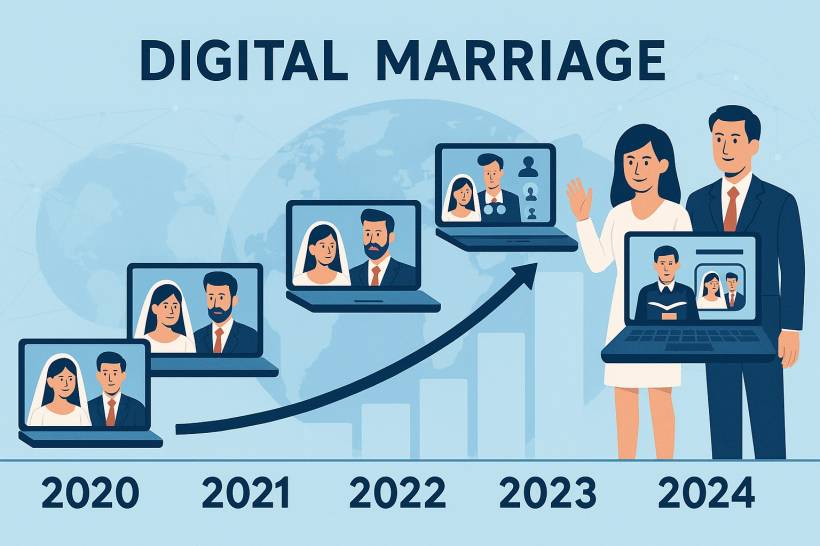
Virtual / "symbolic" weddings: ceremonies held online (in games, VR, livestreams) without legal recognition. Legally recognized online marriages: where the legal requirements (license, witnesses, officiant, registration) are fulfilled by digital or remote processes. Throughout the 2020s, digital marriage has grown from a niche or emergency workaround into a more mature, though still legally tricky, option. Below is a survey of how this has unfolded from 2020 to 2025.
2020: The Pandemic Acceleration & Early Incidents
The COVID-19 pandemic in 2020 forced many couples to cancel or postpone weddings. That urgency spurred innovation — digital weddings went from novelty to necessity.
Key incidents & pivots in 2020
In April 2020, Harvard Medical School graduates Parisa Fallah and Gavin Ovsak held their wedding in a small dorm room while more than 200 guests tuned in by video. Harvard Medical School In New York, the state legalized video wedding ceremonies so couples could marry over Zoom. Sayaka Fukuda and James Storr Brown immediately took advantage: their Manhattan apartment became a digital aisle. The Guardian Many couples pivoted to livestreamed ceremonies. One couple, unable to use their booked venue, married at home and shipped "celebration boxes" to guests to create a shared virtual experience. Inside Weddings.com More broadly, in a survey of 12,000 couples with weddings planned through October 2020, 37% considered virtual weddings as an option. Business Insider Reports suggest that some U.S. states allowed proxy or double proxy marriages (where one or both parties are not physically present) in limited cases — e.g. in 2020, about 4,300 "double proxy" weddings were reported in one U.S. state (Montana) compared to 1,200 in 2019. Bowling Green State University 2024–2025: Maturation, Legal Clarifications, and New Frontiers
In recent years, digital marriage has become more established, though still niche and legally delicate.
Legal clarifications & constraints
As of 2024–2025, in the U.S., Utah continues to be the only state that permits fully remote weddings (license, ceremony, registration) under its law. Chodorow Law Offices+3American Marriage Ministries+3Boundless+3 Other states may recognize marriages performed elsewhere (e.g. marriages done under Utah law), but they do not themselves enable fully remote marriages. American Marriage Ministries+2Boundless+2 In Utah County alone, "thousands" of virtual marriages (including international couples) have been conducted since 2020. Deseret News Proposed legislation (SB81) in Utah attempts to create guardrails — better identity verification, rules for officiants, prevention of proxy misuse. Deseret News+1 Globally, courts in some countries continue to reject the legal validity of remote marriages done abroad, especially when local civil law requires physical presence or formalities. (E.g. the German decision above.) EAPIL New frontiers & creative expressions
Some couples now hold weddings entirely in metaverse or virtual worlds (e.g. Decentraland). For example, the founders of Easy Wedding in the UAE conducted their own wedding in the metaverse (NFT outfits, 3D environments), simultaneously streaming via Zoom and in real life. Wikipedia Digital-first or avatar weddings in online games (e.g. Minecraft, Roblox) have also drawn attention as symbolic, community-driven events — though not always legally binding. WIRED Vendors and tech providers focus more on reliability (latency, multi-camera, backup streams), personalization (VR sets, virtual decor), and guest interactivity. Avixa Portal+1 What We Do Know — Some Quantitative Anchors
Because the domain is new and fragmented, hard data is sparse, but here are a few anchors:
In 2020, nearly 34% of weddings were either fully virtual or had some virtual component (per The Knot / Courtly) courtly.com+1 In 2024, 3,000 Israeli couples used Utah's online marriage system. The Times of Israel Utah County reports "thousands" of virtual marriages since 2020. Deseret News In 2020, ~4,300 double proxy weddings in one U.S. state (Montana) compared to ~1,200 in 2019—an unusual spike attributed to emergency adaptations. Bowling Green State University Survey data: in 2020, 37% of couples considered virtual weddings. Business Insider These numbers hint at strong growth, though not mass adoption of fully digital marriages.
Benefits, Challenges & Legal Risks Benefits
Accessibility & flexibility: couples in distant locations, military couples, or those with mobility constraints can participate. Cost savings: savings on venue, travel, catering, guest accommodations. Inclusion of remote guests: friends/family across the globe can attend with minimal extra cost. Speed & convenience: digital paperwork, fewer physical steps, and sometimes faster scheduling. Pandemic resilience: robust against travel bans, gathering restrictions, etc. Legal recognition: some jurisdictions don't accept digital marriages. Identity verification & fraud: ensuring both parties are who they say are, and consent is genuine. Technical failures: internet outages, poor audiovisual quality, time-zone issues. Witness/officiant logistics: how to ensure valid witnesses, properly authorized officiants, and compliance with local formalities. Cultural or social resistance: for many, marriage rituals and presence matter deeply. Cross-border validity: a marriage valid in one country may be invalid in another (e.g. the German case). EAPIL Outlook & Speculations (2025 and Beyond)
Here's where digital marriage might head:
Hybrid weddings remain standard: even when in-person gatherings resume fully, many couples will mix live and online attendance. Better legal frameworks: more jurisdictions might codify limited remote marriage options with safeguards. Metaverse / VR weddings: immersive digital ceremonies might gain traction, especially for symbolic or celebratory layers. Blockchain / notarization & e-certificates: digital certificates, tamper-proof records, and smart-contract elements might evolve. International cooperation: greater alignment (or treaties) on cross-border recognition of remote marriages. Niche growth rather than mass shift: while traditional weddings will remain dominant, digital marriage will stabilize as a specialized, but viable, alternative. Final Thoughts
Digital marriage, once seen as an oddity born out of global lockdowns, has quietly evolved into a legitimate and sometimes even preferred way to formalize unions in an increasingly connected world. While legal frameworks are still catching up and cultural acceptance varies widely, the concept of love transcending geography has never been more tangible. As we move beyond 2025, what began as a workaround may soon become a standard option — offering couples the freedom to define not just their vows, but the very medium through which they say, "I do."













Comments 1