

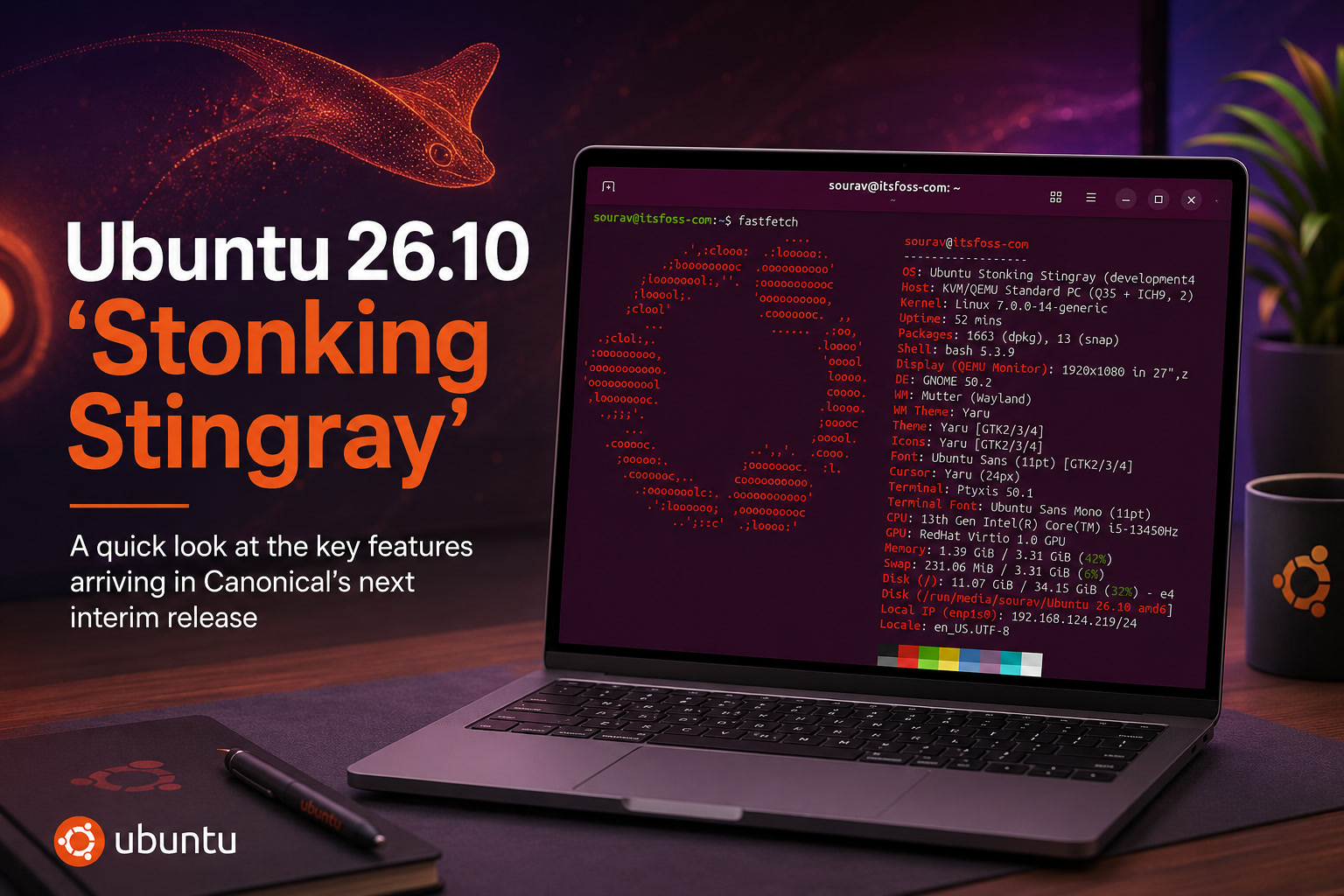
Ubuntu 26.10, codenamed "Stonking Stingray," is shaping up as another experimental step towards Canonical's next major Long Term Support release. Unlike an LTS version, which receives at least five years of security updates, Ubuntu's interim releases arrive every six months and are supported for only nine months.
That shorter lifecycle gives Canonical room to test new kernels, desktop technologies and system-level changes before introducing them more broadly. Ubuntu 26.10 is currently scheduled for release on 15 October 2026, with support expected to continue until July 2027.
As development is still underway, some features may change before the final release.
Ubuntu 26.10 Release Schedule
Canonical's current development timeline includes:
These dates may shift if developers discover serious regressions or other technical issues.
A Simpler Installation Experience Is Being Designed
Canonical is redesigning the Ubuntu installation process to make partitioning and storage configuration less intimidating.
The proposed experience will prioritise safer defaults and guided workflows, while placing advanced options behind additional controls instead of showing every technical setting immediately.
Ubuntu is also working on a new first-boot onboarding experience. Rather than asking users to configure everything during installation, personalisation and selected system settings could be completed after the desktop starts for the first time.
Organisations will still be able to automate these steps for large deployments.
However, the finished installer and onboarding redesign are primarily intended for Ubuntu 28.04 LTS. Ubuntu 26.10 is expected to serve as part of the development and testing cycle rather than receiving the complete experience.
Linux Kernel 7.x Is Expected
Development snapshots of Ubuntu 26.10 have already appeared with Linux kernel 7.0, although the final kernel version has not been confirmed.
Canonical now generally chooses the newest upstream kernel available near the release freeze, even when that version is still approaching its final upstream release.
The company also tracks interim kernels throughout development using monthly snapshots. This allows newer kernels to receive wider testing before Ubuntu's final October release.
As a result, the kernel may change several times before Stonking Stingray is completed.
Ubuntu Is Replacing Its Long-Standing D-Bus Implementation
One of the largest under-the-surface changes is the planned move from dbus-daemon to dbus-broker.
D-Bus is the communication system used by Linux desktop applications and background services. It helps different parts of the operating system exchange messages for tasks such as notifications, removable devices and system controls.
Ubuntu has relied on dbus-daemon since its first release in 2004. While it remains functional, its older design can become less efficient under heavier workloads.
Dbus-broker uses a more modern asynchronous and event-driven architecture. It is designed to handle busy message traffic more effectively and has already become the default on several other Linux distributions.
Most users may never interact with it directly, but the change could improve reliability and responsiveness behind the scenes.
GNOME 51 Brings Desktop Refinements
Ubuntu 26.10 is expected to ship with GNOME 51, which is scheduled for release around September.
The GNOME Shell is receiving several practical fixes. Screenshot selections should extend properly to monitor edges, the shutdown dialog will once again show its update-installation option correctly, and the overview search spinner should behave more consistently while users type.
GNOME will also remember monitor brightness between sessions and display the microphone indicator only when audio is actively being recorded.
Other desktop improvements include a simplified system-information page and warnings when users attempt to install applications that have reached end of life.
GNOME Calendar is also receiving performance-related internal changes and support for opening Microsoft Teams meeting links directly.
Meanwhile, Mutter—the GNOME window manager—is dropping support for older NVIDIA drivers.
Local AI Begins Arriving on Ubuntu
Canonical is beginning to introduce its broader AI strategy, which focuses on local-first processing and open-weight models rather than requiring users to depend entirely on cloud subscriptions.
One of the earliest features is Myna, a local speech-to-text tool.
Users will be able to hold a keyboard shortcut, speak and have the recognised text inserted wherever the cursor is positioned.
The speech recognition runs locally through a sandboxed component called the Canonical Inference Snap. Different model sizes will be available so the feature can adapt to machines with different levels of processing power.
Keeping transcription on the computer may improve privacy and allow the feature to work without continuously sending voice recordings to an external service.
Ubuntu Certified Status Moves Into Settings
Ubuntu is also adding a straightforward way to check whether a computer has been officially certified by Canonical.
The certification status is expected to appear in the About section of the Settings application.
Ubuntu will compare the detected hardware model with Canonical's certification database and report whether the device is fully certified, certified for a different Ubuntu release, similar to a certified model, not certified or unable to be checked.
This should make it easier for users to understand whether their hardware has been formally tested for Ubuntu compatibility.
The App Center Is Becoming Package-Agnostic
Canonical is continuing to rebuild the App Center so applications can be discovered and managed more consistently regardless of packaging format.
The long-term objective is to provide unified search results, categories, ratings and application details for formats such as Snaps and traditional DEB packages.
This is an important improvement after earlier versions of the App Center struggled with basic local DEB installation. Ubuntu 23.10 initially launched without reliable support for opening and installing downloaded DEB files, although the problem was later addressed through updates to Ubuntu 24.04.
A more package-neutral App Center could make software installation feel less fragmented for everyday users.
Ubuntu Continues Replacing Core Tools With Rust
Canonical is also expanding its use of Rust, a programming language designed to reduce common memory-safety problems.
Ubuntu has already adopted Rust-based replacements for several important utilities, including implementations of coreutils, findutils, diffutils and sudo. The Rust-based sudo-rs became the default in Ubuntu 25.10.
The next major component under consideration is ntpd-rs, a Rust implementation of the tools used to keep system clocks synchronised.
Canonical has become a Gold Sponsor of the Trifecta Tech Foundation, contributing €40,000 annually to support this work.
Development priorities include bringing ntpd-rs closer to feature parity with chrony, improving multi-threaded NTP server support, adding GPSd integration and strengthening sandboxing through AppArmor and seccomp.
Final Thoughts
Ubuntu 26.10 is unlikely to be the release most businesses choose for long-term production use, but that is not its main purpose.
Stonking Stingray is a testing ground for technologies that could shape Ubuntu 28.04 LTS. Its most important changes include the move to dbus-broker, GNOME 51, continued Rust adoption, newer Linux kernels and the first practical signs of Canonical's local AI strategy.
The redesigned installer and onboarding experience may not be fully ready by October, but their development shows where Ubuntu is heading: simpler setup, stronger local intelligence and more modern system foundations.
For enthusiasts and developers, Ubuntu 26.10 should provide an early look at Canonical's next generation of desktop and infrastructure changes.











Comments 0