

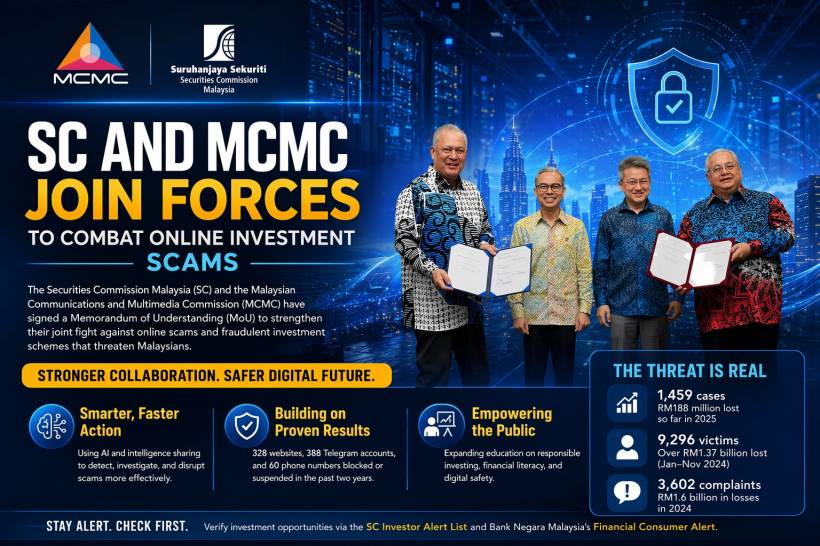
Malaysia's fight against online investment scams is getting a stronger push, with the Securities Commission Malaysia and the Malaysian Communications and Multimedia Commission formally joining forces through a new memorandum of understanding. The move reflects a growing concern over how digital fraud has evolved, especially as scammers become more organised, more convincing, and more effective at reaching potential victims online.
The agreement was signed at the Securities Commission headquarters by SC chairman Mohammad Faiz Azmi and MCMC chairman Mohamad Salim Fateh Din. The signing was witnessed by Communications Minister Datuk Fahmi Fadzil and Deputy Finance Minister Liew Chin Tong, underscoring the seriousness of the issue at a national level.
A More Coordinated Response to Digital Fraud
At its core, this partnership is about creating a faster and more coordinated response to online scams and fraudulent investment schemes. These are no longer isolated cases involving simple fake offers or suspicious cold calls. Today's scams often operate across websites, messaging apps, social media platforms, and even seemingly legitimate-looking digital campaigns.
That is why both agencies are now focusing on deeper cooperation in areas such as intelligence sharing, enforcement coordination, and the development of common operating procedures. They also plan to strengthen the skills and readiness of their enforcement teams, which is an important step when dealing with fraud tactics that keep changing.
Another major part of the collaboration involves the use of emerging technologies, including artificial intelligence. In practical terms, this suggests a stronger push toward faster detection of scam patterns, better monitoring of suspicious online activity, and more efficient investigation processes. As scammers become more sophisticated, regulators are clearly recognising that traditional enforcement methods alone may no longer be enough.
Why This Partnership Matters
The significance of this agreement goes beyond administrative cooperation. It signals a more serious attempt to protect retail investors and ordinary Malaysians who may be exposed to scam offers disguised as investment opportunities.
According to SC chairman Mohammad Faiz Azmi, combining the strengths of both agencies should help improve response times and strengthen public safeguards. That matters because online investment scams often move quickly. A fake website, Telegram channel, or social media page can appear, attract victims, and disappear again within a short period. When agencies work separately, valuable time can be lost. When they act together, the chances of disrupting those activities earlier become much stronger.
MCMC has taken a similar view, stressing that scam operations are becoming larger in scale and more complex in execution. In that environment, coordinated operations are not just helpful, but necessary. The idea is not only to react to scams after people have already lost money, but also to create a safer digital ecosystem that makes it harder for these schemes to thrive in the first place.
Building on Work Already Underway
This new MoU is not the starting point, but rather an expansion of cooperation that was already taking shape. Back in March 2025, the two agencies had already begun working together on faster mitigation measures, particularly in areas such as website blocking and content removal.
That earlier cooperation appears to have produced measurable results. Over the past two years, the SC and MCMC have blocked or suspended 328 websites, 388 Telegram accounts, and 60 phone numbers connected to fraudulent activity. Those numbers show just how widespread and multi-platform these scams have become.
The latest agreement builds on that foundation and fits into a broader national effort to protect confidence in Malaysia's digital economy. It also aligns with the expanded role of the National Scam Response Centre, which has become an increasingly important part of the country's anti-scam response framework.
Public Education Is Still a Major Part of the Solution
Enforcement alone is not enough, and both agencies seem to recognise that clearly. Alongside blocking activities and strengthening investigations, the SC and MCMC are also expected to expand public education efforts.
This is an important part of the strategy because scam prevention is not only about removing harmful content. It is also about helping people recognise warning signs before they become victims. Public awareness campaigns focused on responsible investing, financial literacy, and digital safety can make a real difference, especially when scams are designed to look polished, urgent, and trustworthy.
Many fraudulent investment schemes succeed not just because the scammers are clever, but because victims are pressured by fear of missing out, promises of easy returns, or fake legitimacy created through social proof and online branding. That makes awareness and education just as important as enforcement action.
The Numbers Show the Problem Is Still Serious
This stronger collaboration comes at a time when scam activity in Malaysia remains persistently high. Police recorded 1,459 cases involving non-existent investment schemes this year alone, with losses amounting to RM188 million. While the losses were slightly lower overall, the number of cases increased by 11 percent compared to the same period last year.
That suggests that even if average losses may have shifted, the scam problem itself is not slowing down. In fact, the number of people being targeted or caught up in these schemes appears to still be growing.
The broader picture is even more troubling. Between January and November last year, 9,296 people were reported to have fallen victim to similar scams, with losses exceeding RM1.37 billion. The age group most affected was those between 41 and 50, followed closely by individuals aged 51 to 60. This is a reminder that scam victims are not limited to the very young or very old. Many are working adults, financially active, and likely to be specifically targeted because they are perceived to have savings or investment interest.
Complaints Continue to Rise
Further data from the Securities Commission reinforces the scale of the challenge. In 2024 alone, the regulator received 3,602 scam-related complaints and enquiries, involving losses of more than RM1.6 billion.
What is especially concerning is that the first half of 2025 saw a 23 percent rise in complaints compared with the same period a year earlier. That points to a problem that is still expanding rather than stabilising.
It also shows that online investment scams are not a fringe issue. They are becoming a persistent threat that affects a large number of Malaysians, cuts across age groups, and causes serious financial harm.
Telegram and Websites Remain Key Channels for Scammers
When looking at where these scams are being promoted, Telegram accounted for the biggest share of complaints at 43 percent, followed by websites at 36 percent. Facebook and Instagram made up 19 percent, while TikTok accounted for 2 percent.
These figures reveal how scammers are adapting to the way people consume information today. Messaging apps and social platforms allow fraudsters to spread their schemes quickly, build false credibility, and engage directly with potential victims. Telegram in particular has become a major channel because it can be used to create groups, broadcast messages, and maintain semi-private communities that appear exclusive or insider-driven.
Websites remain important too, often serving as the polished front end of a scam operation. They can be designed to look like real investment firms, complete with fake testimonials, fabricated performance charts, and professional branding. Social media then acts as the funnel, pulling users into those environments.
The Public Still Needs to Verify Before Trusting
One of the clearest takeaways from this announcement is that public caution remains essential. Malaysians are being encouraged to verify investment offers through official channels such as the SC Investor Alert List and Bank Negara Malaysia's Financial Consumer Alert.
That advice may sound basic, but it remains one of the most effective ways to avoid being trapped by a fraudulent scheme. In many cases, scammers depend on speed, emotion, and trust. The moment a person pauses to verify a claim through an official source, the scam often starts to unravel.
Final Thoughts
The new partnership between the Securities Commission and MCMC is a timely and necessary move as online investment scams continue to become more aggressive and more sophisticated. By combining enforcement, intelligence sharing, technology, and public education, both agencies are trying to build a stronger defence against a threat that is clearly not going away.
The challenge now is making sure that these efforts translate into faster action, stronger disruption of scam networks, and greater public awareness. For ordinary Malaysians, the message remains simple but important: stay cautious, verify before investing, and do not assume that something is safe just because it looks professional online.











Comments 0