

The technology industry is entering an unusual period. Major companies are cutting jobs, reorganising teams and investing heavily in artificial intelligence at the same time. For many workers, that combination has created anxiety about job security. For others, it has opened the door to a different kind of opportunity: building a company alone.
Across Silicon Valley, AI tools are making it possible for a single founder to launch products, automate operations and manage tasks that once required a full team. Coding, marketing, customer support, research, analytics and content production can now be handled partly by AI systems, allowing individuals to experiment with businesses at far lower cost.
This shift is giving rise to more one-person start-ups, where founders use AI agents as virtual employees, assistants and in some cases even decision-making partners.
Layoffs Create an Unexpected Opening
The recent wave of tech layoffs has been severe. More than 100 technology companies reportedly cut over 115,000 jobs in the first quarter of 2026, creating uncertainty across an industry that had previously been known for aggressive hiring and high salaries.
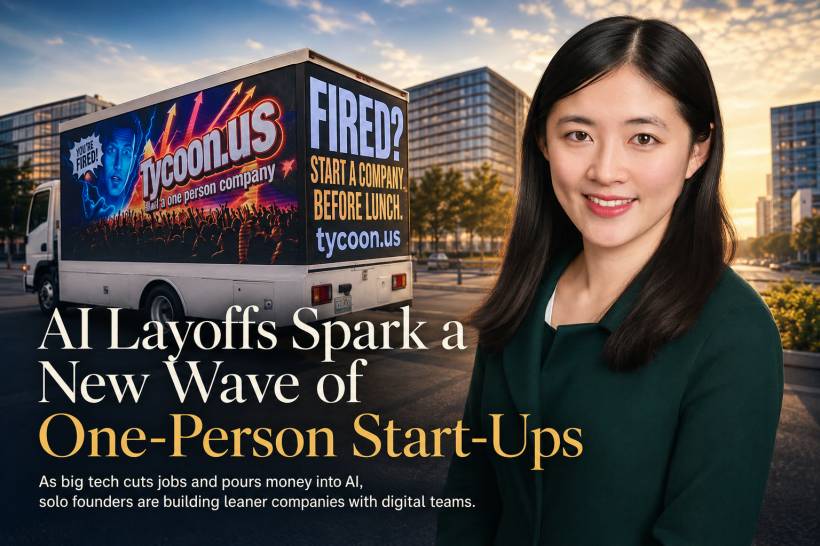
When Meta began implementing plans to reduce part of its workforce, entrepreneur Qu Xiaoyin saw an opportunity to reach people who were suddenly reconsidering their next move.
Her company reportedly sent an LED truck into the area around Meta's headquarters with a direct message for laid-off workers: "Fired? Start a company before lunch."
The message was designed to be provocative, but it captured a growing mindset. For some workers, losing a job is no longer viewed only as a setback. It can also become a chance to build something independently, especially when AI tools reduce the need for a large team, expensive contractors or years of technical development.
Qu, the founder of HeyBoss.AI, represents a growing group of entrepreneurs building platforms for this new type of business owner.
The Rise of the AI-Powered Solo Founder
The traditional start-up model often required founders to hire engineers, designers, marketers, customer support staff and operations teams before a company could scale.
Today, many of those functions can be partly supported by AI.
A founder may use AI to generate website copy, draft advertising campaigns, analyse customer data, respond to support enquiries, test product ideas or build early software prototypes. This does not mean AI can replace every role, but it can allow a smaller team to move faster than before.
For solo founders, that changes the economics of starting a business.
Instead of raising large amounts of money to hire a team immediately, they can validate an idea first. They can build a simple product, test it with real users and only expand when demand becomes clear.
This makes entrepreneurship more accessible to people who may have strong ideas but limited capital, limited technical resources or little experience managing employees.
AI Agents Are Becoming Digital Team Members
HeyBoss.AI is part of a broader movement towards AI-driven business operations.
The company uses AI "executives" designed to support founders with planning, execution and decision-making. Qu has even experimented with appointing an AI chief executive called Astra to help manage tasks across her ventures.
The idea is not simply to use AI as a chatbot. Instead, the AI is positioned as an operational layer that can break a goal into smaller tasks, assign those tasks to other AI agents, monitor progress and report back to the human founder.
For example, a user may tell an AI system they want to increase website traffic, improve sales or launch a new product. The system could then create a marketing plan, suggest content, identify growth opportunities and track results over time.
The human still sets the vision, priorities and boundaries. But much of the repetitive planning and execution can be delegated.
This is why one-person companies are becoming more realistic. The founder may technically work alone, but they are supported by a network of digital tools that function like a small virtual team.
Why AI Layoffs Feel Different
Layoffs are not new in the technology industry. Companies have always hired rapidly during growth periods and cut costs when markets change.
What makes the current moment feel different is that AI is often part of the explanation.
Some companies are reducing headcount because they believe automation will allow them to operate with fewer workers. Others may be cutting staff to redirect money towards AI infrastructure, cloud services, chips, data centres and model development.
In many cases, the situation is more complicated than simply saying AI replaced a worker.
Companies may have overhired during earlier growth periods. They may be facing pressure to improve margins, satisfy investors or restructure business units. AI can become part of the explanation even when it is not the only reason behind the cuts.
Still, the psychological impact is real. Employees hear leaders talk about automation, efficiency and AI-native companies, and many understandably worry that fewer people will be needed in the future.
That fear is helping push some workers towards independent projects, freelance work and entrepreneurship.
Smaller Companies Can Now Build Faster
Venture capitalist David Yin compared the current AI moment to the arrival of cloud computing and app stores.
Cloud platforms made it easier for founders to launch software without buying expensive servers. App stores made it easier to distribute products to users around the world.
AI is now reducing the cost of producing work itself.
A small team can build software faster. A founder can create marketing materials without hiring an agency. Customer support can be handled by automated systems. Market research can be accelerated through AI-assisted analysis.
The likely result is not only more start-ups, but also smaller start-ups.
A business that may have needed 10 employees in the past could potentially begin with one founder, a freelancer and several AI tools. That does not mean the company will remain small forever, but it allows founders to get started with less risk.
The Opportunity Comes With New Challenges
Lower barriers to building products also mean more competition.
When anyone can use AI to build a website, launch an app or create a marketing campaign, standing out becomes harder. Products may be easier to create, but getting customers, building trust and generating stable revenue remain difficult.
AI can help a founder move quickly, but it cannot automatically create a successful business.
A company still needs a clear problem to solve. It needs customers who are willing to pay. It needs strong positioning, reliable operations and a reason for people to choose it over competitors.
This is where human judgement remains essential.
AI can generate options, automate tasks and accelerate execution. But founders still need to understand their market, make strategic decisions and create a vision that people want to support.
A New Type of Lean Start-Up
One example of this emerging model is Freeport Markets, a New York-based start-up founded by Lihong Wang.
The company uses AI to support market analysis, trading ideas and financial news updates. Its team reportedly remains small, with Wang, a co-founder and a full-time engineer handling the core operations.
AI helps the company automate parts of its workflow, but Wang has also acknowledged that human technical expertise remains important.
AI may be useful for generating code, planning systems and handling repetitive work, but building reliable infrastructure at scale still requires skilled engineers. A system may need to support thousands of users at the same time, protect sensitive information and recover from failures without crashing.
This highlights an important reality: AI reduces the number of tasks people need to do manually, but it does not remove the need for experienced people entirely.
Will AI Replace Jobs or Create New Ones?
The answer may be both.
AI can automate specific tasks, especially routine work involving customer support, data processing, scheduling, content generation and basic analysis. That may reduce demand for some roles.
At the same time, AI can create entirely new businesses, new services and new types of work.
A founder who could not previously afford to hire a team may now be able to launch a viable company. A small business may be able to serve more customers without dramatically increasing staff. Professionals may be able to offer specialised services using AI as a productivity tool.
The challenge for workers is adapting quickly enough.
People who learn to work with AI may find ways to become more productive and valuable. Those who rely only on tasks that can easily be automated may face greater pressure.
This is why reskilling, training and access to new opportunities will become increasingly important.
Calls for More Transparency and Support
As AI-related layoffs become more visible, there are growing calls for companies to be more transparent about how automation affects workers.
Some proposals in the United States have suggested requiring employers to report AI-related layoffs, hiring changes and retraining efforts more clearly. Labour groups are also pushing for workers to have a stronger voice when companies introduce automation that could significantly affect jobs.
There are also wider debates about whether the benefits of AI should be shared more broadly.
Some technology leaders have discussed ideas such as public wealth funds, income support or new forms of redistribution if AI creates major productivity gains but reduces the number of jobs available.
These ideas remain highly debated, but they reflect a larger question: if AI makes companies more efficient and profitable, how should those gains be distributed?
Final Thoughts
AI layoffs are creating a difficult and uncertain period for many workers, especially in the technology sector. But they are also accelerating the rise of a new kind of entrepreneur: the solo founder supported by AI tools.
One-person companies will not replace traditional businesses overnight, and AI cannot eliminate the need for skill, creativity, customer trust or sound decision-making. However, it is making it easier for individuals to build, test and operate businesses with far fewer resources than before.
For some people, AI may feel like a threat to job security. For others, it may become the tool that finally makes entrepreneurship possible. The line between employee, freelancer and founder is becoming less clear, and the next generation of start-ups may be much smaller, faster and more AI-driven than the companies that came before them.











Comments 0