

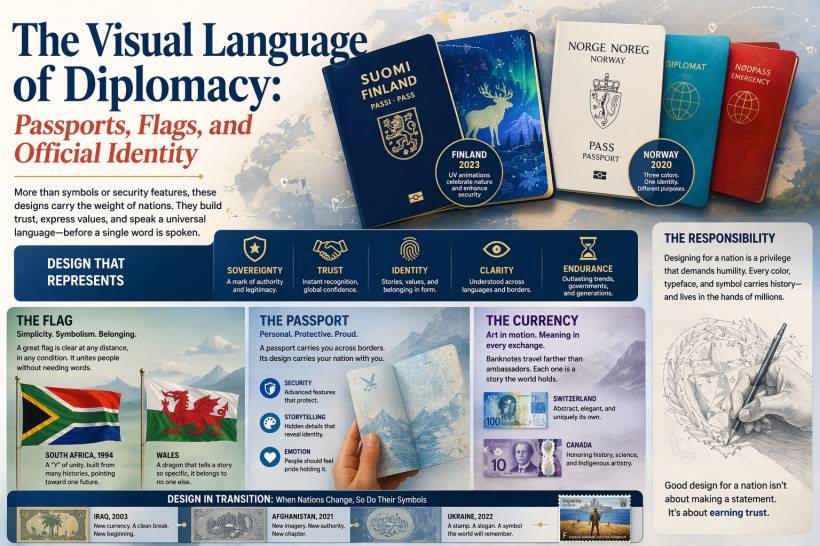
Every country communicates its identity to the world in many ways, through culture, policy, diplomacy, and language. But some of the most powerful messages a nation sends are visual. Passports, flags, currency, and official insignia form a quiet but deeply meaningful visual system that represents national identity across borders.
These objects may appear ordinary at first glance. A passport sits in a pocket, a flag waves on a pole, and a banknote passes from one hand to another in daily transactions. Yet each of these items carries enormous symbolic weight. They are not simply design objects. They represent sovereignty, legitimacy, history, and trust. Designing them is therefore far more than a creative exercise. It is a matter of national responsibility.
Passports: The First Encounter with a Nation
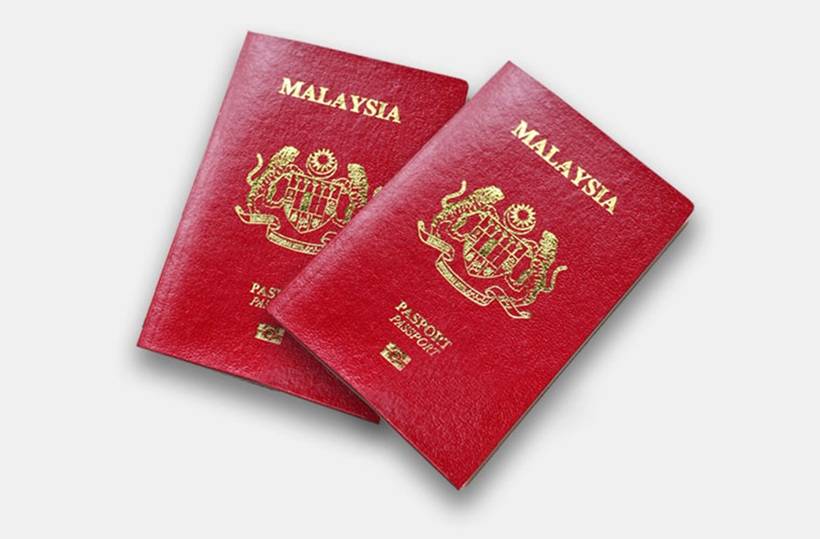
Among all official artifacts, the passport is perhaps the most personal expression of national identity. It travels with its holder across borders and often speaks before the person holding it does. Border officers, immigration systems, and foreign governments interpret a passport as a direct representation of the country that issued it.
Because of this, every design detail matters.
Take Finland's passport redesign introduced in recent years. At first glance, the passport appears simple and understated. Its deep navy cover communicates seriousness and stability, qualities often associated with Nordic governance and design culture. But inside, the document reveals a surprising level of creativity. When viewed under ultraviolet light, the pages display subtle animated scenes: a moose walking across the landscape, snow drifting gently, and clouds moving overhead.
These visual effects are not merely artistic choices. They also serve as sophisticated anti-counterfeiting features. At the same time, they quietly tell a story about Finland's environment and natural identity.
Interestingly, the redesign attracted such attention that many citizens became excited about renewing their passports. What is normally a routine administrative process turned into something almost cultural. When a passport design inspires that level of pride and curiosity, it shows how powerful national design can be.
Norway's passport redesign provides another example of how design choices express national character. Released in 2020, the passport uses three different cover colors depending on its function: white for standard passports, turquoise for diplomatic versions, and red for emergency travel documents. Inside the pages, minimalist illustrations reference Norway's landscapes, fjords, and northern lights.
The aesthetic is intentionally restrained. Rather than relying on elaborate decorative elements, the design communicates confidence through simplicity. It reflects a national identity rooted in calm, clarity, and quiet strength.
These visual decisions are never neutral. Typography, color, imagery, and layout all carry meaning. A heavily ornamented passport may suggest tradition and heritage. A minimalist design may signal modernity and efficiency. When indigenous symbols or cultural references appear in the document, they may acknowledge deeper histories about the land and its people.
In this way, the passport becomes more than identification. It becomes a visual statement about who the nation believes itself to be.
Flags: Simplicity with Deep Symbolism
If passports represent national identity in personal form, flags represent it at a distance. A flag must work in wind, sunlight, darkness, and even when reduced to a tiny icon. It has to communicate meaning instantly, often without any text or explanation.
Because of these constraints, the most effective flags tend to be simple yet symbolic.
The South African flag, introduced in 1994 after the end of apartheid, is often cited as one of the most successful examples of modern national symbolism. The design combines colors and elements associated with earlier flags and political histories, bringing them together into a new composition.
At the center of the design is a distinctive "Y" shape that represents convergence. The symbolism suggests different historical paths merging into a shared future. It was not simply a compromise between political factions. Instead, it created a new visual identity that acknowledged complexity while pointing toward unity.
Other nations rely on strong, distinctive imagery. Wales provides a striking example with its red dragon. The symbol is unmistakable and deeply rooted in mythology and cultural identity. Unlike more abstract flag designs, the dragon communicates heritage directly and memorably.
However, designing a flag also requires strict practical considerations. A flag must be easily reproduced in fabric. It must remain recognizable when seen from far away or when flying in strong wind. It should work equally well in color and black-and-white formats. Most importantly, successful flag designs avoid text, since words become unreadable at distance and may exclude people who speak different languages.
Flags that survive across generations tend to respect these constraints while still conveying powerful meaning.
Currency: Everyday Encounters with National Identity
While passports travel internationally and flags represent a nation symbolically, currency interacts with people on a daily basis. Banknotes and coins circulate constantly, making them one of the most widely seen forms of national design.
Every time a banknote changes hands, it quietly communicates a story about the country that issued it.
The Swiss franc is frequently cited as one of the most thoughtfully designed currencies in the world. Its unusual vertical layout immediately sets it apart from most banknotes. Designed by Manuela Pfrunder, the series avoids predictable imagery like mountains or traditional landscapes. Instead, it focuses on abstract representations of Swiss cultural values, including themes such as time, language, and scientific exploration.
This design choice communicates sophistication and innovation rather than nostalgia. That subtle message reinforces Switzerland's reputation for stability, precision, and modern thinking.
Canada's polymer banknotes illustrate a different approach. Introduced in 2011, the material itself signals technological advancement. Unlike traditional paper notes, polymer currency is more durable and resistant to counterfeiting.
The imagery on these notes balances historical and contemporary themes. References include the Vimy Ridge memorial, an icebreaker research vessel symbolizing scientific exploration, and artwork from Inuit artist Kenojuak Ashevak. Together, these elements present a narrative about Canada's history, its investment in science, and its recognition of Indigenous culture.
Currency design is also highly sensitive. Decisions about which figures, events, or symbols appear on banknotes can spark debate. If certain communities are overlooked or if outdated symbols remain in circulation, the design can become politically controversial. In this sense, creating currency requires careful consideration of national memory and representation.
Design During Political Change
National visual identity can also shift dramatically during periods of political transition.
When governments change or regimes fall, symbols often change with them. After the 2003 invasion of Iraq, new currency was issued that deliberately removed images of Saddam Hussein. The new banknotes used neutral motifs such as agricultural patterns and geometric designs. The goal was to signal a break from the previous regime while avoiding overt political statements about the future.
Afghanistan experienced a similar shift after the Taliban returned to power in 2021. New banknote designs removed images of former leaders and replaced them with religious inscriptions. The design language shifted toward textual and symbolic elements that reflected the new authority's ideological perspective.
In some cases, powerful symbols emerge unexpectedly. Ukraine's now-famous postage stamp featuring the phrase "Russian warship, go fuck yourself" became an international emblem of resistance during the early months of the war in 2022. The design was not the result of a long institutional process. Instead, it captured a moment of national defiance and quickly spread around the world.
These moments show that national identity can be shaped both through formal design processes and through spontaneous cultural responses.
Designing National Identity Is a Serious Responsibility
Designing visual identity for a country is fundamentally different from designing for a brand or commercial organization. Brands can redesign their logos, change color palettes, or reposition themselves in the market. Nations cannot easily do the same.
National symbols carry historical weight. They reflect political decisions, cultural narratives, and collective memories that often include complex and contested histories.
Designers working in this space face difficult questions. Who truly represents the nation's voice? Which stories deserve recognition, and which have been overlooked? How should indigenous communities be represented in national imagery? How can a design encourage unity without erasing diversity?
These are not questions with simple answers. Every design decision, from the color of a passport cover to the imagery on a banknote, communicates something about national priorities and values.
The most thoughtful national design projects acknowledge this responsibility. They recognize that visual identity is not neutral and that the symbols chosen today may influence how a country is understood for decades.
Final Thoughts
Passports, flags, currency, and official seals are far more than administrative objects. They are visual ambassadors that travel across borders, pass through millions of hands, and represent a nation long after any particular government has changed.
The animated moose hidden in a Finnish passport, the flowing geometry of the South African flag, and the wartime stamp that captured Ukraine's resistance all demonstrate the power of visual storytelling in diplomacy.
When designed thoughtfully, these artifacts do more than identify a country. They create a relationship between a nation and the people who encounter it.
Designing that relationship requires not only technical skill but also humility, cultural awareness, and respect for the stories a nation chooses to tell.











Comments 0