

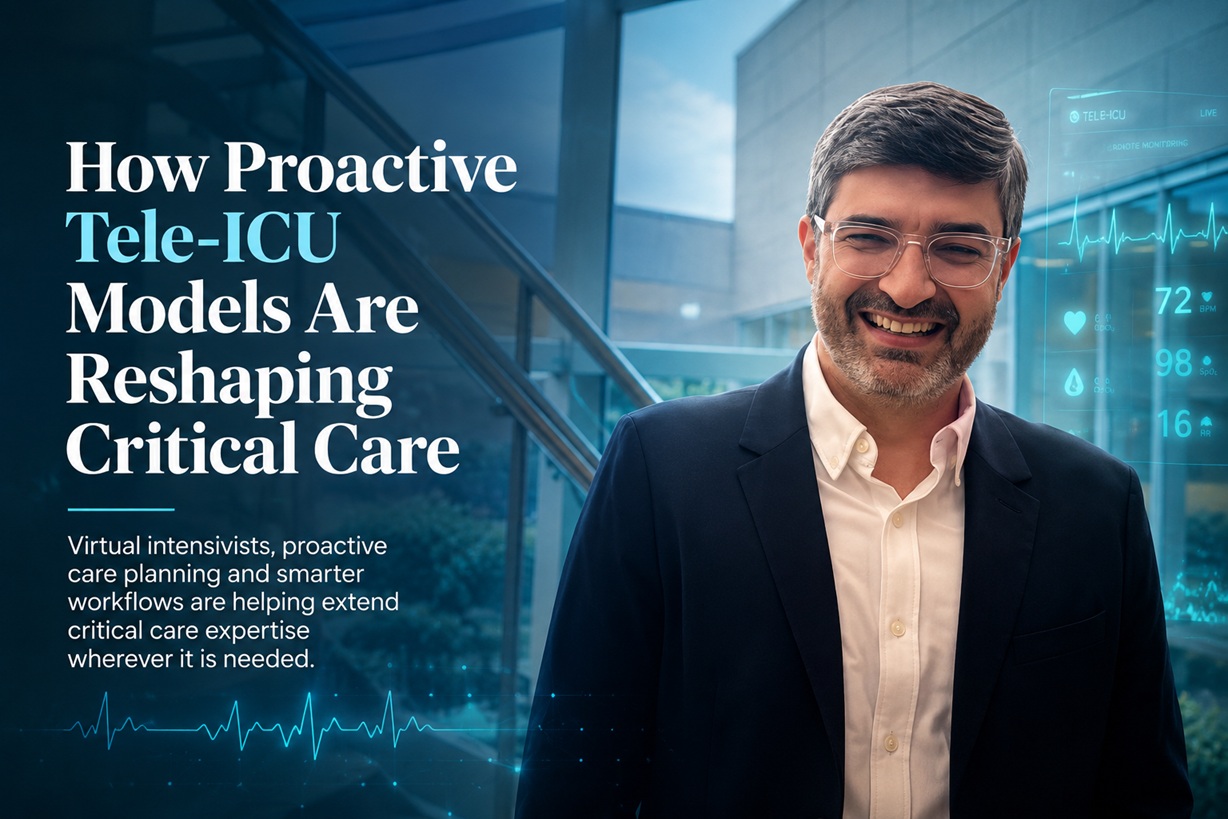
Hospitals are under growing pressure to provide intensive care expertise around the clock, but many facilities simply do not have enough board-certified intensivists to cover every ICU bed, especially in rural and community settings. As patient complexity rises and the critical care workforce remains stretched, tele-ICU is evolving from a remote monitoring tool into something much more useful: a collaborative clinical model that brings specialist expertise directly into hospitals that may not otherwise have it available.
The technology still matters, of course, but according to critical care leaders, the real difference comes from who is sitting on the other side of the connection and how actively they participate in patient care.
Tele-ICU Is Moving Beyond Remote Monitoring
Traditional tele-ICU programmes often focus on watching physiological data, detecting deterioration and generating alerts after a patient's condition changes. That approach can certainly help, but it remains largely reactive.
Dr. Sergio Zanotti, chief medical officer of critical care at Sound Physicians and director of critical care medicine at Memorial Hermann Memorial City Medical Center in Houston, argues that higher-performing tele-critical care programmes operate differently. Instead of waiting for a warning, remote intensivists proactively review patients, collaborate with bedside teams and help establish treatment plans before problems escalate.
This turns tele-ICU from a digital observation service into an extension of the actual critical care team. The bedside clinicians still provide hands-on care and continuity, while remote intensivists contribute specialist knowledge that smaller hospitals may struggle to recruit locally.
The Clinical Model Matters More Than The Camera
Video conferencing, connected monitoring platforms and remote access to clinical information are now relatively standard technologies. Simply installing cameras in an ICU does not automatically improve care.
The real value comes from building a workflow where remote and on-site clinicians function as one team. An experienced intensivist should understand the patient, participate in clinical decisions and work directly with local physicians, nurses and advanced practice providers.
That distinction is important because critical care decisions often need to be made quickly and involve complex judgement. A notification that something is wrong is useful. Having a specialist immediately help determine what should happen next is considerably more valuable.
Tele-Critical Care Can Help Smaller Hospitals Keep More Patients Locally
One of the biggest advantages is access.
Smaller community and rural hospitals may be capable of caring for many seriously ill patients but lack full-time intensivist coverage. Without specialist support, those patients may be transferred to larger hospitals even when the local facility has the beds, equipment and staff required to continue treatment.
Tele-critical care can help bedside teams stabilise patients and decide more accurately who genuinely needs a higher level of care. That can reduce unnecessary transfers while allowing patients to remain closer to their families and communities.
It can also take pressure off major referral hospitals, which are frequently dealing with their own ICU capacity constraints.
It Can Support Growing ICU Programmes Too
The model is not limited to small hospitals.
Health systems expanding their critical care services can face an awkward period where demand is increasing but patient volumes are not yet high enough to justify recruiting several additional full-time intensivists.
Virtual coverage gives hospitals more flexibility during that transition. They can combine on-site specialists with remote critical care physicians instead of depending heavily on temporary staffing.
Zanotti pointed to examples where small ICUs were able to increase the number of patients they safely managed because fewer cases needed to be transferred elsewhere.
At one 200-bed hospital, mechanical ventilation days reportedly dropped by 44% during the programme's first year, while its Case Mix Index rose by 10%, suggesting the hospital was successfully treating more medically complex patients. At another 580-bed trauma centre, the programme was associated with an improvement in its Leapfrog safety grade from D to B.
AI Could Help By Removing The Work That Distracts Clinicians
Artificial intelligence is also beginning to enter critical care, but the most useful applications may not involve replacing clinical judgement.
Zanotti separates hospital work into what he describes as deep work and shallow work. Deep work includes diagnosis, treatment planning and complex clinical reasoning. Shallow work includes documentation, administrative processes and repetitive data entry.
The argument is that AI is currently much better suited to reducing the second category.
If clinicians spend less time typing notes, documenting routine actions or navigating repetitive electronic health record tasks, they can spend more time actually thinking about patients.
That could be especially valuable inside intensive care units, where clinicians already manage enormous amounts of information throughout every shift.
Ambient Documentation Could Be A Practical Starting Point
One promising example is ambient clinical documentation.
These systems can listen to conversations between clinicians and patients and automatically prepare documentation, reducing the amount of time physicians spend staring at computer screens.
Similar technology could eventually work inside critical care environments. Routine observations, procedures and other required documentation could potentially be captured automatically, while clinicians verify the information rather than entering everything manually.
That may not sound as exciting as an AI diagnosing a critically ill patient, but reducing administrative burden could deliver a much more immediate improvement to clinical workflows.
Predictive AI Still Needs Human Action
Predictive analytics can also help identify patients who may be deteriorating or determine which patients require more urgent attention. However, identifying risk does not automatically solve the problem.
An alert still needs someone capable of interpreting the information and deciding what to do.
That is why experienced intensivists remain so important. AI may become increasingly good at surfacing patterns, organising information and prioritising cases, but those capabilities still need to connect to clinical judgement and action.
For the foreseeable future, tele-critical care appears more likely to use AI to support intensivists rather than replace them.
Hospitals Need To Define What Success Actually Means
Another important lesson is that health systems should not deploy tele-ICU simply because the technology is available.
They first need to identify the problem they are trying to solve.
For one hospital, the goal may be reducing transfers. Another may want to improve outcomes for respiratory failure or sepsis. A larger academic centre might be trying to expand specialised services and manage more complicated patients.
Those goals require different success measures.
Clinical outcomes, transfer rates, ventilator days, ICU capacity, patient complexity and staffing costs may all be relevant, depending on the organisation.
Without clearly defined objectives from the beginning, even a technically successful programme can struggle to demonstrate whether it actually made a meaningful difference.
The Future Of Tele-ICU Is More Collaborative Than Technological
The broader lesson is that tele-critical care is becoming less about remote surveillance and more about extending specialist expertise across distance.
Cameras, connected monitoring, predictive analytics and AI can all strengthen the model, but none of them replaces the need for experienced clinicians who understand critical care and take an active role in patient management.
The most successful tele-ICU programmes are likely to be the ones where virtual intensivists and bedside teams operate as a single clinical unit rather than two separate groups connected by technology.
Final Thoughts
Tele-critical care offers hospitals a practical way to address one of healthcare's most difficult problems: growing demand for intensive care without enough specialists to provide it everywhere.
The strongest programmes are moving beyond simply watching patients remotely. They are proactively reviewing cases, helping build treatment plans and giving bedside teams direct access to intensivists when that expertise is needed.
AI could make that model even more effective by reducing documentation and surfacing important information sooner. But technology is only the support structure.
In critical care, better outcomes will still depend on experienced clinicians making the right decisions together, whether they are standing beside the patient or connected from hundreds of kilometres away.











Comments 0