

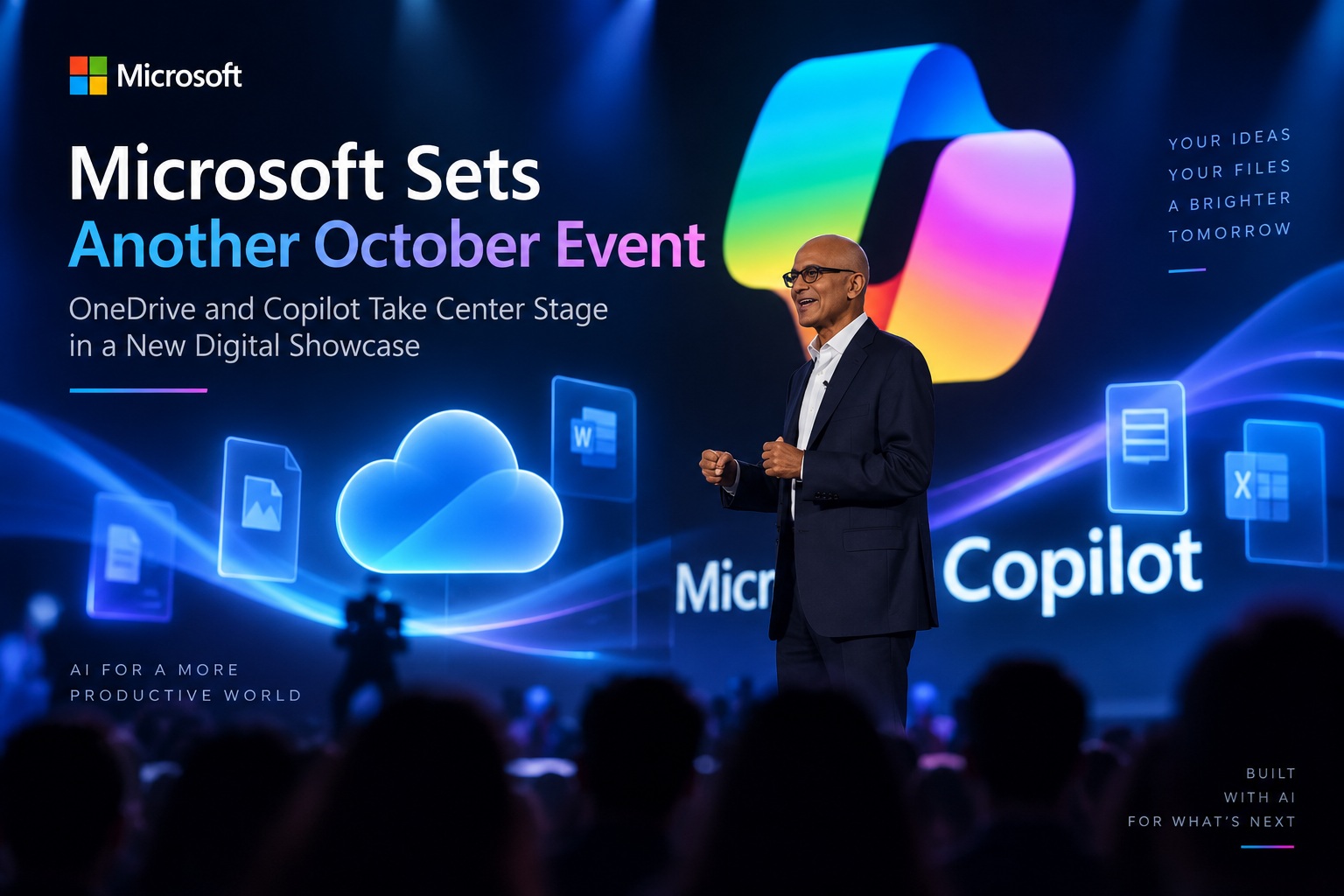
Microsoft already has plenty planned for October, and its upcoming Windows 11 and Surface presentation will not be the company's only appearance next month. The tech giant has now confirmed that its annual OneDrive + Copilot digital event will take place on 20 October 2026, shifting the spotlight away from Windows hardware and toward cloud storage, Microsoft 365 and AI-powered productivity. The online event will be free to attend and will begin at 9 AM PT / 12 PM ET, followed by a live question-and-answer session.
While a OneDrive event may not attract quite the same attention as a new Surface announcement, it could be especially relevant to businesses and Microsoft 365 users who increasingly depend on Copilot to work with documents, images and organisational data. OneDrive has quietly become an important part of Microsoft's AI strategy because it provides much of the content Copilot needs to understand when helping users search, summarise, organise or act on their files. Microsoft's teaser around "turning files into outcomes" suggests that connection will be one of the central themes of the presentation.
Microsoft Is Bringing Its OneDrive Leadership Team Together
Microsoft has confirmed several senior executives who will appear during the event, including Jeff Teper, Executive Vice President of Microsoft Apps and Agents, Adam Harmetz, Corporate Vice President of Product for OneDrive and SharePoint, and Arwa Tyebkhan, Head of Product for OneDrive. They will be joined by product leaders, engineers and specialists from across the OneDrive organisation.
That lineup suggests the presentation will go beyond a simple collection of feature announcements. Microsoft says attendees can expect demonstrations alongside discussion of real-world OneDrive and Microsoft 365 use cases, giving the company an opportunity to show how new capabilities fit into everyday business workflows. For enterprise users, that kind of demonstration is often more useful than a list of isolated features because it shows how the tools are supposed to work together.
The inclusion of executives responsible for both applications and AI agents is also notable. Microsoft has been steadily moving Copilot beyond a chatbot-style assistant and toward a system capable of acting across documents, communication tools and business data. OneDrive naturally becomes part of that foundation because so much organisational information already lives there.
OneDrive Is Becoming More Important to Microsoft's AI Strategy
OneDrive used to be easy to describe simply as Microsoft's cloud-storage service. That description is becoming increasingly incomplete as the company connects it more deeply with Microsoft 365, SharePoint, Copilot and AI-powered search. Files are no longer just objects that need somewhere to live; they are increasingly becoming context that AI systems can analyse and work with.
For example, a user might want Copilot to locate information from several documents, summarise a project folder, compare multiple reports or surface relevant images without manually opening every file. Those workflows depend heavily on Microsoft understanding where the files are stored, who has permission to access them and how they relate to other information in the organisation. OneDrive sits directly in the middle of that equation.
This helps explain Microsoft's "turning files into outcomes" messaging. The next phase of cloud storage is less about simply synchronising folders between devices and more about making the information inside those folders immediately useful. AI becomes the layer that connects the stored content to what the user is actually trying to accomplish.
Expect Practical Copilot Demonstrations Rather Than Just Another AI Pitch
One of the more interesting parts of the event could be seeing how Microsoft translates its broad Copilot ambitions into practical file-management workflows. AI announcements can sometimes become abstract very quickly, particularly when companies focus heavily on future possibilities. An event centred around OneDrive gives Microsoft an opportunity to show capabilities people can actually use inside familiar productivity tools.
This might include faster ways to find documents, understand what is inside them, organise project material or turn stored content into something actionable through Copilot. Real-world demonstrations will be particularly important because Microsoft's enterprise customers want to know how AI saves time rather than simply hearing that another application now includes an AI button.
For organisations already paying for Microsoft 365 and Copilot, improvements to OneDrive integration can potentially have a bigger everyday impact than another standalone AI feature. Employees spend enormous amounts of time searching for files, checking versions, identifying the right document and trying to understand information scattered across different folders. If Copilot can genuinely reduce that effort, OneDrive becomes a much more important productivity platform.
This Is Separate From Microsoft's Windows and Surface Event
The 20 October presentation is distinct from Microsoft's other major October event, which is expected to focus much more heavily on Windows, local AI and Surface hardware. That earlier presentation is likely to attract more consumer attention because hardware launches naturally generate larger headlines, especially when new Surface devices are involved.
However, expectations surrounding the two events are very different. Surface presentations have historically carried excitement around new form factors, redesigned devices and major Windows developments, which means relatively incremental announcements can sometimes feel underwhelming compared with Microsoft's strongest hardware launches. The OneDrive event arrives with a much more focused promise: show users how cloud files and Copilot can work together more effectively.
That narrower scope may actually work in its favour. People attending a OneDrive presentation are unlikely to expect revolutionary hardware or dramatic Windows changes. They are more likely to care about whether Microsoft can make file management, collaboration and AI-assisted productivity meaningfully better.
Cloud AI and Local AI Are Becoming Two Parts of the Same Microsoft Story
The contrast between Microsoft's October events also highlights how the company is developing AI on two fronts. On one side, Microsoft is pushing more AI processing directly onto PCs, where local hardware can handle tasks with lower latency and potentially greater privacy. On the other, cloud services such as OneDrive and Microsoft 365 continue to provide the enormous pools of organisational information that make Copilot useful in the first place.
These approaches are not really competing with one another. A future Windows PC could run more AI locally while still using cloud-connected services to retrieve authorised information from OneDrive, SharePoint or other Microsoft 365 systems. The user may never need to think much about where the processing happens as long as the experience remains quick and secure.
That combination is likely to become increasingly important as AI agents become more capable. The device provides local intelligence and immediate interaction, while the cloud provides shared organisational context. OneDrive therefore becomes less of a background storage utility and more of a data layer within Microsoft's wider AI ecosystem.
Businesses May Find This Event More Relevant Than a Hardware Launch
For enterprise IT teams, collaboration managers and Microsoft 365 administrators, the OneDrive + Copilot event could ultimately have more immediate relevance than another Surface announcement. Most organisations will not replace their entire PC fleet because of one new laptop, but almost every employee may interact with OneDrive or SharePoint daily.
Changes to how files are searched, shared, governed or surfaced through Copilot can affect thousands of employees simultaneously. That makes even relatively small improvements important when deployed across a large organisation.
There are also broader questions around permissions and governance whenever AI gains easier access to corporate content. OneDrive and SharePoint already depend heavily on existing access controls, and Copilot inherits much of that permission model. As Microsoft makes AI more capable of finding and interpreting organisational files, companies will need to pay even closer attention to whether those files are correctly classified and shared in the first place.
The event may therefore be useful not only for showing what Copilot can do, but also for understanding how Microsoft expects organisations to manage the underlying data safely.
A Live Q&A Could Be One of the More Useful Parts
The presentation will be followed by a live Q&A, which gives attendees the opportunity to ask more detailed questions after the demonstrations. That can be particularly valuable for enterprise technologies, where the practical concerns are often much more specific than what appears during a keynote.
Businesses may want clarification around licensing, deployment, privacy, permissions, administrator controls or how particular Copilot features interact with existing OneDrive environments. Product demonstrations can make a feature look effortless, but enterprise customers still need to understand what is required behind the scenes before rolling it out broadly.
Having product leaders and engineers involved should make the Q&A particularly worthwhile if Microsoft uses it to address those operational questions directly rather than simply repeating keynote messaging.
Final Thoughts
Microsoft's OneDrive + Copilot event on 20 October 2026 may not generate the same excitement as a Surface hardware launch, but it could reveal something equally important about the company's direction. Microsoft increasingly sees AI as something that should work across the information people already create rather than exist as a separate destination users have to visit.
OneDrive plays a central role in that strategy because documents, presentations, images and shared project files provide the context Copilot needs to become genuinely useful. The more intelligently Microsoft can connect those files to AI-assisted workflows, the less OneDrive looks like simple cloud storage and the more it becomes part of the operating layer for modern work.
The event's emphasis on demonstrations and real-world use cases should make it especially interesting for organisations already invested in Microsoft 365. Rather than expecting one dramatic announcement, the more useful question may be how many everyday tasks Microsoft can quietly remove from the user's workload.
With Windows, Surface, OneDrive and Copilot all getting attention across October, Microsoft appears to be using the month to show both sides of its AI strategy: more intelligence running locally on the PC, and more intelligence working across the information people already keep in the cloud.











Comments 0