

PlayStation 5 emulation is beginning to move beyond the purely experimental stage, with the open-source SharpEmu PS5 emulator now able to run several commercial games at a playable 60 FPS. The milestone is still a long way from full PS5 compatibility, but it shows how quickly developers are improving areas such as shader translation, Vulkan rendering and PlayStation system-function emulation.
According to an update shared by the SharpEmu developers on September 25, six of the 55 PS5 titles currently tested can now reach what the team describes as a playable state. Another six games are able to reach gameplay but are not yet stable enough to receive the same classification.
For an emulator targeting hardware as recent and complex as the PlayStation 5, that is meaningful progress.
Six PS5 Games Are Now Running at 60 FPS
The latest SharpEmu compatibility results list six titles capable of running at approximately 60 FPS:
The developers are careful about what "playable" means at this stage. None of the six titles has necessarily been tested from beginning to end, so the rating does not guarantee a completely problem-free playthrough.
Instead, it means the games currently run well enough to play without major blockers during testing. Minor graphical glitches, audio problems or other emulation inaccuracies may still remain.
Even with those limitations, getting six commercial PS5 games running smoothly at 60 FPS is an encouraging achievement for such an early project.
SharpEmu v0.0.4 Brings Important Graphics Improvements
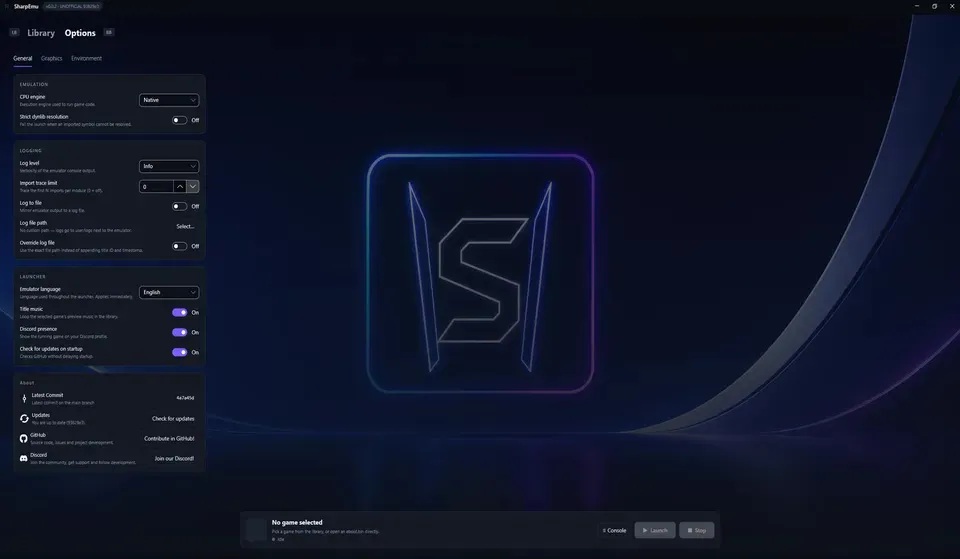
The breakthrough comes with SharpEmu v0.0.4-release.2, released publicly on September 25. The latest version includes improvements to SPIR-V shader translation together with updated Vulkan API support.
Shader translation is one of the more difficult parts of modern console emulation. Games expect the graphics hardware and driver environment of the original console, while the emulator needs to translate those instructions into something a PC GPU and graphics API can understand.
Every improvement to this translation layer can fix rendering problems, improve performance or allow another game to progress further into gameplay.
Vulkan is particularly suitable for this kind of work because it gives developers relatively low-level access to modern GPUs across several operating systems.
Windows, Linux and macOS Are Supported
SharpEmu is written in C# and supports Windows, Linux and macOS. It primarily uses Vulkan for graphics, while macOS compatibility is handled through MoltenVK, which translates Vulkan calls into Apple's Metal graphics API.
One factor making PS5 emulation somewhat different from older console generations is the PlayStation 5's CPU architecture. Sony's console uses an AMD Zen 2 processor based on the familiar x86-64 architecture, which is also used by conventional PCs.
That means SharpEmu does not necessarily need to translate every CPU instruction from a completely different processor architecture. On compatible PC hardware, much of the console's CPU code can execute much more directly.
This does not make PS5 emulation easy, though. The emulator still needs to reproduce Sony's operating-system behaviour, kernel functions, graphics interfaces, memory handling and many hardware-specific services expected by PS5 software.
SharpEmu Focuses on the Core PS5 Execution Environment
The emulator currently works by loading the game's eboot.bin executable together with the required system modules. From there, SharpEmu attempts to provide enough of the PlayStation environment for the software to execute.
That includes partially implementing kernel functions and handling resources submitted through the PS5 graphics stack. Game shaders and AGC graphics commands also need to be translated into formats that conventional PC hardware can process.
A game reaching its title screen therefore already represents the successful emulation of a considerable amount of underlying PS5 behaviour.
Getting from there to a stable 60 FPS experience is another challenge entirely.
Only 12 of 55 Tested Games Currently Reach Gameplay
Despite the recent milestone, SharpEmu remains firmly in early development.
Out of 55 tested PS5 titles, only 12 currently reach a game-ready or gameplay state. Half of those — the six listed above — perform well enough to receive the project's playable classification.
That means the majority of tested software still cannot be played normally.
The current successes also tend to involve less demanding games rather than technically intensive PlayStation 5 releases. Complex modern 3D titles place much heavier demands on graphics emulation, system services, memory management and timing accuracy.
So while the phrase "PS5 emulator running games at 60 FPS" sounds dramatic, it should not be interpreted as meaning that modern PS5 blockbusters are suddenly ready to play on PC.
Demanding 3D Games Remain the Bigger Challenge
The next major hurdle will be getting technically heavier PS5 titles working consistently.
Simple or cross-generation games may depend on a relatively small subset of the console's features. Large AAA titles can interact much more deeply with Sony's graphics stack, storage architecture, multithreading behaviour and system libraries.
A single missing function can prevent a game from booting, while a subtle timing or shader bug might cause crashes several hours later.
This is why emulator compatibility typically progresses unevenly. One game may become fully playable relatively early while another released around the same time may not even reach its main menu.
Compatibility numbers therefore matter more than isolated demonstrations.
KytyPS5 Is Making Progress Too
SharpEmu is not the only project attempting to emulate Sony's current-generation console.
Another experimental emulator, KytyPS5, recently demonstrated the PS5 edition of GTA V running at around 40 to 60 FPS on a powerful PC equipped with a Ryzen 9 9950X3D and Radeon RX 7900 XT.
That demonstration was far from a complete success. The game reportedly crashed after its opening mission, highlighting just how difficult sustained compatibility remains.
Still, the fact that a game as complicated as GTA V can already enter gameplay at relatively high frame rates is another indication that PS5 emulation research is advancing quickly.
Performance alone, however, is only one part of the problem. Stability and accuracy over an entire game are considerably harder achievements.
Why PS5 Emulation Could Advance Faster Than Expected
Previous console-emulation projects sometimes needed many years before mainstream PCs became powerful enough to reproduce the original hardware reliably. PS5 emulation has a few advantages that could potentially shorten part of that journey.
The biggest is the console's relatively conventional AMD architecture. The PS5 uses familiar x86-64 CPU technology and an AMD-derived graphics architecture rather than an exotic custom processor completely unlike desktop hardware.
Modern PCs are also extraordinarily powerful, particularly at the high end.
That still leaves significant software complexity, but developers are not starting from the same architectural distance seen with consoles such as the PlayStation 3, whose unusual Cell processor became notoriously difficult to emulate accurately.
Open-Source Development Could Accelerate Progress
SharpEmu is being developed as an open-source research project, which allows programmers to inspect the code, contribute fixes and experiment with different approaches.
That collaborative model has historically been important for emulation development. Projects such as RPCS3, Dolphin and PCSX2 improved gradually as contributors solved individual compatibility problems and documented increasingly accurate behaviour.
SharpEmu could potentially follow a similar path if developer interest continues growing.
The team also explicitly states that the project contains no copyrighted PlayStation firmware, games or proprietary Sony assets. It is intended for research and educational purposes rather than distributing console software.
Users therefore still need to obtain any required game or system data through legitimate means.
60 FPS Is Impressive, but Compatibility Matters More
Frame-rate demonstrations naturally attract attention because they are easy to understand. Seeing a PS5 game running at 60 FPS makes the emulator appear remarkably mature.
The more important metric in the long term, however, will be how many games work correctly from beginning to end.
An emulator needs much more than raw speed. Saving and loading must work reliably. Audio needs to remain synchronised. Graphics must render correctly across thousands of different scenes. Games need to survive transitions, cutscenes, networking calls and unusual edge cases without crashing.
That level of compatibility takes considerably longer to achieve.
The current six playable titles are therefore best viewed as proof that SharpEmu's foundation is starting to work rather than evidence that PS5 emulation is already ready for mainstream use.
Final Thoughts
SharpEmu reaching playable 60 FPS performance in six PS5 games is an impressive milestone for a project that remains at version 0.0.4. Improvements to SPIR-V shader translation and Vulkan support are already translating into real compatibility gains, while 12 of the 55 tested titles can now reach gameplay.
There is still a huge amount of work ahead. Most PS5 software remains unsupported, demanding 3D titles are particularly difficult, and even games currently labelled playable have not necessarily been verified from start to finish.
Still, PS5 emulation is clearly gathering momentum.
Between SharpEmu improving its Vulkan and shader pipeline and projects such as KytyPS5 beginning to run much more demanding software, developers are gradually uncovering how to reproduce Sony's current-generation console environment on standard PCs.
We are nowhere near a mature PS5 emulator yet.
But the stage where PS5 games can actually boot, render correctly and reach 60 FPS is no longer theoretical — and that makes the next few years of development particularly interesting.











Comments 0