

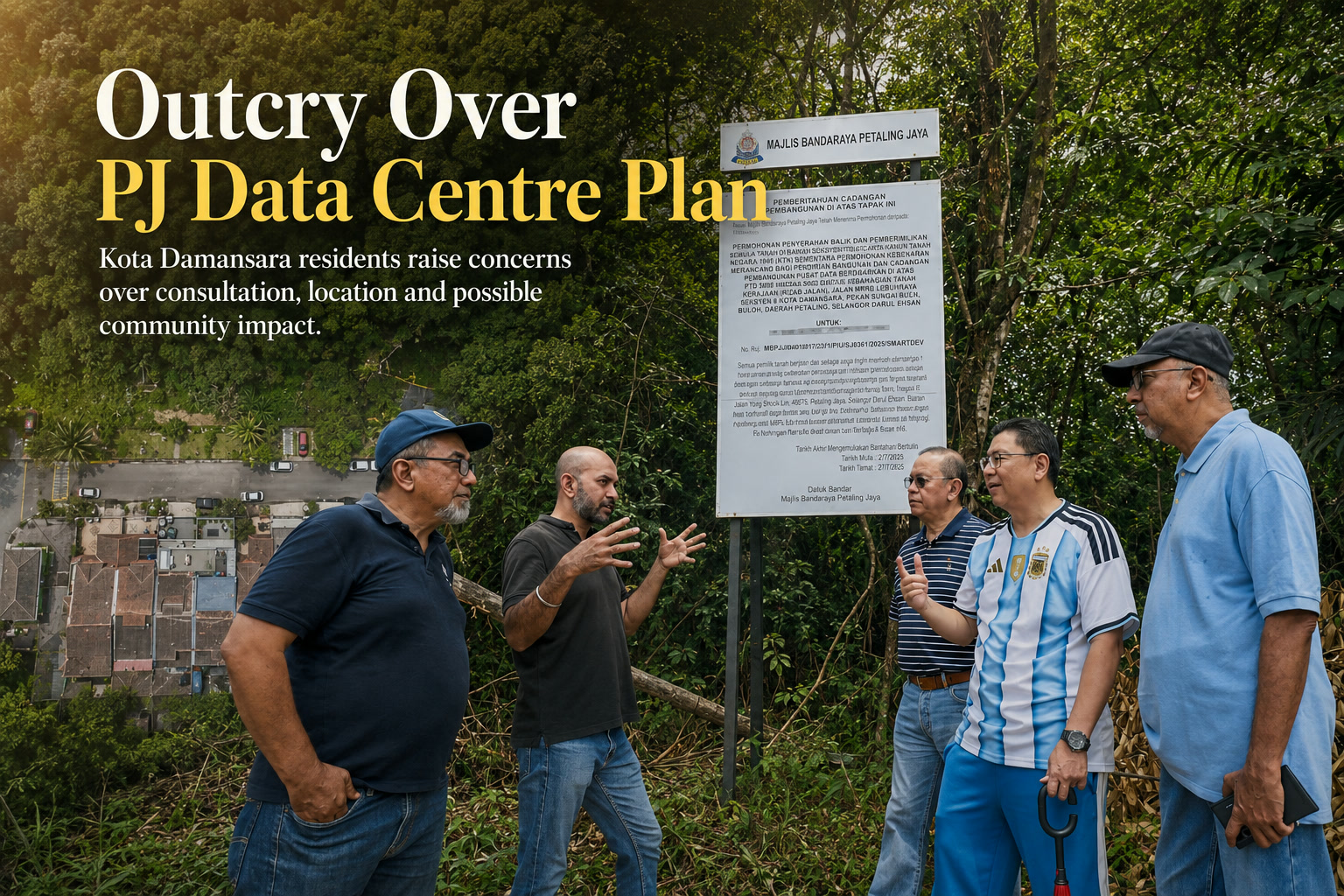
A proposal to build a three-storey business data centre in Kota Damansara has triggered strong concern among nearby residents, but Petaling Jaya City Council has stressed that the project has not been approved.
The development remains at the public-feedback and technical-evaluation stage. As of July 21, MBPJ had received approximately 290 formal objections relating to the proposed site at Jalan Rimba Riang 9/6 in Petaling Jaya.
The application covers 18 privately owned lots beside land reserved for a government road. Residents are questioning not only whether a data centre belongs so close to established neighbourhoods, but also how the consultation process was conducted and whether the public received enough time and information to respond meaningfully.
The Project Is Still Under Review
MBPJ has clarified that the application has not yet been presented to its One-Stop Centre Unit for planning consideration.
Before that can happen, the council must complete the public-feedback process, collect reviews from relevant technical agencies and assess the supporting documents submitted by the developer.
These documents include a development proposal report and a traffic impact assessment, which are available through MBPJ's Development Planning and Engineering departments.
Once the consultation period closes, MBPJ is expected to organise a development briefing for individuals who submitted feedback. Under the council's normal process, this meeting should take place within 30 days of the notice period ending.
Only after the objections, technical assessments and applicant's reports have been examined will the complete proposal move forward for formal consideration.
This means the current debate is not about overturning an approved project. It is about whether the application should be allowed to advance at all.
Errors on the Original Notice Complicated Public Participation
One of the earliest points of controversy involved the information displayed on the original site notice board.
Residents complained that the notice contained an inaccurate application reference and incorrect contact details for the responsible officer. These errors reportedly made it difficult for members of the public to submit feedback through the proper channel.
MBPJ subsequently issued a formal instruction on July 15 requiring the applicant to correct the information.
The correction effectively extended the public-consultation period. The original notice reportedly covered July 9 to 15, while the revised window ran from July 21 to 27.
MBPJ said the extension was intended to preserve transparency and ensure affected residents had a genuine opportunity to respond.
The episode nevertheless raised wider questions about how easily local communities can miss important planning notices when notification depends heavily on a board placed at the project site.
Some Residents Discovered the Proposal by Chance
Several residents said they became aware of the project only shortly before the original objection deadline.
Kota Damansara Section 9 Phase 1 resident Mohd Razif Mohd Lazim reportedly noticed the planning board during a morning walk on July 14. At that point, the displayed deadline was the following day.
He quickly informed a local residents' coalition, which submitted an objection before the stated closing date.
Experiences like this have strengthened calls for a more direct and reliable notification process.
For a project that may affect traffic, noise, utilities and the surrounding environment, residents argue that consultation should not depend on someone happening to pass the site and notice a sign.
Local councillors, residents' associations, elected representatives and nearby property owners could all play a role in distributing the information more widely.
Additional Notices Were Sent to Nearby Stakeholders
Following the controversy, MBPJ issued registered notices on July 17 requesting specific feedback from local stakeholders.
The notices were sent to 11 homeowners living within 20 metres of the proposed site along Jalan Rimba Riang 9/3 and Jalan Rimba Riang 9/5A.
Copies were also issued to the Sungai Buloh Member of Parliament, the Kota Damansara state assembly representative and the office of the MBPJ Zone 3 councillor.
Recipients were given seven days to provide their views.
Although this expanded the consultation, residents continue to question whether a one-week response period is sufficient for a technically complex development.
Understanding a data centre proposal may require reviewing traffic studies, utility requirements, acoustic reports, cooling systems, emergency arrangements and the project's relationship with neighbouring homes.
Meaningful consultation requires time not only to object, but also to understand what is being proposed.
Why a Data Centre Near Homes Raises Concern
A data centre does not normally attract the same visitor traffic as a shopping centre or office tower. However, that does not mean it has no effect on its surroundings.
These facilities operate continuously and contain large amounts of computing, electrical and cooling equipment. Residents are therefore concerned about issues such as:
The concern is not necessarily that every data centre will produce unacceptable effects. The question is whether this particular location, design and operating model are suitable for a site close to established residential communities.
That can only be determined through detailed technical studies and transparent public review.
Noise Could Continue Around the Clock
Data centres generally operate 24 hours a day because the systems they host are expected to remain continuously available.
Even when there are few employees or visitors on site, cooling equipment, ventilation systems, pumps, transformers and other mechanical infrastructure may continue running.
Backup generators may also require periodic testing.
A sound level that appears manageable during the daytime can feel much more intrusive at night when surrounding areas are quieter.
Residents therefore want to know where the cooling and power equipment would be positioned, what acoustic barriers would be installed and how noise would be measured at nearby property boundaries.
A simple promise that the facility will comply with legal limits may not be enough. Communities will expect the reports, modelling assumptions and mitigation measures to be explained clearly.
Energy and Water Demand Are Also Being Questioned
Modern data centres can require significant amounts of electricity. Depending on the cooling technology used, they may also consume substantial water.
Residents and local representatives have raised concerns about whether the proposed facility could place additional pressure on supplies serving the surrounding neighbourhood.
This does not automatically mean the project would cause shortages. Utility providers and technical agencies would need to assess the expected load, available capacity and any infrastructure upgrades required.
The developer should also explain whether the facility would use air cooling, water-based systems or a hybrid arrangement.
Without this information, residents may reasonably fear that the project's resource demands will be carried by the existing community.
Potential Heat Impact Needs Proper Assessment
Data centres convert most of the electricity they consume into heat.
Cooling systems remove that heat from server rooms and release it elsewhere. The way this is designed can influence conditions around the site.
Residents have questioned whether discharged heat could affect nearby homes or contribute to higher local temperatures.
They are also concerned about the potential effect on the nearby Kota Damansara Community Forest.
A proper assessment should examine the direction and temperature of exhaust air, equipment placement, surrounding vegetation, building setbacks and the cumulative effect of continuous operation.
Landscaping may improve the visual appearance of the site, but it should not be treated as a substitute for effective thermal and acoustic engineering.
The Proposed Site Has More Than One Land-Use Classification
Under the Petaling Jaya Local Plan 2, Amendment 3, the site includes land categorised for business and services, covering shop or office lots, as well as land designated for transport, including a road reserve.
Residents accept that landowners generally have the right to develop private land in accordance with planning rules.
Their concern is that parts of the proposal may extend beyond the privately owned lots and into the government road reserve.
Section 5 resident Foo Kwan Pheng argued that developing land reserved for a road would require a separate state decision to alienate or approve the land for another use.
Such approval would not be automatic.
Residents are also worried that occupying the road reserve could limit future road expansion, particularly if traffic in the area increases over time.
A Road Reserve Is More Than Empty Land
A road reserve may appear unused, but it can serve an important long-term planning purpose.
It may be retained for future road widening, pedestrian facilities, drainage, utilities, public transport infrastructure or safety improvements.
Once a permanent building extends into that space, future upgrades can become more difficult or expensive.
This is why residents want MBPJ and the state authorities to explain clearly which parts of the proposal sit on private land, which affect the road reserve and whether any application has been made to change the status of that land.
A transparent site-boundary plan would help the public understand the issue without relying only on interpretations of the notice board.
A 50-Metre Buffer Is Part of the Suitability Assessment
MBPJ said the proposal would be assessed against PlanMalaysia's Data Centre Planning Guidelines 2024.
Those guidelines require a 50-metre buffer between the data centre structure and the boundaries of residential lots.
The buffer may include roads, building setbacks, perimeter planting, parking areas and other separation features.
However, the existence of a 50-metre distance alone does not prove that a site is suitable.
The council must still examine where noisy equipment will be placed, how heat will be discharged, whether generators face residential properties and how traffic will enter and leave the site.
A buffer should function as a genuine protective zone, not merely a measurement on a planning drawing.
Residents Question Whether the Site Matches the Original Commercial Intention
The 1.1-hectare project site is zoned for commercial use, but residents argue that the local plan originally envisioned shops or office-type development serving the surrounding community.
They do not believe that every form of commercial infrastructure should automatically be considered equally suitable.
A neighbourhood retail development, for example, creates a very different operating environment from a continuously running data centre.
The same site was reportedly considered for a 50-storey condominium development in 2024, which also faced local opposition.
Residents now want the authorities to retain the original concept of lower-impact shops or services that could provide more direct benefit to nearby households.
The argument is not simply about the zoning label. It is about what type of development the zoning was intended to support and whether the proposed use fits the surrounding urban environment.
Traffic May Be Lower Than Retail, but It Still Requires Study
Data centres do not normally generate large numbers of daily customers, but traffic concerns remain relevant.
Construction could involve heavy vehicles, cranes, equipment deliveries and road closures. Once operational, the facility would still require employees, contractors, security personnel, maintenance teams and periodic deliveries of replacement equipment or fuel.
Emergency vehicles must also be able to reach the site safely.
Residents want the traffic impact assessment to address existing road conditions, entry and exit points, peak-hour effects, pedestrian safety and the implications of building near the road reserve.
The study should also consider unusual events such as equipment replacement, generator servicing or emergency maintenance, rather than focusing only on ordinary staff movements.
The Community Coalition Represents More Than 500 Households
The formal objections have been coordinated partly through Gabungan Penduduk Kota Damansara.
The coalition represents communities from Jalan Istana Kota Section 9, Damansara Residency Section 9 and Kota Damansara Section 9 Phases 1 and 2, covering more than 500 households.
Its concerns include quality of life, round-the-clock operations, noise, heat, energy use, traffic and possible effects on the nearby forest.
Coalition spokesperson Narindera Pall Singh also criticised the limited period initially provided for objections.
Residents believe a major infrastructure proposal should involve broader engagement rather than a narrowly managed notice process.
The scale of the response—approximately 290 objections by July 21—shows that the project has become a significant local issue rather than a complaint raised by only a few immediate neighbours.
Elected Representatives Have Submitted Objections
MBPJ Zone 3 councillor Muhamad Shazwan Suhaimi and Sungai Buloh MP Datuk Seri R. Ramanan have both submitted formal objections.
Muhamad Shazwan raised concerns about land-use compatibility, planning policy, traffic, road safety, electricity, water, noise and insufficient public engagement.
He called for the application process to be paused until the relevant technical reports are disclosed for public review and residents are given a formal hearing.
Ramanan said his office had not been included in discussions about the project.
He argued that proposals for large-scale developments should involve elected representatives and local stakeholders from the beginning.
This criticism reflects a broader issue in development planning: consultation is most effective when it begins before community trust has already been damaged.
Technical Reports Should Be Understandable to the Public
MBPJ has said the applicant's development proposal and traffic assessment can be accessed through its relevant departments.
Providing access is important, but accessibility involves more than making documents physically available.
Technical reports can contain hundreds of pages of modelling, engineering assumptions and specialised terminology.
Residents may need summaries explaining:
Clear public summaries would allow residents to engage with the proposal based on evidence rather than rumours or incomplete information.
Data Centres Bring Economic Value but Need Appropriate Locations
Malaysia is attracting growing investment in data centres as demand for cloud computing, artificial intelligence, digital services and regional connectivity increases.
These facilities can contribute to economic development, technology infrastructure and business investment.
However, national growth targets do not mean every proposed location should be accepted.
Large data centres are infrastructure-intensive developments. Their suitability depends on land availability, power capacity, water resources, network connections, road access and distance from sensitive uses such as homes, schools and natural areas.
Placing a facility in the wrong location can create long-term conflict even when the project itself is technically compliant.
Good planning should support digital investment while directing it toward sites where its benefits can be realised with fewer effects on communities.
Federal Guidance May Need to Become More Detailed
The Human Resources Minister has indicated that the broader issue of data centres near residential areas may be raised at Cabinet level.
The objective would be to push for more comprehensive federal guidelines and stronger mechanisms governing such developments.
Existing planning guidelines provide an important foundation, but rapid growth in the sector may require more specific requirements.
These could cover:
Clearer national rules would also help local authorities make more consistent decisions instead of evaluating each proposal through a mixture of general planning categories and case-specific conditions.
Seven Days May Not Be Enough for Complex Proposals
Residents have compared the seven-day response window with the longer consultation period they believe should apply under the Town and Country Planning Act 1976.
MBPJ extended the period after the notice errors were identified, but the dispute illustrates why minimum consultation timelines matter.
A short deadline may be technically compliant under a particular process yet still be inadequate for meaningful public participation.
Residents need time to obtain documents, consult neighbours, seek technical advice and prepare reasoned submissions.
Longer consultation does not guarantee that everyone will support the project. It does, however, reduce the risk that people feel decisions are being made before they have been properly heard.
MBPJ Retains the Final Planning Authority
Under the Town and Country Planning Act 1976, MBPJ has the statutory authority to approve or reject the application.
Its decision must take account of planning policies, technical-agency recommendations, submitted reports and public feedback.
Any party dissatisfied with the eventual decision may submit an appeal to the Appeals Board.
This means neither the number of objections nor the developer's application automatically determines the result.
A planning authority must evaluate the substance of the concerns, the technical evidence and the suitability of the proposed mitigation measures.
However, strong public opposition should signal that the council must explain its eventual decision carefully and transparently.
What Should Happen Before Any Decision
Before the proposal advances, residents should be provided with a clear and consolidated explanation of the project.
This should include an accurate site plan, the relationship with the road reserve, the location of major equipment and evidence that the required residential buffer can be achieved.
The public should also receive understandable summaries of the traffic, acoustic, utility and environmental assessments.
A briefing or hearing should allow residents to ask questions directly of the developer, consultants, technical agencies and council officers.
Responses should be documented so that concerns are not merely collected but addressed.
If major information remains unavailable, the evaluation should not be rushed simply to meet an administrative timeline.
Final Thoughts
The controversy surrounding the proposed Kota Damansara data centre is not only about one development application.
It highlights a growing planning challenge as Malaysia expands its digital infrastructure while data centres move closer to established urban communities.
Residents are not wrong to ask how continuous operations, cooling systems, utility requirements, traffic and heat could affect their neighbourhood. The developer is also entitled to have the proposal assessed through a fair and evidence-based planning process.
The responsibility now lies with MBPJ to ensure that the evaluation is transparent, technically rigorous and genuinely open to public participation.
The project has not been approved, and the large number of objections should not be treated as a procedural inconvenience. They are an indication that residents need clearer information and stronger assurance that their concerns will shape the decision.
Data centres may be essential to Malaysia's digital future, but where and how they are built matters. Development should not move faster than the planning safeguards needed to protect the communities expected to live beside it.











Comments 0