

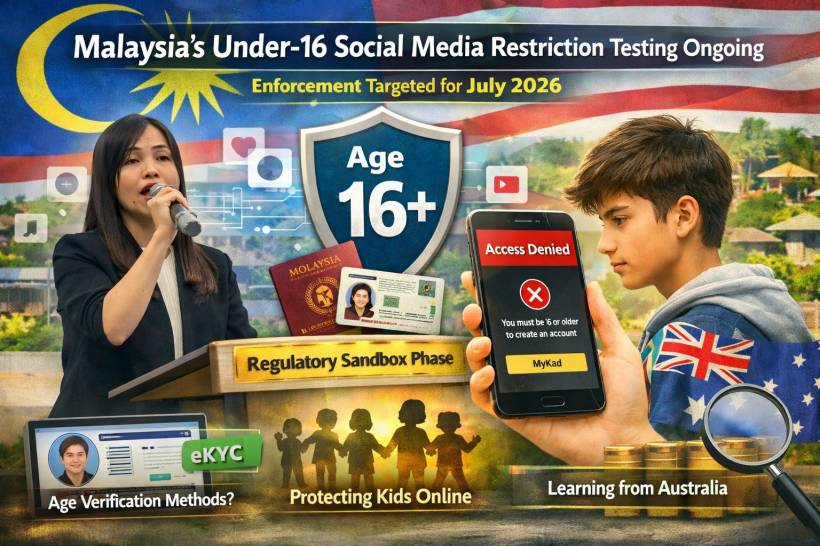
Malaysia's plan to restrict social media access for users under 16 is no longer just a "we're thinking about it" idea. According to Deputy Communications Minister Teo Nie Ching, the proposal has already moved into a regulatory sandbox phase, which is basically the government's way of saying: "We're testing this in a controlled environment first before we flip the switch for everyone."
The goal is to figure out the safest, most practical way to enforce an age limit without causing chaos for users, platforms, or parents.
What's the Current Status: Regulatory Sandbox Phase
Teo said the minimum age policy is being tested in a regulatory sandbox, with authorities working directly with social media platforms to try different implementation approaches.
Think of this as a trial run, where the government and platform providers can:
In short, it's less about making an announcement and more about figuring out the mechanics.
When Could It Actually Be Enforced? July 2026 Is the Target
Malaysia's Communications Minister Datuk Fahmi Fadzil previously pointed to a mid-year rollout, but Teo's latest update gives a clearer window: enforcement could begin as early as July 2026.
That doesn't mean every detail is final or that it will definitely happen exactly then, but it does signal the government is aiming for a firm timeline rather than leaving it open-ended.
Why Malaysia Is Doing This: The Online Safety Act 2025
Teo linked the age restriction plan to the Online Safety Act 2025 (OnSA), which took effect earlier this year.
The idea behind the Act is to reduce exposure to harmful online content by placing stronger obligations on internet service and content providers to protect vulnerable groups, especially children.
So this under-16 proposal isn't being framed as a one-off policy. It's being positioned as part of a larger approach: make platforms more responsible for what minors are exposed to and how they're protected.
The Biggest Challenge: How Do You Verify Age Without Breaking Everything?
This is where things get tricky, and it's probably why the sandbox phase matters so much.
Teo said discussions with platform providers have already started, and the current focus is identifying the most effective and safest approach to age verification.
Because age limits on paper are easy. Age limits in real life, on the internet, are where things get messy.
If verification is too weak, kids bypass it in five minutes.
If verification is too strict, everyone gets annoyed, privacy concerns explode, and platforms get blamed for over-collecting personal data.
So the sandbox is essentially the government and platforms asking: "What's the least painful method that still works?"
Will eKYC Be Part of It? Possible, But Not Confirmed
There has also been talk about using electronic Know-Your-Customer (eKYC) style verification for social media registrations. That could mean confirming identity using official documents or national ID systems such as passports, MyKad, or MyDigital ID.
However, in the most recent statements from Teo and Fahmi, eKYC wasn't directly mentioned, and nothing has been officially confirmed.
So the most accurate way to describe it right now is:
Malaysia Is Watching Australia's Approach Closely
This isn't happening in isolation either.
Malaysia has previously said it is studying Australia's online safety model as a potential reference point. Australia has taken one of the most aggressive stances globally by implementing restrictions that prevent children under 16 from accessing social media, with the policy taking effect in December last year.
Malaysia seems to be looking at how Australia handles enforcement, compliance, loopholes, and legal or practical challenges — and then deciding what could realistically be adapted locally.
What This Could Mean for Users and Parents
If Malaysia moves ahead with enforcement starting July 2026, a few things become very likely:
And the big unknown will be how strict the verification feels day-to-day.
If it becomes too complicated, people will complain.
If it's too easy to bypass, it becomes a symbolic rule instead of a protective one.
The Bottom Line
Malaysia is actively testing an under-16 social media restriction through a regulatory sandbox, and July 2026 is being positioned as the earliest likely enforcement window. The plan is tied to the Online Safety Act 2025, with age verification being the central challenge that authorities and platforms are currently trying to solve.
Expect more concrete details once the sandbox phase reveals what works — and what doesn't.











Comments 0