

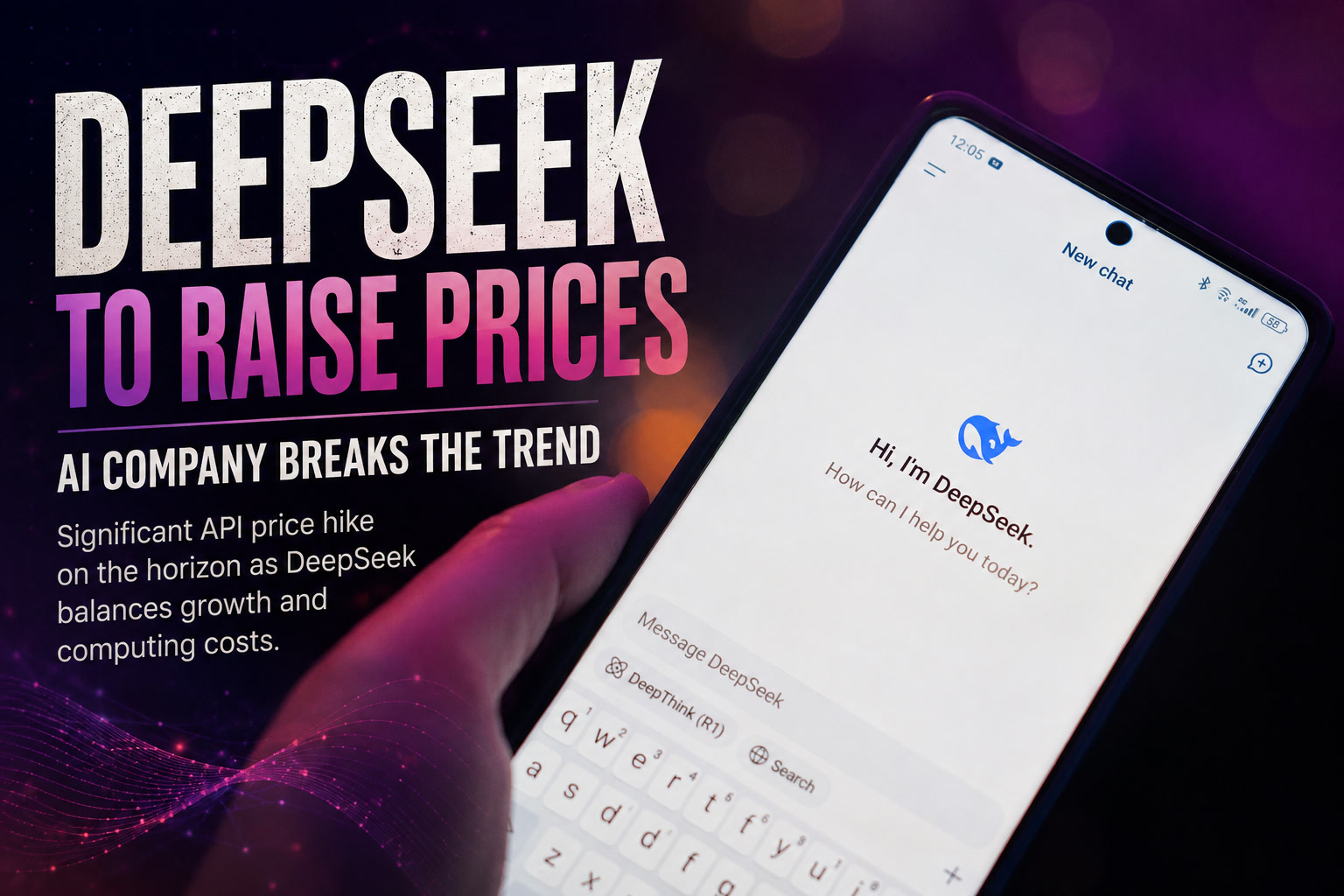
For much of the recent AI price war, DeepSeek has stood out by offering capable models at prices dramatically lower than many competing services. That positioning helped the Chinese AI company attract developers, startups and businesses looking to experiment with advanced models without committing to expensive API bills.
That advantage may soon become less pronounced.
DeepSeek has informed customers that it intends to raise the overall pricing of its API services in the near future. The company described the coming adjustment as significant, but it has not revealed the new rates or confirmed when they will take effect. Its official pricing documentation currently advises developers to plan their usage while waiting for a more detailed announcement.
A Major Change From DeepSeek's Usual Pricing Strategy
The announcement is notable because DeepSeek has built much of its market identity around affordability.
While other AI providers have introduced discounts, smaller models and more efficient processing tiers, DeepSeek pushed pricing considerably lower. Its strategy made sophisticated AI services accessible to developers who might otherwise have struggled to justify the cost of running large workloads.
DeepSeek's V4 Flash model is currently listed at US$0.14 per million uncached input tokens and US$0.28 per million output tokens. Cached input is even cheaper, at US$0.0028 per million tokens. The model supports a context window of up to one million tokens and can operate in both thinking and non-thinking modes.
At those rates, developers can process substantial amounts of text, code or business data without producing the kind of API bills normally associated with frontier AI systems.
A substantial increase would therefore represent more than a routine pricing adjustment. It could change how customers evaluate DeepSeek against competing models.
DeepSeek Has Not Yet Revealed the New Rates
The most important details remain unknown.
DeepSeek has not said whether the increase will apply equally to V4 Flash, V4 Pro and future models. It has also not clarified whether input, output and cached-token charges will rise by the same percentage.
There is currently no confirmed effective date, transition period or guarantee that existing customers will receive temporary access to the previous rates. The official notice only says that overall API pricing will increase in the near future and that customers should prepare for a significant adjustment.
That uncertainty presents a practical budgeting problem for organisations already using DeepSeek in production.
A developer experimenting with a small personal project may be able to switch providers quickly. A company that has integrated DeepSeek into customer-support systems, coding agents, document-processing pipelines or internal applications may need considerably more time to assess the financial impact and test alternatives.
Its Current Pricing Is Far Below Major Rivals
The scale of DeepSeek's existing price advantage becomes clearer when compared with other AI services.
Bloomberg's comparison placed Moonshot AI's Kimi K3 at US$3 per million input tokens and US$15 per million output tokens. Anthropic's higher-end Fable 5 model was listed at US$10 for input and US$50 for output per million tokens. DeepSeek V4 Flash, by contrast, currently costs US$0.14 and US$0.28 for those same token categories.
These models are not necessarily identical in performance, reliability, latency or intended use. A direct token-price comparison does not show the complete cost of finishing a real task.
A cheaper model may need more retries, longer prompts or additional validation. A more expensive model may complete certain assignments with fewer requests. Nevertheless, DeepSeek's prices have been so much lower that they created substantial room for experimentation, even when efficiency differences were considered.
Research firm Artificial Analysis recently described V4 Flash as one of the least expensive recognised models to operate. Its estimated cost per benchmark task was around three US cents, substantially below the comparable figures reported for Moonshot, OpenAI and Anthropic models.
The Low Prices Created a Difficult Market for Competitors
DeepSeek's pricing did more than attract customers. It forced competitors to explain why their models cost considerably more.
When a capable model is available at a fraction of the usual price, providers in the middle of the market face a particularly difficult challenge. They may not offer the strongest performance, but they also cannot compete with the lowest-cost service.
This situation has been described as a "death zone" for AI providers whose products are both more expensive and less capable than the most attractive alternatives.
DeepSeek's pricing therefore influenced expectations across the wider industry. Developers became more willing to question whether high inference charges accurately reflected operating costs or whether some providers were protecting unusually large margins.
The forthcoming increase suggests that ultra-low pricing may be difficult to maintain indefinitely, especially as customer demand grows and models become more computationally demanding.
Affordable AI Still Requires Expensive Infrastructure
Every API request consumes real computing resources.
AI companies must purchase or lease accelerators, operate data centres, maintain high-speed networks, store large volumes of data and provide enough spare capacity to handle sudden changes in demand. They also need engineers, safety teams, customer support and continuous model development.
A model may be efficient, but millions of users generating large prompts and outputs can still create substantial infrastructure costs.
DeepSeek's V4 models support context windows of up to one million tokens. While that capability is valuable for analysing large codebases or lengthy documents, long-context requests can place additional pressure on memory and computing infrastructure.
DeepSeek must therefore balance three competing goals: keeping prices attractive, maintaining reliable service and generating enough revenue to finance future growth.
The planned increase may indicate that its earlier rates were effective for rapid adoption but less suitable as a long-term commercial model.
From Market Disruption to Commercial Sustainability
Chinese AI companies have competed aggressively through inexpensive and openly available models. This helped them attract developers globally while challenging the assumption that the most capable AI systems must always come with premium pricing.
However, investors increasingly expect these companies to show a path towards sustainable revenue.
According to reports carrying Bloomberg's coverage, DeepSeek's decision could mark an important turning point for China's AI industry. Startups that initially focused on low prices and rapid adoption may now be under pressure to prove that they can build commercially viable businesses.
DeepSeek is also reportedly pursuing a major fundraising effort while preparing for a possible initial public offering. Should those plans proceed, founder Liang Wenfeng would need to satisfy investors while continuing to fund infrastructure, research and international expansion.
That does not necessarily mean DeepSeek is abandoning its affordable approach. Even after a sizeable increase, its pricing could remain below many competing services.
The real question is how large the gap will be once the new rate card is published.
Developers May Need to Recalculate Their AI Costs
For individual users, a change measured in fractions of a dollar may initially seem minor. At production scale, however, those differences can become substantial.
Applications using retrieval-augmented generation, coding agents or document analysis may repeatedly send large amounts of context to the model. An AI agent may inspect files, generate a plan, run tools, review results and retry failed actions during a single task.
The visible response might contain only a few hundred words, while the underlying workflow processes millions of tokens.
Businesses currently relying on DeepSeek should therefore examine:
The cheapest advertised token rate is not always the cheapest total solution. Migration work, testing, slower responses and differences in output quality can all influence the actual cost.
Third-Party Providers Could Offer Another Option
DeepSeek models are also available through third-party platforms that host and serve the models using their own infrastructure.
Those providers determine their own prices, capacity limits and service conditions. Some may continue offering competitive rates after DeepSeek changes its direct API pricing, while others may adjust their charges to reflect higher demand or operating costs.
Using a third-party host introduces additional considerations. Developers must compare data-handling policies, geographical availability, uptime, performance and whether the hosted model behaves consistently with DeepSeek's official service.
The same model name does not always guarantee an identical experience across providers. Differences in quantisation, configuration, context limits and supporting infrastructure can affect both quality and reliability.
Organisations handling confidential information should also verify where data is processed and whether the provider meets their security and compliance requirements.
Could Customers Move to Cheaper Alternatives?
A large increase may encourage developers to reconsider their dependence on DeepSeek, particularly if another provider offers acceptable performance at a lower price.
However, switching is not always straightforward.
Applications may rely on DeepSeek-specific behaviour, prompt formats, output patterns or performance characteristics. Even where providers support OpenAI-compatible APIs, developers still need to evaluate response quality, tool calling, structured output and error handling.
Businesses may therefore remain with DeepSeek if the model continues delivering better overall value, even at a higher price.
DeepSeek also benefits from strong recognition among developers and a growing ecosystem around its models. Its long context window, reasoning options and compatibility with coding tools may help retain users who value those capabilities more than the lowest possible token rate.
The Price Increase Could Test Customer Loyalty
DeepSeek's earlier pricing made adoption an easy decision for many developers. The financial risk of testing the service was extremely low, and businesses could run large experiments without major commitments.
A higher price will change that calculation.
Customers will begin comparing DeepSeek more closely on reliability, latency, support, privacy and task completion—not merely on the cost of individual tokens. The company will need to demonstrate that its models offer enough value to justify the new rates.
This could ultimately be healthy for the market. Extremely low introductory pricing can accelerate adoption, but sustainable competition also requires companies to fund infrastructure and continue improving their products.
The danger for DeepSeek is that a sudden or poorly explained increase could push customers to diversify before the company has established stronger long-term relationships with them.
Final Thoughts
DeepSeek's planned API price increase signals a potentially important transition for both the company and the wider AI industry.
The firm entered the global conversation by proving that capable AI could be offered at dramatically lower prices. That strategy placed pressure on competitors, challenged existing business models and gave developers access to powerful tools at very little cost.
Now, DeepSeek must show whether it can convert that popularity into a sustainable business without losing the affordability that made it stand out.
Until the company publishes the new prices and effective date, it is impossible to determine the true impact. A large percentage increase could still leave DeepSeek cheaper than many rivals because its current rates are unusually low.
For developers and businesses, however, the message is clear: DeepSeek's present pricing should no longer be treated as permanent. Organisations using the API at scale should review their consumption, prepare alternative options and wait for the official rate card before making long-term cost assumptions.











Comments 0