

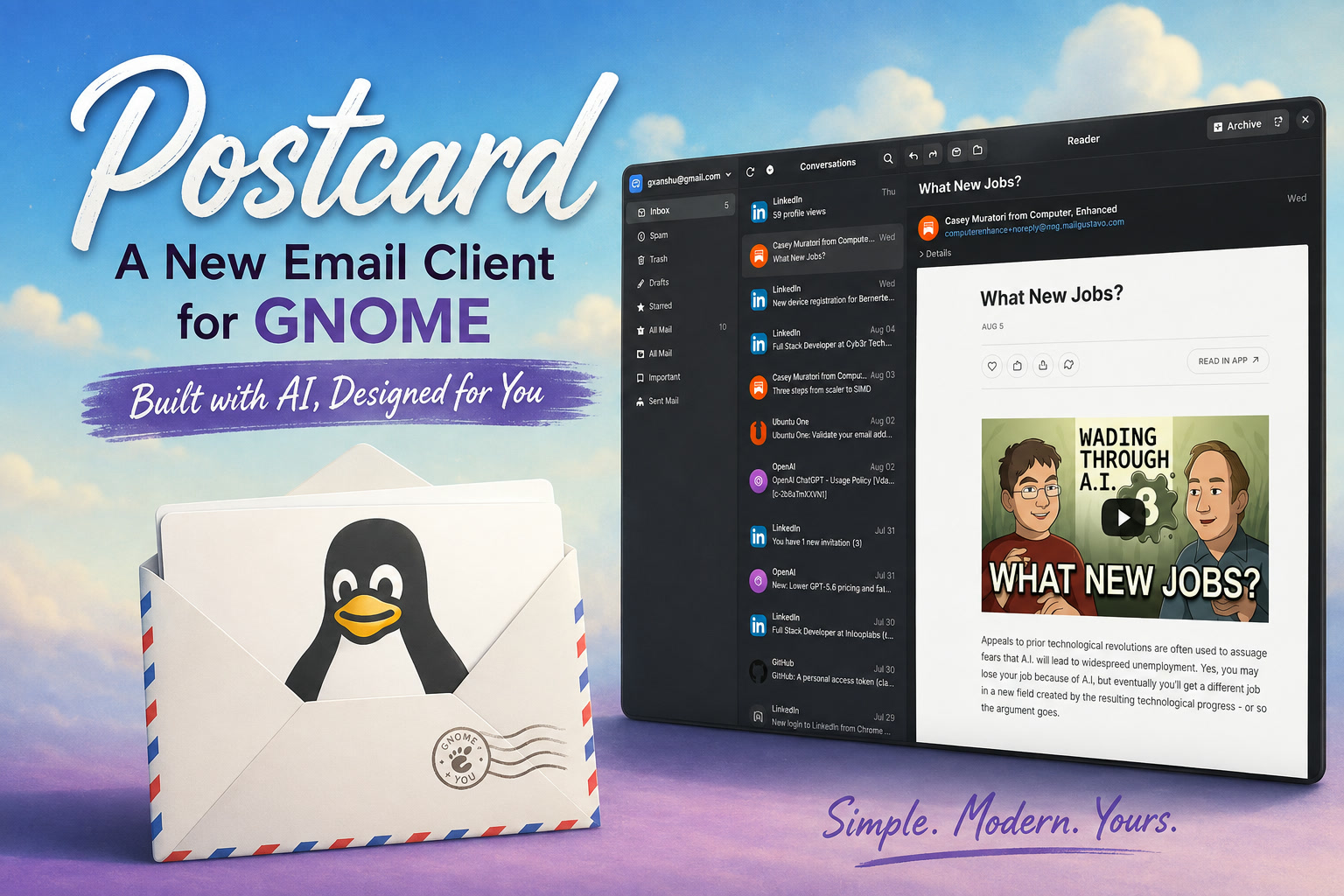
The Linux desktop has no shortage of email clients, but finding one that feels truly modern, lightweight and closely integrated with GNOME can still be surprisingly difficult. A new open-source application called Postcard is attempting to fill that gap.
Created by solo developer gxanshu, Postcard is a modern GTK-based email client designed specifically around the GNOME desktop experience. What makes the project particularly interesting is that its developer is also openly acknowledging the use of AI coding tools during development.
Rather than hiding that involvement, the project treats AI assistance as part of the development process while still publishing the source code for anyone to inspect.
The result is an email client that already looks polished and familiar, although its developer is equally clear that Postcard remains a young project that should probably not yet become anyone's only email application.
A Modern Email Client Built for GNOME
Postcard is written primarily in Python and uses GTK4 together with libadwaita, allowing it to closely follow GNOME's modern visual design language.
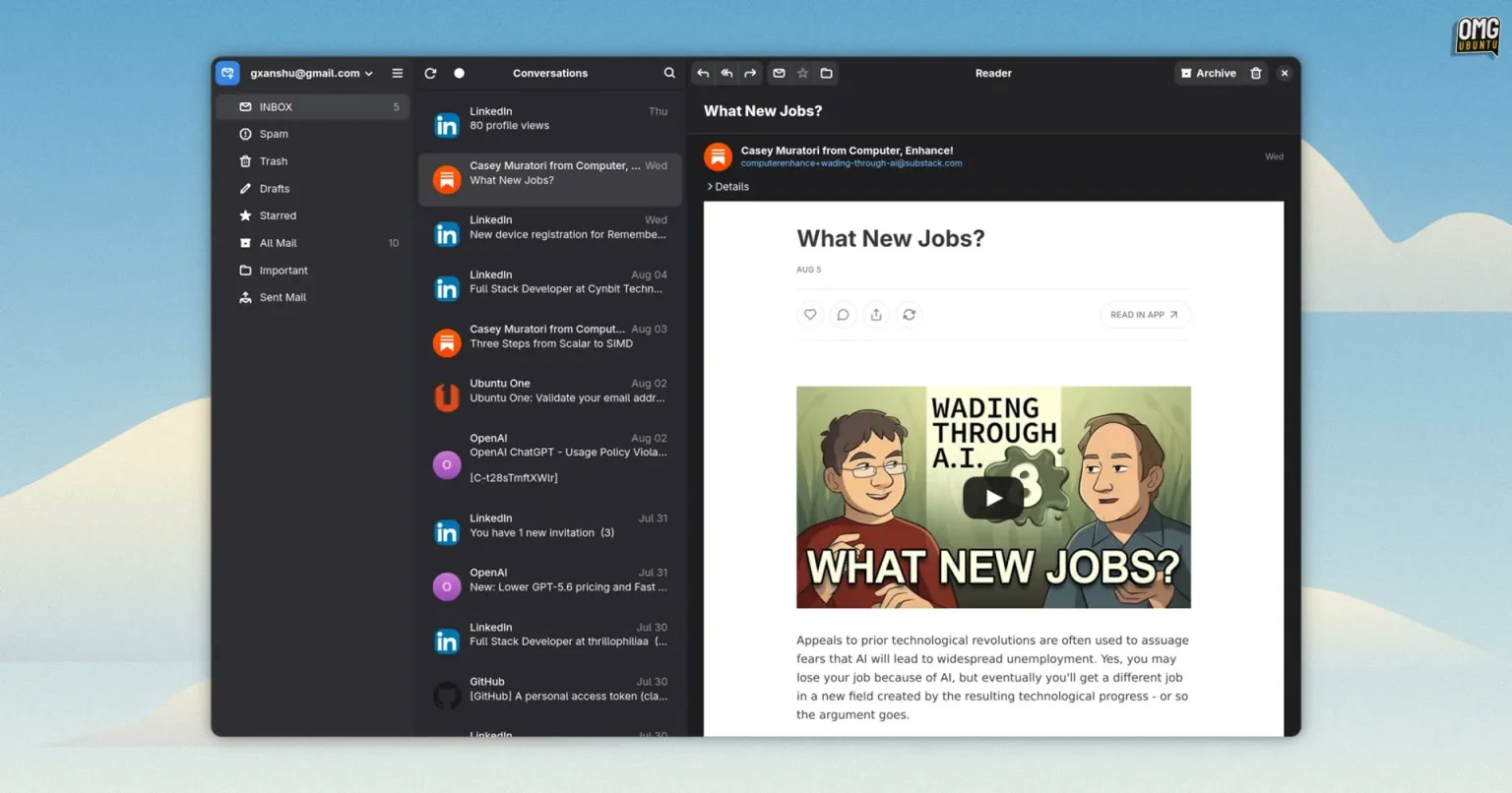
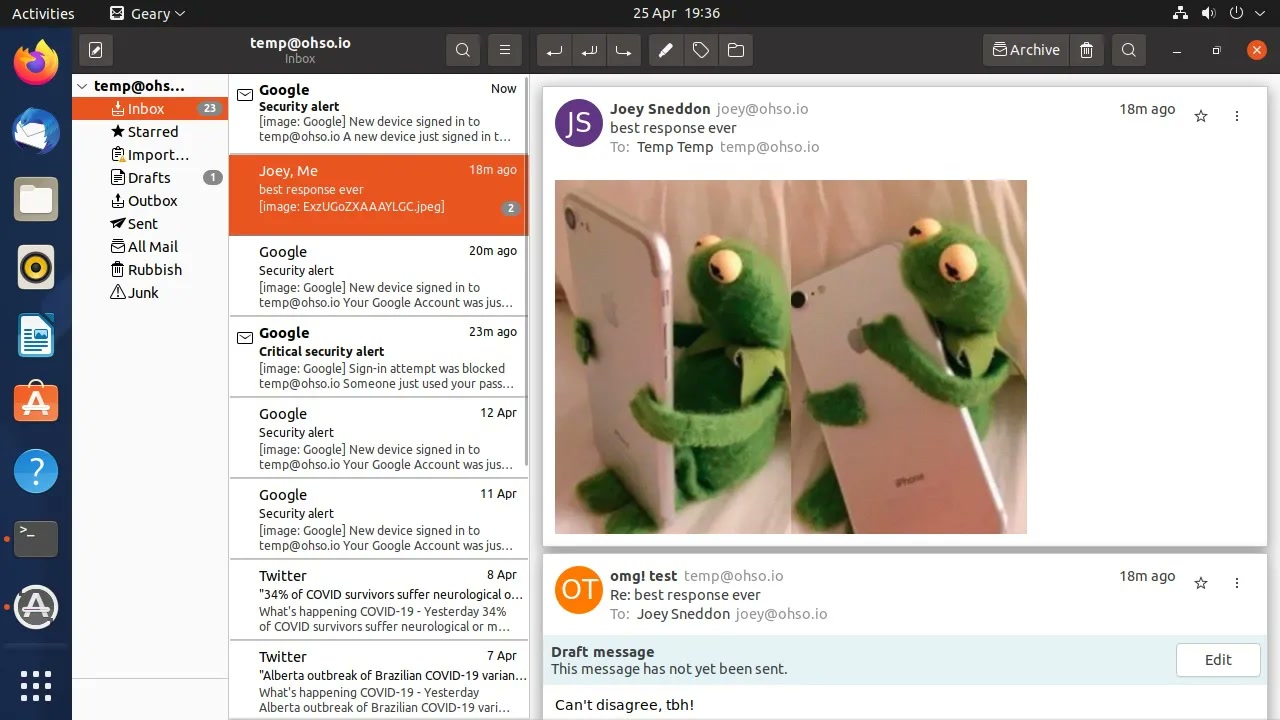
The interface will immediately look familiar to anyone who previously used Geary.
Postcard adopts a three-column layout:
It is a straightforward arrangement that works particularly well on larger desktop displays.
The application also follows the GNOME Human Interface Guidelines, meaning menus, controls and navigation should feel consistent with other modern GNOME applications.
For users who prefer software that visually belongs on the desktop rather than feeling like a cross-platform application dropped on top of Linux, that consistency can be a major attraction.
The Technology Behind Postcard Is Relatively Traditional
Despite the AI-assisted development story, the underlying technologies are fairly conventional.
Postcard uses Python's imaplib and smtplib libraries for receiving and sending email through IMAP and SMTP.
Email content is indexed locally using SQLite, allowing the application to provide search capabilities without relying entirely on remote services.
HTML emails are rendered through WebKitGTK, while passwords are stored securely using libsecret, the same secret-storage system commonly used across GNOME applications.
Nothing about this architecture is especially exotic.
That may actually be a good thing.
Email is one of those applications where reliability and predictable behaviour are often more valuable than unusual technical experimentation.
Gmail Works Through GNOME Online Accounts
Postcard supports standard email providers using IMAP and SMTP.
Gmail integration is handled through GNOME Online Accounts.
If your Google account is already configured through GNOME's account settings, Postcard can detect and use it rather than requiring users to configure everything manually again.
Multiple email accounts are supported as well.
However, one notable limitation is the lack of a unified inbox.
If you have several accounts, Postcard does not currently combine all incoming messages into a single large inbox.
You instead need to navigate between accounts.
That will probably be fine for someone managing one or two addresses, but users juggling many personal and work accounts may find it restrictive.
The Basic Email Features Are Already There
Postcard already includes most of the features expected from a simple everyday mail client.
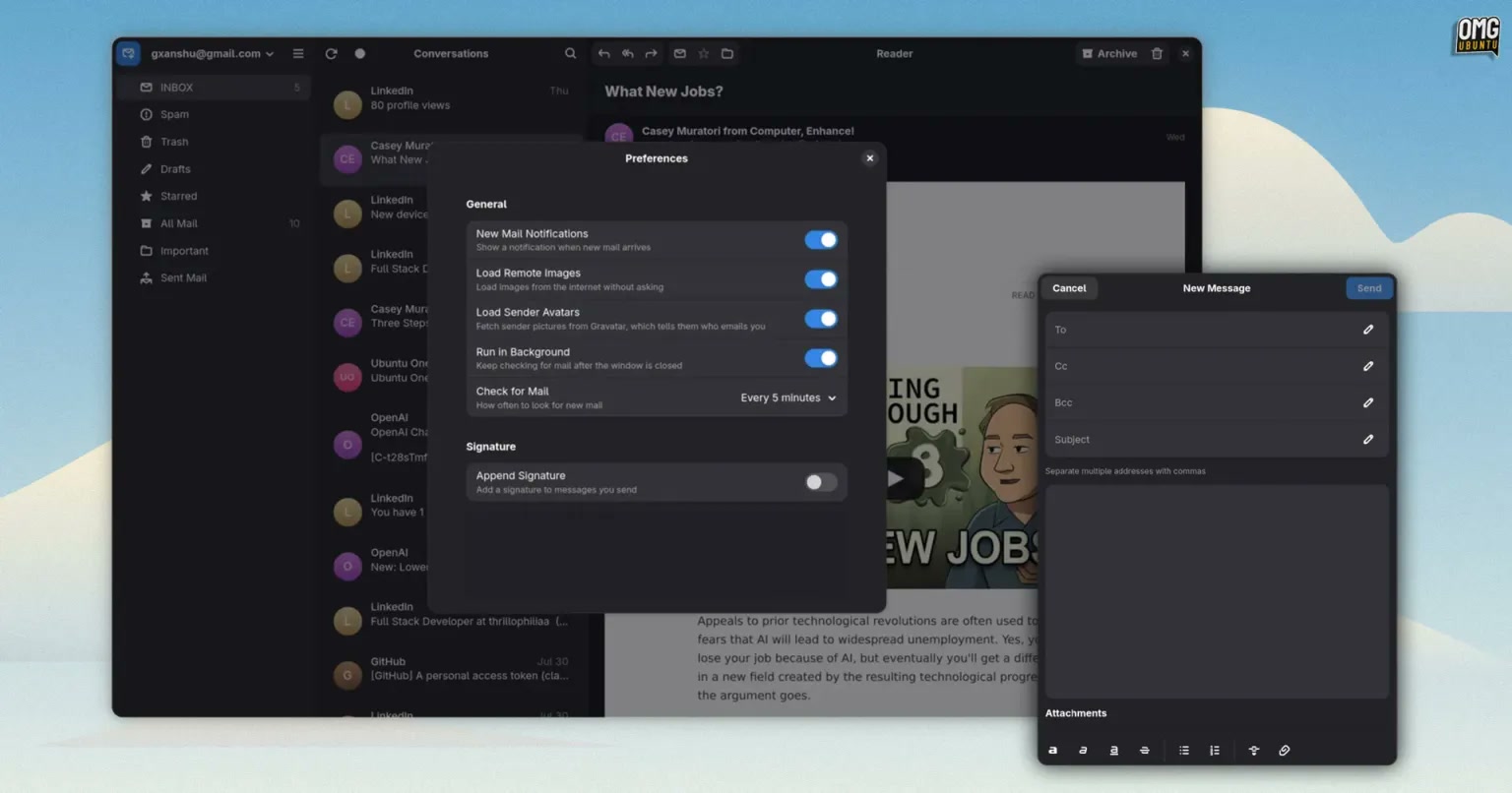
Users can receive notifications when new mail arrives, control synchronisation behaviour, search messages and view threaded conversations.
The message composer supports rich-text formatting along with the usual subject, Cc and Bcc fields.
Attachments are also supported.
The Preferences window remains relatively modest, but it includes a few useful controls.
Users can define an email signature and choose whether remote images should automatically load inside messages.
Blocking remote images is particularly useful for privacy because email marketers frequently embed tiny invisible images known as tracking pixels.
When those images load, the sender can potentially determine that the message was opened.
Postcard can prevent that behaviour by blocking external images.
There is also an option to keep the application running in the background after its main window has been closed, allowing it to maintain mail connections and continue receiving notifications.
Some Power-User Features Are Still Missing
Postcard is currently much simpler than mature email clients such as Thunderbird or Evolution.
There is no built-in PGP or GPG configuration for encrypted email.
There is no integrated calendar.
Client-side filtering rules are absent.
Exchange Web Services support is also not planned, according to the developer.
POP support is similarly not mentioned.
For someone who manages large amounts of corporate email or depends on advanced message rules, encryption and calendar integration, Postcard probably will not replace an established client anytime soon.
But that may not necessarily be the goal.
There is still a sizeable group of Linux users who simply want a clean application that sends and receives email without turning into an entire productivity suite.
For those users, Postcard's simplicity may actually be attractive.
The Developer Says Not to Depend on It Yet
The project is still evolving quickly.
Postcard reportedly received five updates in only two weeks, showing that development remains very active.
The project's documentation itself advises users to try the application for a few weeks rather than immediately trusting it as their sole email client.
That is sensible advice.
Email is not like experimenting with a calculator or weather application.
A bug in an email client can potentially affect important messages, attachments, drafts or synchronisation.
Users testing Postcard should therefore keep access to their existing email service through another client or the provider's web interface until they are confident that everything is working reliably.
The AI-Assisted Development Debate Is Hard to Ignore
Postcard also enters the increasingly complicated discussion surrounding software created with AI coding tools.
Modern coding assistants can dramatically accelerate development.
A single developer can now build interfaces, generate boilerplate code, troubleshoot errors and explore unfamiliar libraries much faster than before.
That means applications that may once have required a small development team can now potentially be created by one motivated person.
The difficult part often comes later.
Getting a project to 80% completion can happen surprisingly quickly.
Maintaining the final 20% is another matter entirely.
Users begin reporting unusual bugs.
Different Linux distributions behave differently.
Accessibility problems appear.
Packaging breaks.
Translations are requested.
Feature requests accumulate.
Security problems need to be fixed.
The work gradually moves away from exciting feature development and toward long-term maintenance.
That is where many experimental AI-assisted projects struggle.
"Vibe Coded" Software Has Developed a Reputation
The phrase "vibe coding" has increasingly been used to describe software created with substantial assistance from generative AI tools.
The term can mean different things depending on who uses it.
Sometimes it simply describes developers using AI as another programming assistant.
Other times it refers to people generating large portions of applications without fully understanding the resulting code.
The latter has understandably created concerns.
Flathub reportedly stopped accepting AI-assisted submissions under certain circumstances, while Codeberg has also taken measures against low-maintenance AI-generated projects because abandoned repositories still consume infrastructure and storage resources.
Research following rejected AI-assisted applications reportedly found that many were later abandoned.
That reinforces the concern that AI makes it extremely easy to start projects but does not necessarily make developers more willing to maintain them for years.
Postcard's Transparency Is Refreshing
One positive aspect of Postcard is that the developer is not pretending AI played no role.
The project's creator is transparent about using AI coding tools during development.
That honesty matters.
Users can decide for themselves whether they are comfortable running an application developed this way, and because Postcard is open source, technically inclined users can inspect the code directly.
AI assistance itself does not automatically make software unreliable.
Experienced developers increasingly use tools such as Claude, ChatGPT, GitHub Copilot and other coding assistants every day.
The more important questions are whether the developer understands the resulting code, tests it properly and remains committed to maintaining the project.
Postcard's long-term success will therefore depend far more on its maintenance than on which tools helped write the first version.
Installing Postcard on Ubuntu and Other Linux Distributions
Postcard is distributed as a Flatpak, although it is not currently hosted on Flathub.
Users who want to experiment with it can add the project's own Flatpak repository:
Postcard can then be installed with:
The project also provides a .flatpakref file through its GitHub releases.
That file can be opened using compatible Flatpak software managers such as GNOME Software or Bazaar.
Because the application comes from its own repository rather than Flathub, users should remember that updates and package maintenance depend directly on the project developer.
GNOME Users Have Been Waiting for More Email Options
Postcard is not the only recent attempt to create a modern GTK email client.
Projects such as Post and Vireo are also trying to fill the space left by slower development around older GNOME email applications.
Geary remains perhaps the best-known example of a lightweight GNOME mail client, but its development pace has slowed considerably.
Meanwhile, Thunderbird has become substantially more polished, but it still carries its own cross-platform design identity rather than feeling completely native to GNOME.
Evolution remains extremely capable but can feel excessive for someone who simply wants email.
That leaves room for something lighter.
If Postcard continues improving, it could eventually become an attractive middle ground: more modern and focused than Evolution, while remaining more deeply integrated into GNOME than broader cross-platform alternatives.
AI Could Help Revive Small Desktop Software Projects
There is also a broader positive side to AI-assisted development that should not be overlooked.
Traditional desktop applications have become increasingly difficult for small independent developers to justify.
Users expect polished interfaces, accessibility support, frequent updates, multiple account types and reliable security.
Building all of that alone can take enormous amounts of time.
AI tools may allow individual developers to experiment with ideas that would otherwise never get built.
That could be particularly valuable for Linux, where many useful applications serve relatively small audiences and therefore cannot support large commercial development teams.
The challenge is ensuring those applications survive beyond the initial excitement.
AI can help someone write a mail client.
It cannot force them to maintain it five years later.
Final Thoughts
Postcard is an interesting addition to the growing collection of modern GNOME applications.
Its clean GTK4 and libadwaita interface, IMAP and SMTP support, local search, Gmail integration and privacy controls already make it capable enough for basic email use.
At the same time, important features remain missing, and the developer openly recommends treating the application as something to test rather than something to immediately trust with your entire email workflow.
The AI-assisted development angle will inevitably attract debate.
Some users will see it as another example of disposable "vibe coded" software.
Others may see exactly the opposite: AI giving a solo developer enough leverage to create a polished Linux application that otherwise might never have existed.
For Postcard, the real test will not be how quickly it was created.
It will be whether development continues once the easy features are finished, the difficult bug reports arrive and users begin depending on it.
If the project survives that stage, GNOME may finally have another genuinely modern lightweight email client worth keeping around.











Comments 1