

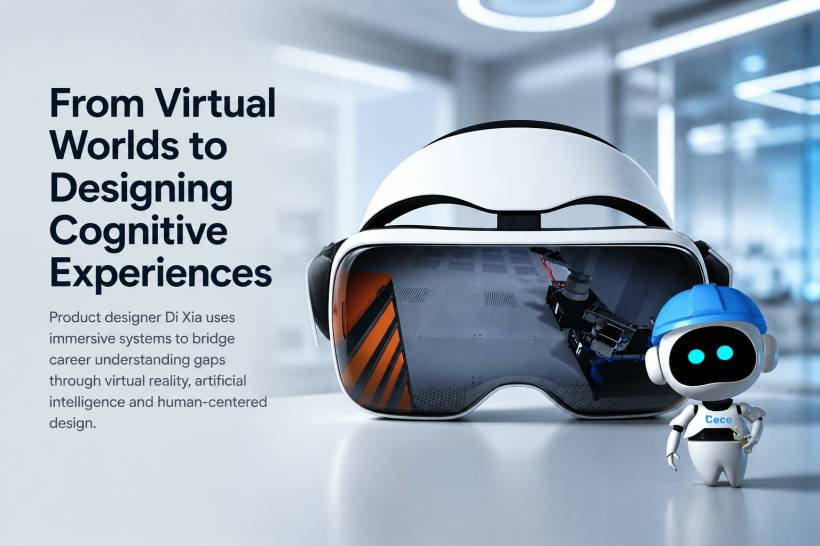
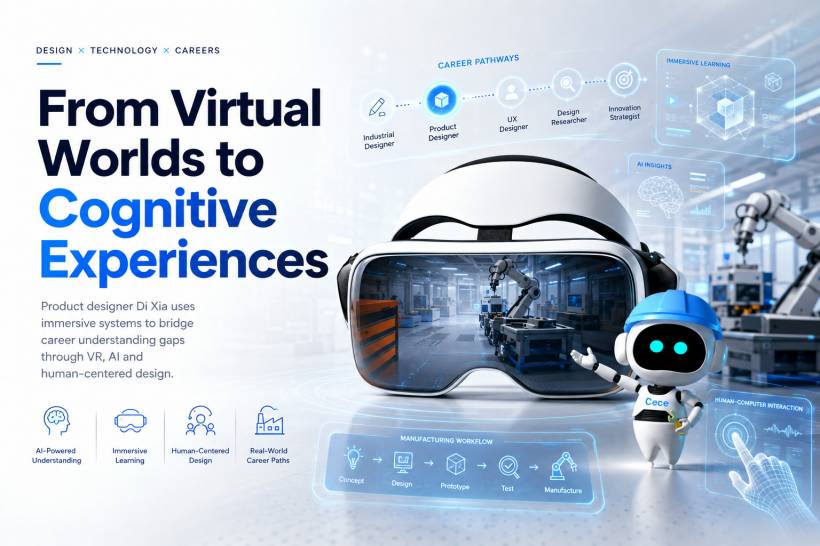
Product Designer Di Xia has received recognition at the 2026 A' Design Award & Competition for Cece, an immersive career learning system that uses virtual reality and artificial intelligence to help people better understand complex career pathways.
The award marks an important moment in Di Xia's design journey. However, it is not only a recognition of one project. It also reflects a deeper design philosophy that has shaped his work across virtual world creation, human-computer interaction, AI-driven experiences and cognitive design.
At the heart of his work is a simple but powerful question:
How can complex systems become easier for people to see, explore and understand?
That question eventually became the foundation for Cece.
Turning Career Learning Into an Immersive Experience
Cece was developed from a real problem found in career education and workforce preparation.
During his studies in the Master of Human-Computer Interaction and Design program at the University of Washington, Di Xia and his team conducted field research into manufacturing workforce training environments. Their research found a recurring gap between how manufacturing careers actually work and how those careers are usually explained to students or job seekers.
Manufacturing roles often require spatial awareness, collaboration, decision-making and familiarity with real workflows. Yet career education is still commonly delivered through static formats such as text, diagrams, videos or classroom explanations.
This creates a disconnect. Job seekers may not fully understand what a role involves, while employers may struggle to find candidates who understand industry expectations.
For Di Xia, this was not only an education issue. It was a design issue.
Instead of adding more written explanations or longer videos, he explored a different approach: create an environment that people could enter, interact with and learn from directly.
Why Traditional Career Education Often Falls Short
Many career pathways are difficult to understand from the outside. This is especially true in industries where the work involves equipment, processes, spatial relationships and team-based decision-making.
A job title alone rarely explains what a person actually does every day. Even detailed descriptions may fail to show the environment, pressure, workflow and decision points involved in the role.
This is where Cece tries to make a difference. It transforms career exploration from passive reading into active participation.
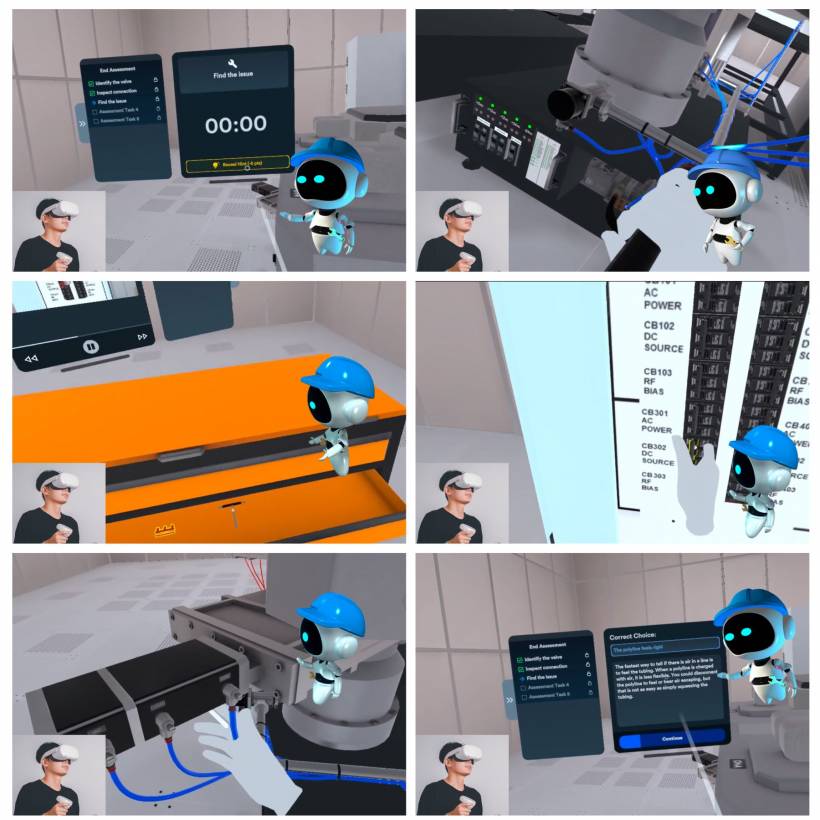
Instead of only learning about a manufacturing role, users can experience parts of the work environment themselves. They can observe equipment, understand workflows, make decisions and see the results of those decisions inside an immersive system.
Through this process, career learning becomes more concrete. Users are not simply told what a job is. They are guided to understand it through experience.
Using VR and AI to Bridge Understanding Gaps
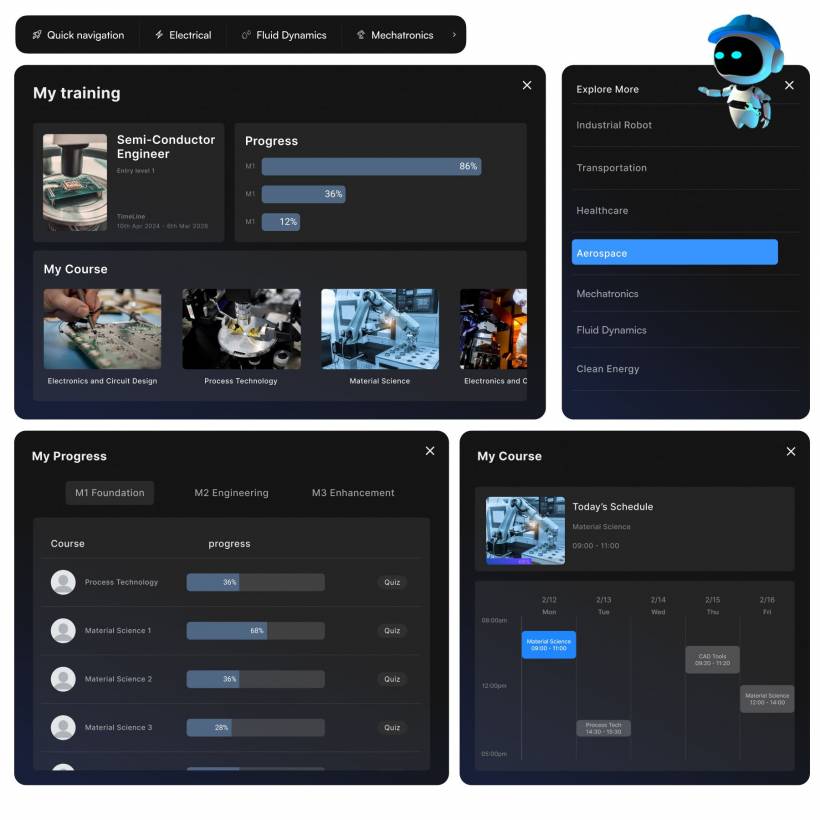
Cece combines immersive virtual reality with artificial intelligence to help users navigate complex career information in a more intuitive way.
The goal is not to remove complexity. Manufacturing and technical careers are naturally complex. Instead, the goal is to create pathways through that complexity so users can understand it step by step.
Within the system, users can explore professional environments in a more structured and interactive manner. This helps them build a clearer mental model of how different roles, tools and workflows connect.
Cece addresses several common gaps in career learning:
• The gap between school preparation and industry expectations
• The gap between employer needs and job seeker understanding
• The gap between abstract information and practical decision-making
By turning career exploration into an experience, the system gives users a better chance to understand not only what a role is, but also how it feels to work within that environment.
A Human-Centered Approach to Complex Systems
Di Xia's design approach is grounded in the belief that design should solve real problems for real people.
That means he does not begin with technology for its own sake. Instead, he starts with user research, identifies actual pain points and then decides what role technology should play.
This is important because VR and AI can easily become flashy tools without meaningful purpose. In Cece, the technology is used to support understanding, not to impress users with novelty.
The system is built around human needs: clarity, exploration, decision-making and confidence.
This research-driven approach allowed Cece to find a meaningful intersection between technology and learning. It does not simplify the professional world into something unrealistic. Instead, it helps users gradually make sense of real-world complexity through interaction.
From Game Worlds to Real-World Learning Systems
Before moving deeper into human-computer interaction and cognitive experience design, Di Xia spent years in the game industry.
He started as a 3D artist and later moved into leadership roles on large-scale projects. That background gave him years of experience in building virtual worlds, shaping spatial experiences and understanding how users behave in interactive environments.
His work included contributions to internationally recognised AAA franchises such as Heroes of Might and Magic and the Fable series. He also served as Lead Artist on Fable HD Remaster.
These projects were not only about visual production. They required a deep understanding of how environments guide attention, how interfaces support action and how users interpret visual cues inside interactive systems.
For Di Xia, game development became a practical training ground for designing experiences that people could navigate, understand and emotionally connect with.
Lessons From Large-Scale Online Games
One notable example from Di Xia's career is Xian Meng Qi Yuan, a large-scale 3D fantasy MMORPG mobile game where he served as Art Lead.
In that role, he contributed to world-building, visual development and UI interaction design. The game achieved strong commercial success, reportedly accumulating more than 20 million Android downloads and ranking among leading fantasy MMORPG titles in China.
Working on projects of this scale required more than artistic skill. It involved understanding how millions of users move through virtual spaces, respond to visual systems, interact with interfaces and remain engaged over time.
Those experiences helped shape Di Xia's broader view of design. He learned that immersive systems can do more than entertain. They can guide behaviour, support learning and create shared understanding.
That insight later became central to his transition from entertainment-focused virtual worlds to real-world cognitive experience design.
A Turning Point at the University of Washington
Di Xia's graduate studies at the University of Washington marked a major turning point in his career.
Instead of focusing only on building virtual worlds for games, he began exploring how the same design principles could be applied to more practical human challenges.
The tools were familiar: spatial storytelling, visual communication, interaction design and systems thinking. But the purpose became different.
Rather than asking how to make a game more engaging, he began asking how immersive experiences could help people learn, decide and understand.
"I've always felt that I could do more meaningful work," he says.
That shift helped him connect his past experience in game development with a new focus on human-computer interaction, education and AI-supported decision-making.
Designing for Understanding, Not Just Interaction
A consistent theme in Di Xia's career is the idea that interaction should lead to understanding.
In games, users learn by exploring. They understand a world through movement, feedback, choices and consequences. Di Xia applies that same principle to non-game environments.
Cece reflects this philosophy clearly. It treats career understanding as something users can build through experience, rather than something they must absorb passively.
This approach is especially relevant today as industries become more complex. Many fields now require workers to understand systems, workflows, technologies and collaboration patterns that are difficult to explain through traditional training methods alone.
Immersive systems can make these invisible structures more visible.
Working at the Intersection of AI, UX and Media Design
Today, Di Xia works at Freemind Seattle as a Senior Product Designer, UX Designer and Media Designer.
His work covers enterprise technology experiences, multimodal AI interaction systems, digital interfaces, spatial media and real-time visual systems.
This combination reflects the direction of his broader career. He is no longer focused on one design discipline only. Instead, his work sits at the intersection of multiple experience layers:
• Spatial experience
• AI-assisted interaction
• Media systems
• Human decision-making
• Enterprise technology
The common goal remains the same: helping people better understand and navigate increasingly complex digital and physical environments.
Why Projects Like Cece Matter
As industries such as manufacturing continue to evolve, the gap between education and workforce expectations can become harder to close.
Students and job seekers may know the name of a career, but not the real environment behind it. Employers may struggle to communicate what they need. Educators may find it difficult to represent complex roles through traditional teaching materials.
Projects like Cece suggest a different future for career learning.
Instead of only reading about a job, users may be able to step inside a simulated environment, interact with workflows and gain a more realistic understanding of what the career involves.
This could be especially valuable for industries where work is highly visual, spatial, technical or collaborative.
Creating Clarity Within Complexity
Di Xia's work shows how immersive design can move beyond entertainment and become a tool for understanding.
From AAA game worlds to AI-supported career learning systems, his career has followed a consistent direction: building experiences that help people make sense of complex environments.
Cece is an example of that philosophy in action. It uses virtual reality and artificial intelligence not as decorative technologies, but as tools to bridge understanding gaps between education, industry and real-world career expectations.
As AI and immersive systems become more common in learning and workforce development, Di Xia's approach points toward a future where people do not just consume information. They experience it, explore it and gradually build understanding through interaction.
At the center of his design philosophy is a clear mission: to create clarity where there is confusion, and to use experience as a language for helping people understand the systems around them.











Comments 0