

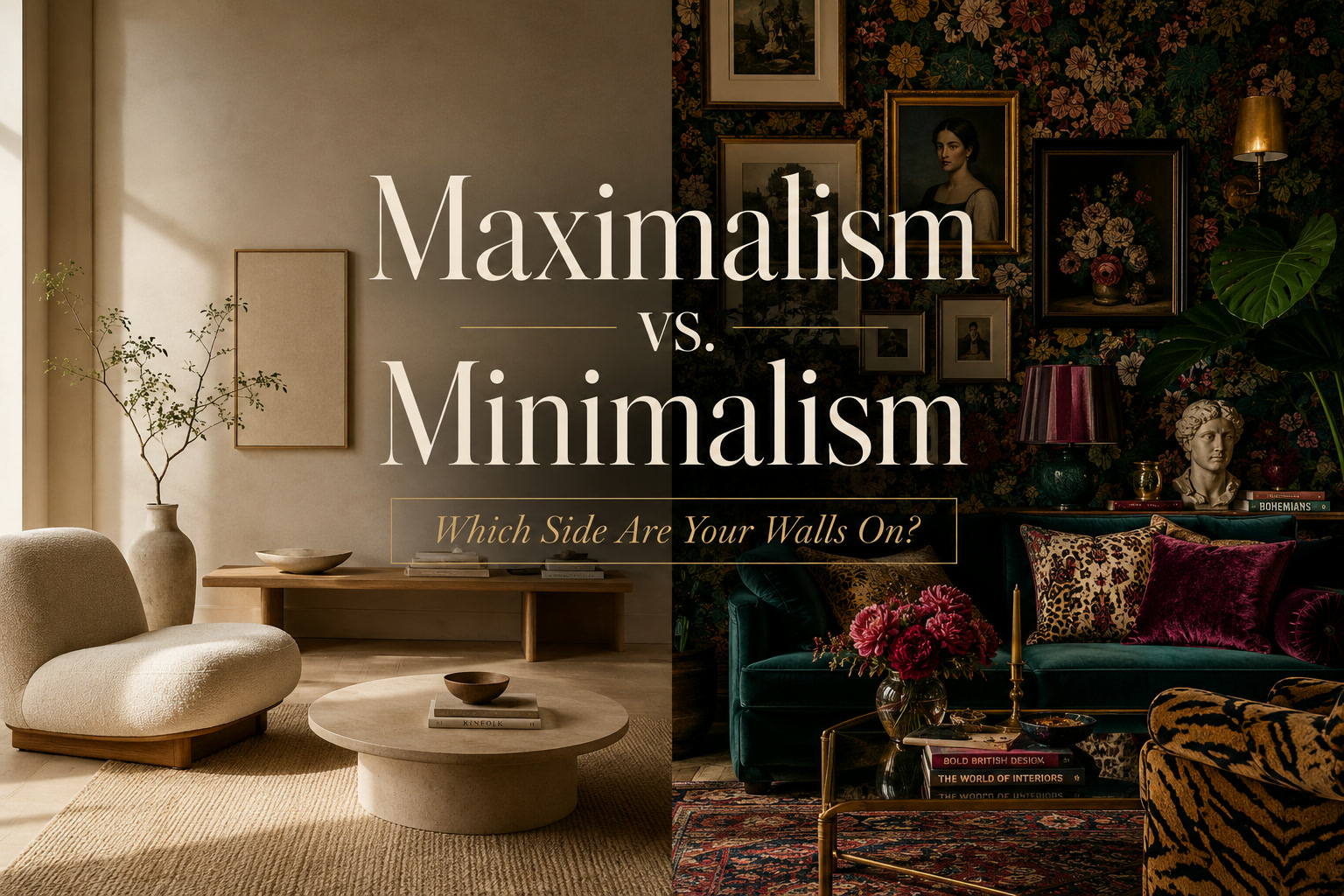
Interior design often presents maximalism and minimalism as opposing trends, as though one must eventually defeat the other. In reality, neither approach is universally better. They simply create different experiences.
Minimalism gives a room breathing space. Maximalism surrounds it with personality. One communicates through restraint, while the other speaks through pattern, colour and visual richness.
The better choice depends less on what is fashionable and more on the room itself: its size, natural light, purpose and the feeling you want when you enter it. In either case, the walls usually make the strongest statement.
Two Different Ways to Control a Room
Minimalism is based on editing. It removes unnecessary visual elements so the remaining details have more impact.
Maximalism works through careful addition. It brings together colour, pattern, artwork and texture to create an immersive environment.
Both approaches require discipline.
A poorly designed minimalist room can feel empty, cold or unfinished. A poorly planned maximalist space can become visually exhausting. The problem is not the style—it is the lack of intention behind it.
Good minimalism controls a room through subtraction. Good maximalism controls it through curation.
That is the real difference.
Your Walls Set the Direction
Furniture and accessories contribute to a room's personality, but walls establish its visual foundation.
A large stretch of warm, plain colour immediately creates a quieter atmosphere. A richly patterned wallpaper can make the same room feel dramatic, intimate and full of movement.
Once the wall treatment is decided, many of the remaining design choices naturally follow.
A bold wall may require simpler furniture and fewer decorative objects. A restrained wall gives artwork, lighting and furniture more opportunity to stand out.
This is why choosing a wall finish should not be treated as an afterthought. It determines how loudly—or quietly—the room communicates.
When Minimalism Works Best
Minimalism often suits rooms intended for rest, concentration or recovery.
Bedrooms, studies and small spaces may benefit from a calmer backdrop, particularly when there is already limited natural light or visual space.
Plain walls can make a room feel larger because the eye is not interrupted by repeated patterns. Soft neutral colours, muted greens, warm whites and gentle earth tones can also create a more restful environment.
However, minimalism does not require everything to be white or beige.
A deep clay, muted blue or warm grey can still feel restrained when used consistently. The goal is not to remove colour but to reduce unnecessary competition.
Minimalism works particularly well when the room already contains architectural details, attractive furniture or natural materials that deserve attention.
How to Keep Minimalism From Feeling Cold
The most common mistake is assuming that minimalism means removing almost everything.
A room may look tidy yet still feel uncomfortable when it lacks warmth, texture or personal meaning.
The solution is not necessarily adding more objects. It is selecting richer materials.
Wood, linen, wool, stone, woven fabrics and handmade ceramics can make a simple room feel layered without making it busy. Warm lighting also softens plain walls and prevents them from looking clinical.
One carefully chosen artwork may create more personality than a wall covered with unrelated decorations.
Minimalism is not the absence of character. It is character presented with space around it.
When Maximalism Makes Sense
Maximalism is well suited to rooms where energy, conversation and personality are important.
Living rooms, dining areas, creative spaces and entrance halls can often support stronger patterns and deeper colours because these spaces are designed to feel active and expressive.
A maximalist room can also feel comforting rather than overwhelming. Dark florals, botanical prints or richly coloured walls may create a cocoon-like atmosphere, especially when supported by warm lamps and soft furnishings.
Small rooms are not automatically unsuitable for bold design either.
In some cases, trying to make a compact room appear larger can result in a space with little personality. Embracing its smaller proportions through an enveloping colour or wallpaper may create a more memorable result.
The important question is not whether the room is small. It is whether you want it to feel open and quiet or intimate and immersive.
Maximalism Is Not the Same as Clutter
The word "maximalism" is sometimes misunderstood as permission to place everything in one room.
That is not good maximalist design.
Successful maximalism relies on relationships between colours, patterns and materials. The room may contain many visual elements, but they should feel connected.
A dramatic jungle-print wallpaper, for example, may already provide enough movement. Pairing it with simpler furniture and repeated colours from the pattern can create balance.
Problems arise when every object demands equal attention.
Maximalism works best when there is still a hierarchy: one dominant pattern, several supporting colours and quieter areas where the eye can rest.
Clutter develops accidentally. Maximalism is assembled deliberately.
Consider the Room's Purpose
The same design style will not feel appropriate in every part of the home.
A living room used for entertaining may benefit from a bold wall that immediately gives guests something to notice. A bedroom intended for deep rest may work better with softer colours and fewer visual distractions.
A home office may need enough personality to feel motivating without introducing patterns that compete for attention during work.
Lighting matters too.
Pale walls can help a dim room reflect more available light. However, using light colours is not the only solution. A low-light room can also be intentionally transformed into a darker, atmospheric space with deep colour, layered lamps and reflective details.
Instead of trying to force every room to feel bright and spacious, consider working with its natural character.
Bold Patterns Change After Dark
Wallpaper and strong colours rarely look exactly the same throughout the day.
A print that feels bright and cheerful in daylight may become much darker and more dramatic under evening lighting. Similarly, a plain wall that appears neutral during the day may develop warmer or cooler undertones at night.
Always test wallpaper samples and paint colours under the actual lighting conditions of the room.
Observe them in the morning, afternoon and evening. Place samples near existing furniture and fabrics rather than judging them alone in a showroom.
This is especially important with large botanical, geometric or dark floral patterns. Once installed across an entire wall, the effect will be much stronger than it appears on a small sample.
The Feature Wall Offers a Practical Middle Ground
You do not need to commit the entire room to one design philosophy.
A single patterned feature wall can provide maximalist impact while the remaining walls preserve a calmer backdrop.
This approach works because contrast strengthens both sides.
The bold wall appears more dramatic because it is surrounded by visual quiet. Meanwhile, the plain walls feel intentional rather than unfinished because they support a clear focal point.
The feature wall should normally be chosen based on the room's architecture. It could sit behind the bed, sofa, dining table or another natural focal area.
Avoid selecting a random wall simply because it is empty. The pattern should direct attention toward something important rather than compete with the room's layout.
Mixing Both Styles Throughout the Home
A home does not need one design identity in every room.
You might prefer a minimalist bedroom, a richly patterned dining area and a hallway filled with artwork. Consistency can still be maintained through repeated colours, materials or lighting choices.
For example, a deep green used in a maximalist wallpaper could reappear as a small accent in a quieter room. The same timber finish may connect both spaces even when their decorative styles differ.
This creates continuity without forcing every room to look identical.
Homes are used for different moods and activities. Their design can reflect that variety.
Choose Based on How You Want to Feel
Instead of asking whether minimalism or maximalism is more stylish, ask what emotional response you want from the space.
Do you want the room to feel peaceful, open and uncluttered? A minimalist direction may be more suitable.
Do you want it to feel energetic, memorable and full of character? Maximalism may serve the room better.
Do you want both calm and personality? Start with a restrained foundation and introduce one confident area of pattern or colour.
The answer should come from the experience you want to create, not from a trend forecast.
Common Questions
Is maximalism or minimalism more fashionable?
Both remain relevant because they fulfil different needs. Design trends may temporarily favour one, but neither becomes permanently outdated when executed thoughtfully.
Can a small room use maximalist wallpaper?
Yes. A bold pattern can give a small room depth and identity. The key is controlling the surrounding furniture, colours and accessories so the room remains coherent.
How can I stop a minimalist space from feeling unfinished?
Introduce texture, warm lighting and a few meaningful objects. Minimalism should feel edited, not abandoned.
Can minimalism and maximalism work together?
Absolutely. One dramatic wall in an otherwise quiet room is one of the easiest ways to combine them successfully.
Final Thoughts
The choice between maximalism and minimalism is not really about picking a winning design trend. It is about deciding how much you want a room to communicate.
Minimalism creates calm through careful reduction. Maximalism creates energy through thoughtful layering. Both can feel sophisticated, welcoming and personal when approached with intention.
Your walls will usually make the decision most visible, so choose them with care. Consider the room's natural light, purpose and atmosphere, and always test stronger colours or patterns under evening lighting before committing.
A successful room does not need to belong entirely to one camp. Sometimes the most balanced solution is a quiet space with one wall that is allowed to speak loudly.











Comments 0