

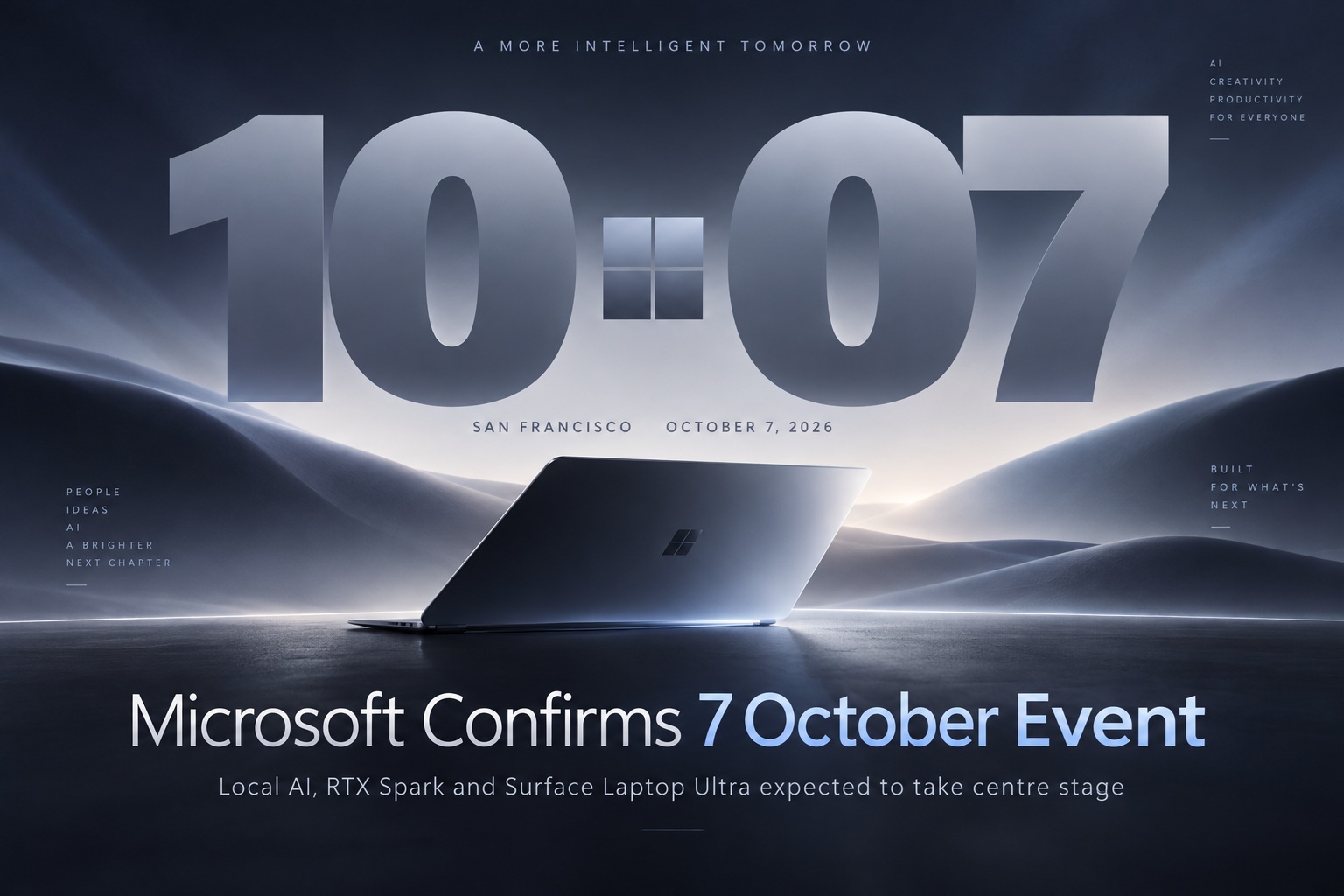
Microsoft has confirmed that it will hold a special event in San Francisco on 7 October, with the company promising to discuss "how local AI will shape the next chapter of the PC." While Microsoft has stopped short of revealing exactly what hardware will be introduced, the timing and the people involved strongly suggest that the event will focus on a new generation of AI-focused Windows PCs, including the long-rumoured Surface Laptop Ultra.
The event is expected to bring together some of the biggest names behind the next phase of Windows computing. Microsoft CEO Satya Nadella, NVIDIA CEO Jensen Huang, and Microsoft Executive Vice President of Windows and Devices Pavan Davuluri are all scheduled to appear. Their presence points toward a broader discussion covering Windows, NVIDIA's upcoming RTX Spark platform, and new Surface hardware designed to push more AI processing directly onto the PC.
Local AI Looks Set to Be the Main Theme
The phrase "local AI" is particularly important because it reflects a wider shift taking place across the PC industry. Instead of sending every AI request to a cloud server, manufacturers increasingly want laptops and desktops to run larger AI models directly on-device. That can reduce latency, improve privacy, allow some features to work offline, and remove the recurring cloud cost associated with processing every task remotely.
Microsoft has already been pushing Windows toward this model through its broader AI PC strategy, but RTX Spark could significantly raise the amount of computing power available inside premium notebooks. If the upcoming Surface Laptop Ultra does indeed use the platform, it would give Microsoft a flagship device designed not simply around conventional productivity, but around locally running generative AI, creative applications, and high-performance GPU workloads.
The presence of Jensen Huang is another strong indication that NVIDIA's role will extend beyond supplying graphics hardware. Microsoft and NVIDIA have worked together extensively across cloud computing and AI infrastructure, but RTX Spark could bring some of those capabilities much closer to ordinary Windows users. The 7 October event may therefore be as much about the future direction of the PC as it is about one specific Surface product.
Surface Laptop Ultra Could Be the Headline Device
The Surface Laptop Ultra is widely expected to be one of the most interesting announcements if it appears at the event. Microsoft has not officially confirmed the device yet, so its launch should still be treated as an expectation rather than a certainty. However, previous reports have linked the machine closely with NVIDIA's RTX Spark platform, making it an obvious candidate for an event centred around local AI.
A Surface Laptop Ultra would also make sense strategically. Microsoft has spent years using Surface devices to demonstrate what it believes a modern Windows PC should look like, even when other manufacturers eventually sell far more units. A flagship RTX Spark laptop could serve the same purpose by showing developers and PC makers how Microsoft expects powerful local AI to integrate with Windows.
The "Ultra" branding would also suggest something positioned above conventional Surface Laptop models rather than simply another incremental refresh. If Microsoft wants to demonstrate advanced AI workloads, creative tools, local model inference, and GPU-accelerated applications, it would need hardware capable of significantly more than everyday office tasks.
RTX Spark Is Much More Than a Typical Laptop Processor
The most interesting part of the expected hardware is the NVIDIA RTX Spark processor, an ARM-based system-on-chip developed in collaboration with MediaTek. Rather than separating the CPU and GPU into completely independent components, the platform combines high-end processing resources around a unified architecture intended to support demanding AI and graphics workloads.
The reported configuration includes 20 Grace CPU cores, 6,144 Blackwell RTX GPU cores, and NVIDIA's fifth-generation Tensor Cores. At the top end, the platform can also support as much as 128GB of unified memory, allowing the CPU and GPU to work with the same large memory pool rather than constantly moving data between separate system and graphics memory.
NVIDIA claims the chipset can deliver around 1 petaflop of FP4 AI performance, with the major components connected through NVLink-C2C. FP4 is particularly relevant to generative AI because lower-precision computation allows models to run faster and more efficiently while using less memory. In a laptop, that could make it possible to run much larger AI models locally than current mainstream notebooks can comfortably handle.
Unified Memory Could Be One of the Biggest Advantages
The potential 128GB unified-memory configuration could prove just as important as the processor's headline performance. Large language models and generative AI workloads can consume enormous amounts of memory, and traditional laptops often separate system RAM from dedicated GPU memory. That division can become restrictive when a workload needs more GPU-accessible memory than the graphics processor physically provides.
A unified architecture gives the CPU and GPU access to the same pool, reducing those constraints and potentially allowing much larger models or creative workloads to run locally. Apple has already demonstrated some of the advantages of unified memory across its own silicon, and RTX Spark appears to take a similar broad concept while combining it with NVIDIA's Blackwell GPU technology.
For developers, researchers, video creators, 3D artists, and users experimenting with local AI, memory capacity could therefore determine which RTX Spark configuration is genuinely useful. The difference between 24GB and 128GB may be far more significant for AI workloads than it would be for ordinary productivity software.
Will Microsoft Offer Several Surface Laptop Ultra Configurations?
One unanswered question is whether Microsoft will release the Surface Laptop Ultra in several hardware configurations rather than offering the full RTX Spark platform in only one very expensive model. That possibility becomes more interesting when looking at what other manufacturers are reportedly preparing.
Asus, for example, is expected to offer five configurations of its RTX Spark-powered ProArt P14, primarily differentiated by unified-memory capacity. Reported options range from 24GB all the way to 128GB of LPDDR5X, giving buyers a wider choice between affordability and the ability to run particularly demanding AI workloads.
Microsoft could adopt a similar strategy for Surface. A lower-memory configuration would make the Laptop Ultra accessible to more users, while 64GB or 128GB models could target professionals who need the machine specifically for AI development, content creation, engineering, or other memory-intensive tasks.
The decision could have a major impact on pricing. A fully equipped RTX Spark notebook with 128GB of unified memory is unlikely to be inexpensive, so multiple configurations would give Microsoft more flexibility in positioning the device across different professional audiences.
ARM Windows Could Be Entering a Much More Powerful Phase
RTX Spark could also represent another important milestone for Windows on ARM. Until relatively recently, ARM-based Windows PCs were primarily associated with battery efficiency, thin designs, and always-connected computing. The arrival of more capable ARM processors has steadily changed that perception, and a platform containing thousands of Blackwell GPU cores would move the discussion into an entirely different performance category.
That does not mean software compatibility suddenly becomes irrelevant. Professional users considering an ARM-based workstation still need applications, drivers, development tools, and plug-ins that work properly with the architecture. Microsoft has made significant progress in Windows ARM compatibility and emulation, but specialist workloads may still require careful testing.
If Microsoft introduces a Surface Laptop Ultra alongside RTX Spark, the company will likely use the event to demonstrate how far that ecosystem has progressed. Strong hardware specifications are important, but the bigger question is whether Windows and its software ecosystem can take full advantage of them without making users think constantly about architecture compatibility.
Microsoft Is Already Teasing the Event
Microsoft has begun promoting the October event through its social media channels, although the teasers reveal very little beyond the general focus on AI, Surface, and the future of the PC. That is fairly typical for a major hardware announcement, with the company clearly trying to build interest without confirming products ahead of the presentation.
The involvement of Microsoft, NVIDIA, and MediaTek gives the event a broader scope than an ordinary Surface refresh. Rather than simply introducing another laptop with a faster processor, the companies appear to be preparing a new computing platform where CPU performance, GPU acceleration, unified memory, and local AI are designed to work together from the beginning.
That makes the event worth watching even for people who have no intention of buying a Surface device. If RTX Spark performs as promised, competing Windows manufacturers are likely to adopt the platform as well, potentially creating a new class of powerful ARM-based AI laptops across the wider PC market.
Final Thoughts
Microsoft's 7 October event is shaping up to be one of its more interesting hardware presentations in recent years. The confirmed focus on local AI, combined with appearances from Satya Nadella, Jensen Huang, and Pavan Davuluri, suggests that Microsoft wants to talk about more than individual product upgrades. The company appears ready to outline how it sees increasingly powerful AI processing becoming part of the everyday Windows PC.
The expected Surface Laptop Ultra could become the showcase for that vision, particularly if it launches with NVIDIA's ambitious RTX Spark platform. With 20 Grace CPU cores, thousands of Blackwell GPU cores, fifth-generation Tensor Cores, and potentially up to 128GB of unified memory, the hardware sounds closer to a portable AI workstation than a conventional productivity notebook.
There are still important questions around pricing, battery life, thermals, software compatibility, and the number of configurations Microsoft will offer. Most importantly, the Surface Laptop Ultra itself has not yet been officially announced, so the details remain speculative until Microsoft takes the stage.
For now, 7 October is the date to watch. If Microsoft and NVIDIA deliver what the teasers appear to be building toward, the event could mark the beginning of a much more powerful generation of Windows-on-ARM PCs—one where running serious AI workloads locally becomes a standard part of what a premium laptop is expected to do.











Comments 0