

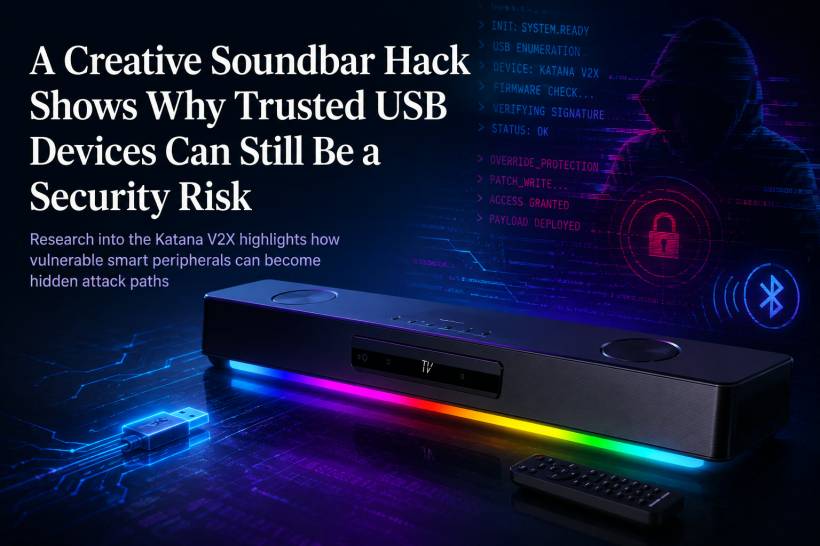
Cybersecurity stories usually focus on laptops, phones, routers, or cloud accounts. A gaming soundbar is probably not the first thing most people would imagine as a security risk. After all, it is just an audio device sitting under a monitor, connected by USB, Bluetooth, or both.
That is what makes this case interesting. Cybersecurity researcher Rasmus Moorats recently demonstrated how a Creative Katana V2X gaming soundbar could be hijacked without the attacker needing to physically touch it or even pair with it in the usual Bluetooth sense. The research highlights a much bigger issue in modern hardware security: once a device is trusted by your computer, it can sometimes do far more than you expect.
The Device at the Centre of the Research
The affected product is the Creative Katana V2X, a gaming soundbar designed for desktop and console setups. Like many modern audio devices, it is not just a "speaker" in the traditional sense. It contains firmware, USB functionality, Bluetooth features, media controls, and software integration.
That extra intelligence is what makes today's peripherals convenient, but it also increases the attack surface. A device that can receive firmware updates, communicate wirelessly, and identify itself to a computer over USB needs proper security controls. If those controls are weak, the device can potentially be modified to behave in unexpected ways.
According to Moorats, the soundbar exposed an unauthenticated Bluetooth interface and lacked firmware signing protections. In simpler terms, the device could accept modified firmware without properly confirming whether that firmware came from Creative or a trusted source.
Why Firmware Signing Matters
Firmware signing is one of those security features most users never think about, but it is extremely important. It works like a digital authenticity check. Before a device accepts and runs new firmware, it should verify that the firmware has been signed by the manufacturer.
Without firmware signing, an attacker may be able to create modified firmware and push it to the device. Once that happens, the device is no longer just running the manufacturer's intended software. It is running whatever the attacker programmed it to run.
That is especially dangerous for USB-connected peripherals because computers tend to trust devices that are already plugged in. A keyboard, mouse, speaker, headset, webcam, or controller may all seem harmless, but USB devices can identify themselves in different ways to the operating system.
How a Soundbar Can Pretend to Be a Keyboard
The most worrying part of the demonstration is that the soundbar could be modified to behave like a keyboard. Moorats reportedly achieved this by changing the speaker's USB descriptor set, allowing the device to present itself not only as an audio/media device but also as a keyboard.
This is a familiar concept in cybersecurity. It is similar to the BadUSB technique, where a trusted USB device is reprogrammed to act like another type of device, usually a keyboard. Once the computer recognises it as a keyboard, it may accept keystrokes from it automatically.
That matters because keyboards are powerful. A keyboard can open a command prompt, type commands, launch scripts, visit websites, or change settings. The computer does not necessarily know whether those keystrokes came from a real human or from a compromised USB device.
In this case, Moorats said the modified firmware ran a custom build based on FreeRTOS and used a diagnostic task to wait until the USB subsystem was ready. Once the device had booted and the host computer recognised it, the soundbar could automatically type and execute a command.
Why This Attack Is More Concerning Than a Normal Malicious USB Device
BadUSB-style attacks are not new. Security researchers have been warning about them for years. The difference here is the delivery method.
With a typical malicious USB attack, the victim usually has to plug in an untrusted device. That might be a suspicious thumb drive, a fake charging cable, or a modified USB accessory. There is at least some physical interaction involved.
This soundbar scenario is more uncomfortable because the device already belongs to the victim. It is already sitting on the desk. It is already trusted. It is already connected through USB. If an attacker can modify the firmware wirelessly, the victim does not need to plug in anything new.
That changes the threat model. The risky device is not something strange that appears out of nowhere. It is something familiar that the user already owns.
The Bluetooth Angle Makes It Even More Awkward
Bluetooth pairing normally gives users the impression that wireless access requires permission. You expect that a device needs to be paired before another device can interact with it meaningfully.
Moorats' findings suggest that the vulnerable interface did not require proper authentication. That means the weakness was not simply "someone paired with my speaker." The issue was deeper: a pathway existed that could allow firmware-level interaction without the kind of trust check users would expect.
For everyday users, this is the uncomfortable lesson: not all Bluetooth-related communication is the same as normal pairing. Devices can expose service interfaces, update mechanisms, diagnostic modes, or vendor-specific features that are invisible to most users but still reachable under certain conditions.
The Bigger Lesson for Hardware Manufacturers
This case is not only about one soundbar. It is about the security expectations we should have for modern peripherals.
Any device that can receive firmware updates should have strong protections around that process. At minimum, manufacturers should ensure:
• Firmware updates are cryptographically signed
• Update channels require proper authentication
• Diagnostic interfaces are disabled or protected in retail products
• USB device identities cannot be easily abused
• Security researchers have a clear disclosure channel
Consumers increasingly connect many "smart" or semi-smart devices to their computers. Gaming accessories, audio devices, webcams, docks, lighting controllers, and input devices are no longer simple hardware. They are small computers with firmware, and they need to be treated that way.
The Disclosure Process Sounds Like Its Own Problem
One of the most frustrating parts of the story is not just the vulnerability itself, but the reported response process. Moorats said they attempted to contact Creative through the company's support web form, but did not receive a meaningful response after multiple attempts.
They then escalated the matter to SingCERT, Singapore's Cyber Emergency Response Team. Even that process was reportedly not smooth. Eventually, Creative responded and said it did not consider the issue to be a vulnerability because it did not present a cybersecurity risk.
That response is difficult to agree with from a security perspective. If a USB-connected device can be remotely modified to behave like a keyboard and execute commands on a host machine, it is reasonable to treat that as a cybersecurity concern. Even if exploitation requires certain conditions, the potential impact is serious enough to deserve proper investigation and mitigation.
An Unofficial Patch Is Available, But That Comes With Risk
Since there was no official fix, Moorats released a tool that patches the CTP-over-Bluetooth flaw and can reflash the speaker over USB. However, this is not an official Creative update.
That means users should approach it carefully. An unofficial firmware patch may reduce the security issue, but it can also introduce compatibility problems. Moorats reportedly does not have Creative's official source code, so applying the fix could affect functionality, including compatibility with Creative's own mobile app.
This puts users in an unfair position. They either continue using a device with a reported security weakness or rely on an unofficial fix that may break normal features. Ideally, this should be handled through an official firmware update from the manufacturer.
Why This Matters Even If You Do Not Own This Soundbar
Most people will read this and think, "I do not own that model, so this does not affect me." That may be true on a direct product level, but the broader issue still matters.
Modern peripherals are becoming more complex. A gaming keyboard has onboard memory. A mouse has firmware. A headset has wireless logic. A soundbar has Bluetooth and USB control features. A monitor may have USB hub functions and software control. All of these devices sit close to the computer and often enjoy a high level of trust.
The more intelligent these devices become, the more important it is for manufacturers to secure them properly. Security cannot be treated as something only routers, operating systems, and antivirus tools need to worry about.
Final Thoughts
This Creative soundbar research is a useful reminder that cybersecurity risks can appear in places users do not normally expect. A speaker is not just a speaker anymore when it has firmware, Bluetooth communication, USB descriptors, and update mechanisms.
The most concerning part is not that a researcher managed to modify a device in a lab. That is what researchers do. The real concern is the combination of unauthenticated access, lack of firmware signing, USB trust, and a weak disclosure response. Those are the ingredients that turn a clever technical discovery into a wider conversation about hardware security.
For users, the practical takeaway is simple: keep firmware updated where official updates exist, avoid exposing Bluetooth devices unnecessarily, and be aware that even trusted peripherals can become part of the security chain. For manufacturers, the message should be even clearer. If a device can be updated, it needs proper update security. If a device connects over USB, it needs to be designed with the assumption that USB trust can be abused. And when researchers report these issues, the response should not be dismissal, but proper investigation.











Comments 0