

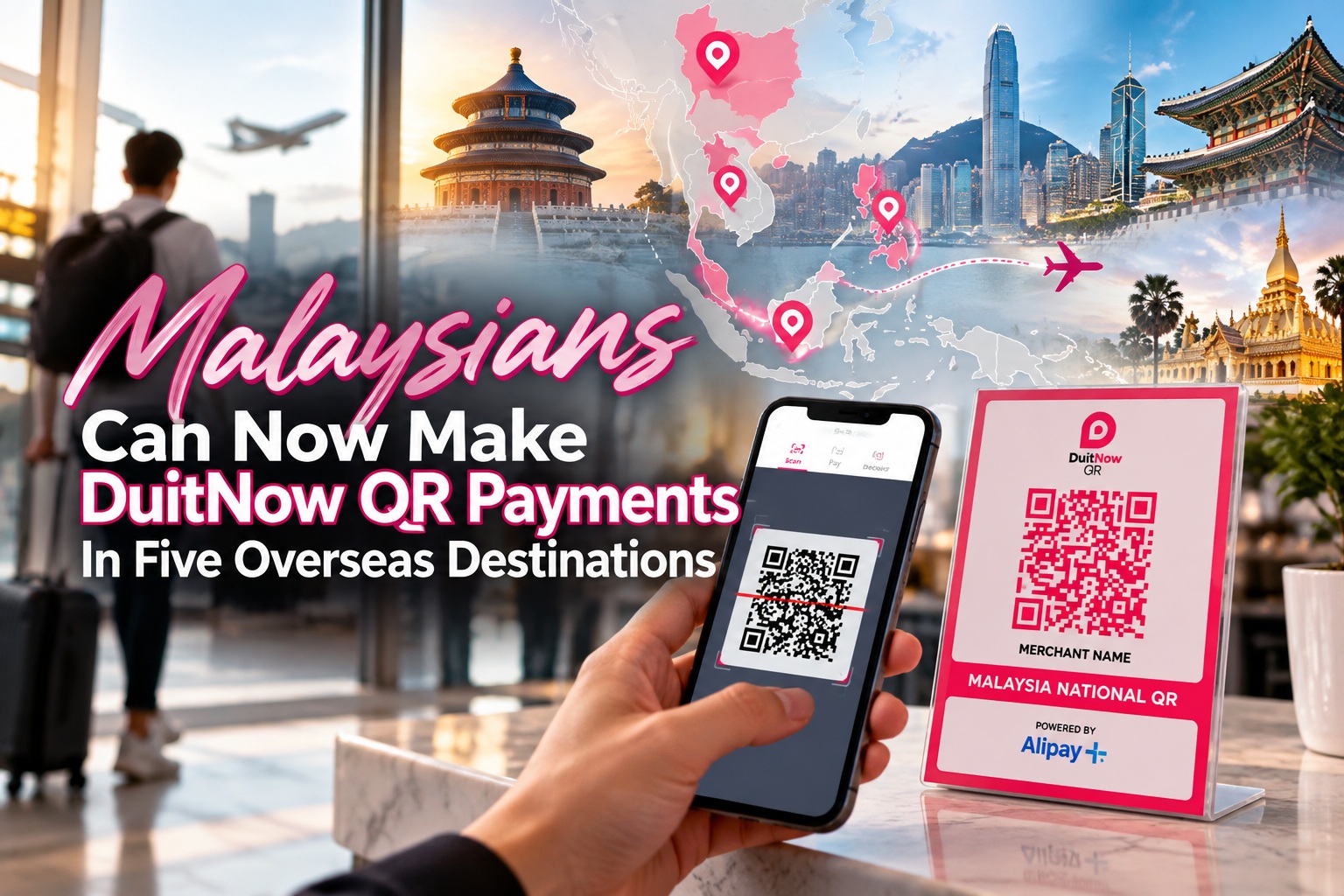
Malaysians travelling abroad can now use DuitNow QR to make payments in five overseas markets through their existing mobile banking apps. Payments Network Malaysia, or PayNet, has expanded its cross-border QR payment network through a partnership with Ant International's Alipay+, allowing eligible users to scan participating merchant QR codes without needing a separate foreign payment app.
The initial rollout covers China, Hong Kong SAR, South Korea, the Philippines and Laos. The service is designed to make overseas payments feel much more familiar for Malaysian travellers by keeping the entire process inside the same banking applications they already use at home.
Three Malaysian Banks Support The Service For Now
Not every Malaysian bank supports outbound DuitNow QR payments yet. At launch, the service is available through Maybank, CIMB and Hong Leong Bank, giving customers of these institutions immediate access to the new cross-border functionality.
PayNet has also confirmed that Bank Islam is expected to join the programme, although no specific launch date has been announced. More banks are likely to follow as the network expands and additional financial institutions complete the required integrations.
For travellers, this means availability currently depends both on the destination and on whether their bank is part of the participating network.
The Payment Process Works Much Like It Does In Malaysia
Using DuitNow QR overseas is intended to feel almost identical to making a QR payment locally. Customers simply open the QR payment function inside their supported Malaysian banking app and scan a merchant QR code displaying the Alipay+ logo.
The app will then show the transaction details for review before the customer confirms the payment. Everything remains within the Malaysian banking app, so users do not need to download Alipay+, create another account or maintain a separate foreign wallet.
That simplicity is one of the biggest advantages because travellers can continue using the banking environment they already know.
No Separate Alipay+ Account Is Required
Although Alipay+ provides the underlying cross-border connectivity, Malaysian users are not required to register directly with the platform. The service acts in the background, connecting participating Malaysian banks with supported merchants in overseas markets.
This reduces the friction normally associated with travelling, where users may otherwise need to install local payment apps, register foreign accounts or rely heavily on physical cards and cash.
For occasional travellers in particular, using an existing banking app is much more convenient than setting up an entirely new payment ecosystem for a short trip.
The Partnership Previously Worked In The Opposite Direction
PayNet and Ant International already had an existing partnership before this latest expansion. Previously, travellers using supported Alipay+ partner wallets could make payments at merchants in Malaysia that accept DuitNow QR.
The new rollout extends that relationship in the opposite direction, allowing Malaysians to use their local banking apps when paying at participating overseas merchants.
This effectively creates a more two-way cross-border payment corridor rather than only allowing foreign visitors to spend within Malaysia.
Cross-Border QR Payments Are Growing Rapidly
The timing of the expansion reflects strong growth in cross-border payment activity. In 2025, PayNet recorded almost 30 million cross-border transactions, representing an increase of approximately 150% compared with 2024.
A large portion of this growth was linked to transactions involving China, highlighting how important regional travel and payment interoperability have become.
As more travellers expect to pay digitally wherever they go, QR interoperability is becoming increasingly valuable across Asia.
China Is Likely To Be One Of The Most Useful Destinations
Among the five supported destinations, China could be particularly significant for Malaysian travellers. QR-based payments are deeply embedded into everyday transactions there, with many merchants relying heavily on digital wallets.
Being able to use a Malaysian banking app directly could remove one of the more inconvenient parts of travelling in China, especially for users who would otherwise need to arrange access to local payment platforms.
The broader Alipay+ network also gives PayNet access to a large merchant ecosystem, making China an important first market for outbound DuitNow QR usage.
Hong Kong SAR Also Joins The Initial Rollout
Hong Kong SAR is another major destination included in the first phase. Malaysian travellers visiting for business, tourism or family trips can use supported banking apps at participating Alipay+ merchants.
The feature should be particularly useful for smaller everyday purchases where QR payments are more convenient than card transactions.
As merchant acceptance grows, travellers may increasingly be able to rely on DuitNow QR for routine spending without changing how they normally pay.
South Korea Is Included As Well
South Korea is also part of the launch, adding another popular travel destination to the service. The country already has a highly developed digital payment environment, making it a natural market for interoperable QR payments.
Malaysian visitors can potentially use the same banking apps they use domestically when shopping, dining or making other eligible purchases at participating merchants.
That consistency reduces the number of payment methods travellers need to manage throughout a trip.
The Philippines And Laos Complete The First Five Markets
The Philippines and Laos round out the initial group of supported destinations. Their inclusion shows that PayNet is not limiting the service only to major East Asian markets.
Both countries are part of the wider regional push towards interoperable digital payments across Southeast Asia. Connecting DuitNow QR to these markets can make travel and cross-border commerce easier for consumers and businesses alike.
It also strengthens Malaysia's role in the growing regional QR payment ecosystem.
The Expansion Supports Bank Negara Malaysia's Cross-Border Payment Goals
PayNet says the initiative aligns with Bank Negara Malaysia's broader vision for faster, more efficient and more inclusive cross-border payments.
Traditional international payment methods can involve additional fees, unfamiliar processes and slower settlement. QR interoperability offers a simpler alternative by connecting domestic payment systems directly across borders.
For consumers, the main benefit is convenience. For the wider financial system, the bigger advantage is creating payment infrastructure that works more seamlessly between countries.
Interoperability Is Becoming The Bigger Goal
The long-term objective is not simply to make one Malaysian payment method work in five countries. PayNet is building towards a broader interoperable network where users can move between markets without needing completely different payment systems each time.
This approach is particularly relevant in Asia, where many countries already have mature domestic QR payment platforms. Connecting those systems can be much more practical than expecting everyone to adopt one universal wallet.
DuitNow QR therefore becomes part of a larger regional payment network rather than functioning only as a domestic service.
More Banks Are Expected To Join
The current list of Maybank, CIMB and Hong Leong Bank is only the starting point. PayNet has confirmed that it will continue working with Malaysian financial institutions to bring more banking apps into the cross-border ecosystem.
As more banks participate, the service should become accessible to a much larger proportion of Malaysian travellers.
Wider bank support will be important if outbound DuitNow QR is expected to become a mainstream travel payment option rather than a feature available only to selected customers.
More Countries Will Also Be Added
The five launch destinations are not intended to be the final list. PayNet plans to expand the service to additional markets over time through continued partnerships with regional payment networks and financial institutions.
The success of the initial rollout will likely influence how quickly that expansion happens. Markets with strong Malaysian travel flows and established QR payment infrastructure would be natural candidates for future inclusion.
Over time, DuitNow QR could potentially become a familiar payment option across a much broader part of Asia.
This Could Reduce Dependence On Cash While Travelling
One practical benefit of the service is reducing the amount of foreign currency travellers need to carry. Cash remains useful in many situations, but managing multiple currencies can be inconvenient.
Being able to scan a QR code using a Malaysian banking app provides another payment option alongside cards and cash. This can be particularly useful for smaller merchants where card acceptance may be limited but QR payments are common.
Travellers should still keep backup payment methods available, but DuitNow QR adds another layer of flexibility.
It Could Also Reduce The Need For Multiple Foreign Wallets
Frequent travellers sometimes end up with several payment apps installed simply because different countries favour different ecosystems. Managing all those accounts can become cumbersome.
Cross-border DuitNow QR helps simplify that experience by letting one familiar Malaysian banking app interact with supported merchant networks overseas.
The more countries PayNet adds, the more useful this becomes. A single domestic payment method that works across several destinations is far easier to manage than maintaining separate wallets for every market.
Final Thoughts
PayNet's expansion of outbound DuitNow QR through Alipay+ is a significant step towards making Malaysian digital payments more useful beyond the country's borders. Travellers using Maybank, CIMB or Hong Leong Bank can now pay at participating merchants in China, Hong Kong SAR, South Korea, the Philippines and Laos directly through their existing banking apps.
The experience remains familiar: open the QR payment function, scan an Alipay+ merchant code, review the transaction and confirm. There is no need to create a separate Alipay+ account or download another wallet.
Bank Islam is expected to join the service later, while PayNet plans to continue adding more banks, apps and overseas destinations over time.
With cross-border QR transactions already growing rapidly, this expansion could make DuitNow QR much more than a Malaysian payment system. It is gradually becoming part of a wider regional payment network that could make travelling and spending across Asia considerably simpler.











Comments 0