

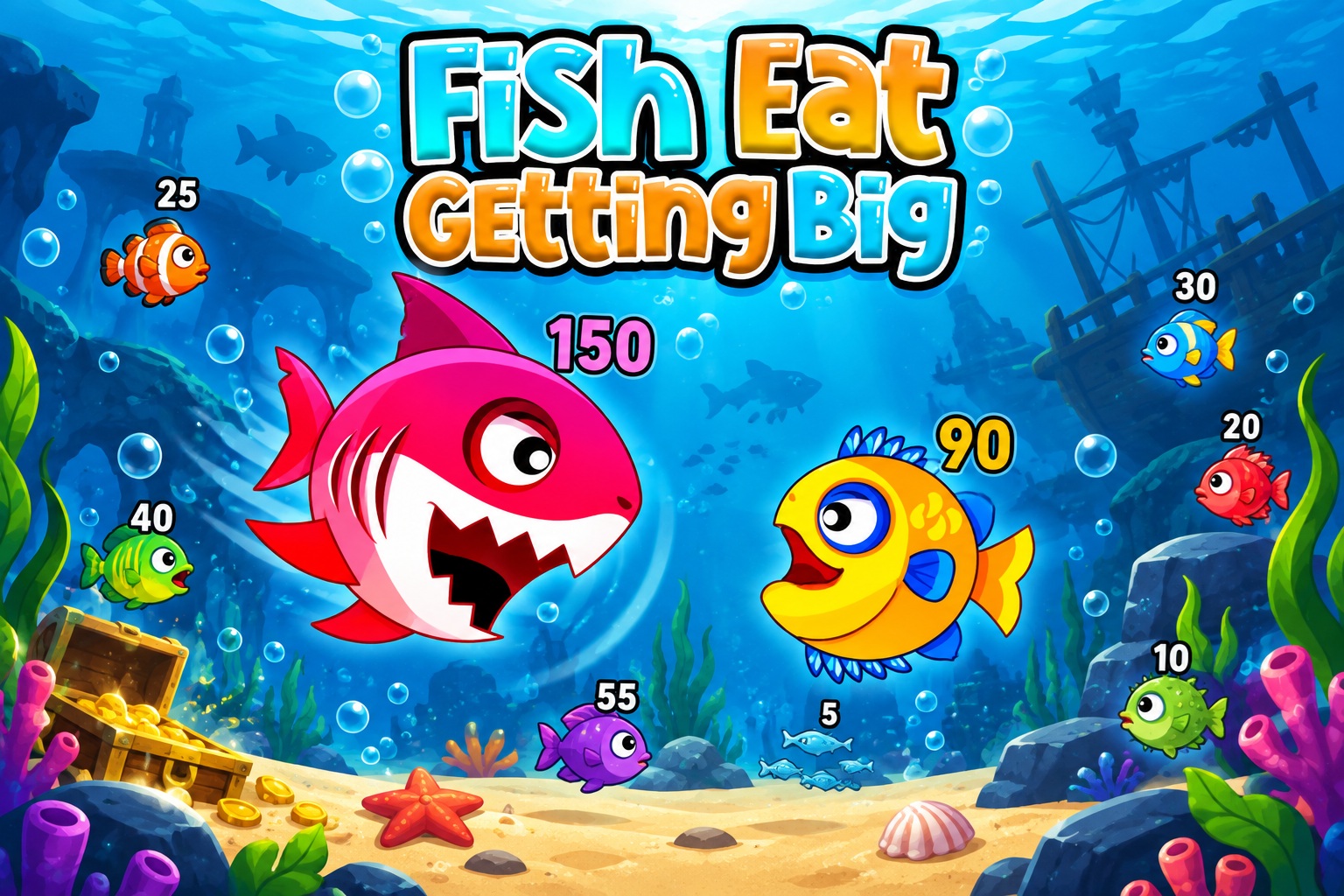
Fish Eat Getting Big is a colorful arcade survival game built around one simple rule: eat smaller fish, avoid anything larger than you, and keep growing until you become one of the most powerful creatures in the ocean. You begin relatively small and vulnerable, surrounded by sea creatures that may either become your next meal or immediately end your run. Every successful bite increases your size and opens the possibility of hunting stronger targets, creating a satisfying sense of progression that can be understood almost immediately. The concept is simple, but the constant need to judge danger keeps every swim through the ocean surprisingly tense.
The appeal of Fish Eat Getting Big comes from the way your role changes naturally as you grow. A fish that looks terrifying during the opening moments may eventually become ordinary food once enough smaller creatures have been eaten, while entirely new threats appear as you move into more dangerous areas. Players constantly need to compare size, choose safe targets, avoid reckless collisions, and decide whether a risky meal is worth approaching. This creates a smooth progression from vulnerable prey to powerful predator without requiring complicated controls or lengthy tutorials.
Now playable online through Lemon Web Games, Fish Eat Getting Big can be experienced directly in your web browser as part of a growing collection of arcade, survival, casual, animal, ocean, and browser-playable games. Its straightforward movement and easy-to-understand objective make it suitable for quick sessions, while the constant desire to grow larger gives each run a strong one-more-try feeling. Whether you prefer carefully working your way up through safe targets or aggressively chasing anything that looks slightly smaller, the game provides an enjoyable underwater challenge built around risk, growth, and survival.
Start Small and Stay Cautious
The beginning of a run is often the most vulnerable stage because many creatures in the ocean are still larger than you. Small fish become your safest targets, and chasing them allows your character to gradually gain enough strength to challenge something bigger. Rushing toward unfamiliar creatures without checking their size can end a run immediately, so patience is extremely valuable during these early moments. Learning which targets are safe becomes the first major skill.
This cautious opening also creates a strong sense of anticipation because every meal moves you closer to the point where previously dangerous creatures can finally be hunted. The ocean slowly feels less threatening as your fish becomes larger. However, becoming stronger never means becoming completely safe because bigger predators continue appearing. The food chain simply moves upward with you.
The Bigger Fish Eat the Smaller Fish
Fish Eat Getting Big is built around a straightforward food-chain mechanic where size determines who can eat whom. Smaller creatures provide opportunities to grow, while larger ones must be avoided until your fish becomes strong enough to challenge them. This rule is easy to understand visually, allowing players to make quick decisions without stopping to study complicated statistics. Survival depends on respecting that hierarchy.
The mechanic also creates immediate consequences for careless movement. Swimming directly into a larger predator can undo all the progress made during a successful run. Players therefore need to look ahead rather than concentrating only on the closest available meal. Good awareness becomes increasingly important as more fish fill the screen.
Growth Changes the Entire Ocean
One of the most satisfying parts of the game is watching the ocean change from your perspective as the fish grows. Creatures that initially controlled large sections of the screen eventually become potential food, giving players a clear feeling of progression. This transformation happens naturally through gameplay rather than through menus or traditional level statistics. Becoming larger immediately changes what you can safely approach.
Growth also creates new challenges because a larger body can require more careful movement around hazards and other creatures. The player gains power but may also become a larger target moving through increasingly crowded waters. This prevents progression from eliminating all difficulty. Every new size creates a slightly different version of the same survival puzzle.
Size Recognition Becomes a Core Skill
Successful players quickly learn to recognize which creatures are safe before swimming directly toward them. A few moments of observation can prevent a promising run from ending through an unnecessary mistake. When several different fish are moving across the same area, choosing the correct target becomes almost like a quick visual puzzle. Players must constantly compare opportunities and threats while remaining in motion.
This skill becomes increasingly automatic with experience. New players may hesitate before approaching each creature, while experienced players begin identifying safe targets almost instantly. That improvement makes later runs feel faster and more confident. Much of the game's progression therefore comes from the player's own growing familiarity.
The Ocean Never Feels Completely Safe
Even after becoming much larger, the player can rarely swim without paying attention. Bigger predators remain capable of ending a run, and danger can approach from directions that were not being watched. A strong position can quickly become dangerous when several large creatures move into the same area. Constant awareness is therefore essential.
This uncertainty keeps the gameplay interesting despite the simplicity of the core mechanic. The player may dominate one section of the ocean before suddenly encountering something far stronger. Instead of becoming completely relaxed after growing, you simply begin hunting within a higher level of the food chain. The challenge evolves alongside your size.
Choosing the Safest Target Matters
Not every edible fish is equally worth chasing. A small target surrounded by larger predators may be far more dangerous than another meal slightly farther away. Players need to consider the surrounding area rather than focusing only on whether a particular creature can technically be eaten. The safest route is often more valuable than the fastest possible growth.
This creates a light strategic layer beneath the arcade movement. Waiting for a dangerous predator to move away can create a much safer opportunity moments later. Experienced players gradually stop chasing everything immediately and begin selecting targets more deliberately. That patience can dramatically increase survival time.
Greed Can End a Good Run
Fish Eat Getting Big constantly tempts players to become more aggressive as their fish grows. A larger creature that looks only slightly weaker can seem like an easy meal, but approaching carelessly may expose the player to something even stronger nearby. Long successful runs often end because confidence turns into greed. The game rewards ambition, but only when it is supported by awareness.
This risk-and-reward structure gives the simple eating mechanic much of its tension. Playing too safely can slow growth, while playing too aggressively can quickly destroy progress. The best runs usually fall somewhere between those extremes. Players need to know when to chase and when to retreat.
Movement Is Simple but Important
The controls are straightforward, allowing attention to remain focused on the ocean rather than a complicated control scheme. Moving smoothly around threats is more important than memorizing buttons or abilities. A quick change of direction can prevent a collision with a larger predator, while poor positioning can trap the fish between several dangerous creatures. Basic movement therefore becomes the foundation of survival.
The simplicity makes the game highly accessible, but good movement still separates experienced players from beginners. Skilled players can weave through crowded areas while keeping several possible escape routes available. They avoid drifting into corners or areas dominated by larger fish. Small positioning decisions gradually become extremely important.
Crowded Waters Increase the Pressure
As more creatures fill the screen, every movement requires greater attention. A safe route can suddenly disappear when another predator crosses from the opposite direction, while chasing one small fish may lead directly into a much larger threat. Crowded sections force players to watch the entire surrounding area rather than only the current target. This makes the game increasingly intense without introducing complicated new mechanics.
The chaos can also create opportunities. Several small creatures may become trapped near one another, allowing rapid growth if the player can approach safely. The challenge is taking advantage of these situations without becoming trapped as well. High-risk areas often provide the fastest progression.
Eating Creates a Satisfying Progression Loop
The core gameplay loop is extremely direct: find something smaller, eat it, become stronger, and search for the next target. Every successful meal provides immediate progress that can be seen directly through the changing size and capability of your fish. There is no need to wait for a long level-up animation or navigate through upgrade menus. The reward is visible almost instantly.
This creates a strong sense of momentum during a successful run. Once the player finds a good sequence of safe targets, growth can happen rapidly. The ocean begins opening up as more creatures become edible. That constant progression makes it easy to continue playing longer than originally intended.
From Prey to Predator
The most enjoyable transformation happens when the player realizes that a creature they spent several minutes avoiding can now be hunted. What was once an obstacle suddenly becomes another source of growth. This reversal creates some of the game's strongest moments because it clearly demonstrates how far the fish has progressed. The player moves gradually from prey toward predator.
However, the ocean always contains something larger. Even a powerful fish can encounter another creature capable of ending the run. This prevents the progression from becoming completely one-sided. The food chain always extends beyond the player's current strength.
Patience Can Be More Powerful Than Speed
Although the game encourages constant movement and eating, waiting can sometimes be the smarter decision. A larger predator blocking access to several smaller fish may eventually move away, creating a safe feeding opportunity. Charging directly into the area can instead result in an immediate defeat. Understanding when not to act becomes an important part of survival.
Patient players also have more time to observe movement patterns and identify escape routes. This can make risky areas much easier to navigate. The game rarely forces the player to consume the first available target. Good decisions often matter more than rapid movement.
Escape Routes Matter
Before entering a crowded section, it helps to know where the fish can retreat if something goes wrong. Swimming directly into an area filled with predators without a clear exit can quickly lead to being trapped. Open water usually provides more flexibility, while narrow spaces can become dangerous when larger creatures approach. Maintaining room to maneuver significantly improves survival.
Experienced players naturally begin thinking about both attack and escape at the same time. They chase food while keeping enough distance from major threats to change direction safely. This makes movement feel much more controlled. Survival becomes less about reacting at the final second and more about avoiding dangerous situations before they fully develop.
Different Fish Keep the Ocean Visually Interesting
The variety of sea creatures helps make growth feel more meaningful because players encounter increasingly different targets as they progress. Smaller fish may dominate the early stages, while more intimidating creatures become relevant later. This provides visual feedback that the run is moving into a more dangerous phase. The ocean gradually feels broader as new threats become important.
Different sizes also make the food-chain mechanic easy to read. Players can often understand the general danger of a creature simply by comparing its presence with their own fish. This keeps the screen readable despite the increasing number of moving targets. Visual recognition becomes a natural part of gameplay.
The Game Creates Its Own Personal Challenges
Reaching a larger size becomes an obvious goal, but players can create additional challenges for themselves. One run may focus on surviving as long as possible, while another may involve growing more aggressively and taking greater risks. Experienced players may try to reach major growth milestones faster than before. The simple mechanics leave plenty of room for these personal objectives.
This is important for replayability because the underlying rule never changes. Instead, improvement comes from better judgment and smoother movement. Players can feel themselves becoming more efficient with every attempt. That personal progression keeps the game entertaining even after the basic concept is fully understood.
Mistakes Are Easy to Understand
When a run ends, the reason is usually immediately clear. The player may have approached a fish that was too large, failed to notice a predator entering from the side, or become trapped while chasing food. This clear feedback makes failure easier to accept because players can usually identify what should be done differently next time. The lesson becomes part of the next attempt.
Games built around quick retries benefit greatly from understandable failure. Instead of feeling random, defeat usually comes from a decision that can be improved. Players naturally become more cautious in similar situations during later runs. This turns repeated attempts into a learning process.
Quick Restarts Encourage Another Attempt
Fish Eat Getting Big works well as an arcade experience because losing does not need to feel like the end of a major campaign. The concept is simple enough that players can quickly begin another run and immediately start rebuilding their fish. This makes experimentation much less frustrating. Risky strategies can be tested without a huge commitment.
The quick restart mentality also strengthens the one-more-try appeal. A player who was close to reaching a new size may immediately want another opportunity. Small improvements become easy to notice between runs. This cycle can make short play sessions unexpectedly long.
A Relaxing Idea With Sudden Moments of Panic
Swimming through colorful ocean environments and eating smaller fish can feel surprisingly relaxing when danger is far away. The pace can remain calm while the player searches for safe targets and gradually grows. That mood can change instantly when a much larger predator enters the same area. The transition between relaxation and panic gives the game much of its personality.
This balance makes Fish Eat Getting Big suitable for casual play without becoming completely passive. Players can enjoy the simple underwater setting while still needing to react quickly when danger appears. The game does not require constant intensity to remain engaging. Its quieter moments make sudden threats more exciting.
The Food Chain Creates Natural Progression
Many games require complicated systems to communicate progression, but Fish Eat Getting Big achieves it entirely through the food chain. Becoming larger automatically changes which creatures are dangerous and which can be eaten. This creates new objectives without requiring separate missions or lengthy instructions. The player's own growth constantly redefines the world.
The simplicity makes progression extremely intuitive. Players do not need to study upgrade trees to understand whether they have become stronger. They can immediately test that strength against creatures they previously avoided. The ocean itself becomes the progression system.
Good Runs Build Confidence
A successful sequence of meals can create strong momentum, especially when the player begins moving quickly from one safe target to another. The fish grows, more creatures become edible, and the surrounding ocean suddenly feels much less threatening. This confidence encourages more ambitious hunting. The challenge is preventing confidence from turning into carelessness.
Long runs become memorable because players can clearly remember the stages they moved through. Starting small and eventually dominating creatures that once seemed enormous creates a satisfying arc within a single session. Even when the run eventually ends, reaching a new personal size can feel like an achievement. This gives the game a strong arcade-style reward loop.
Bigger Does Not Always Mean Easier
Growing larger provides obvious advantages, but it can also change how easily the fish moves around crowded environments. More space may be required to avoid hazards and navigate between other creatures safely. A route that was comfortable at a small size can become much tighter later. This means players need to adapt rather than simply assuming growth eliminates all danger.
The most successful runs come from recognizing these changes early. Players may need to avoid cramped areas or take wider paths through the ocean as their fish becomes larger. Movement strategy evolves naturally with size. Growth therefore creates new problems at the same time that it solves old ones.
Awareness Becomes More Important Than Reflexes Alone
Fast reactions can save the fish from sudden danger, but awareness is even more valuable because it prevents many dangerous situations from happening at all. Watching the edges of the screen helps identify incoming predators before they become immediate threats. Recognizing crowded areas allows players to choose safer routes. The best defense is often avoiding the dangerous position entirely.
This gives the game more depth than simply chasing smaller fish as quickly as possible. Players who think about the surrounding ocean generally survive longer than those who focus entirely on food. The challenge is balancing hunger with caution. Every meal should ideally leave the fish in a safe position for the next move.
Why Fish Eat Getting Big Still Feels Fun
Fish Eat Getting Big works because the central mechanic provides constant and understandable rewards. Every smaller fish is a potential step forward, every larger creature represents a future target, and every increase in size changes how the player sees the ocean. The game does not need a complicated story or large control scheme because the food-chain progression creates its own sense of purpose. You always know what you are trying to achieve.
The experience also adapts naturally to different play styles. Cautious players can grow slowly by selecting safe targets, while more aggressive players can take greater risks for faster progression. Both approaches can work until one poor decision puts the fish in danger. That flexibility gives repeated runs enough variation to remain entertaining.
Playing Fish Eat Getting Big Online Today
Through Lemon Web Games, Fish Eat Getting Big can now be played directly in your web browser with no downloads or setup required. Features of the web-based version include:
• Browser-based play for quick access
• No installation required
• Simple underwater movement and easy-to-understand survival gameplay
• Growth-based progression where smaller fish become food and larger creatures remain dangerous
• Colorful ocean environments filled with different fish sizes and changing threats
• Quick arcade-style attempts that encourage repeated play and personal improvement
• Accessible play through Lemon Web Games
The browser format suits Fish Eat Getting Big particularly well because the objective can be understood almost immediately. Players can begin swimming, hunting smaller fish, and growing within moments without needing to learn complicated systems. A short session can provide a quick arcade challenge, while longer runs encourage increasingly careful movement as the fish becomes larger and more valuable.
Who Should Play Fish Eat Getting Big
• Players who enjoy casual arcade and survival games
• Fans of eat-and-grow gameplay and food-chain progression
• Players who enjoy underwater and ocean-themed games
• Fans of simple controls with increasingly risky gameplay
• Players who like quick attempts, personal improvement, and one-more-try challenges
• Anyone looking for a browser game built around growing from a tiny fish into a powerful ocean predator
Fish Eat Getting Big is especially suitable for players who enjoy games that can be understood quickly but still reward better decision-making over time. The colorful presentation keeps the experience approachable, while the constant threat of larger predators adds enough tension to make every run interesting. Players who enjoy watching a character visibly grow stronger throughout a session should find the progression particularly satisfying. It works equally well as a quick casual game or something to replay repeatedly while trying to reach a larger size.
Play Fish Eat Getting Big Online Now
Fish Eat Getting Big is now available to play online through Lemon Web Games, giving players an easy way to dive into its colorful underwater food chain directly in the browser. The objective is simple: start small, hunt creatures that are safe to eat, keep growing, and avoid anything powerful enough to eat you first. Every successful meal changes the balance slightly, bringing the fish closer to becoming one of the dominant predators in the ocean.
For players exploring the Lemon Web Games library, Fish Eat Getting Big offers a straightforward arcade experience where progress is visible throughout every run. There are no complicated combat systems standing between the player and the central challenge, only movement, size, awareness, and the constant decision of what should be eaten next. Whether you prefer slow and careful growth or aggressive hunting, the ocean always provides another target and another threat.
Final Thoughts
Fish Eat Getting Big succeeds because it turns one of nature's simplest rules into an immediately enjoyable game: the big fish eat the little fish. Starting as a vulnerable creature and gradually moving upward through the food chain creates an instinctively satisfying sense of progression. Every predator avoided during the opening stages can potentially become food later, giving players a clear reason to continue growing. The concept remains easy to understand from beginning to end.
Its greatest strength is the balance between power and vulnerability. Growth allows players to hunt increasingly larger creatures, but it never completely removes danger because there is always another predator somewhere in the ocean. Careful movement, good target selection, patience, and awareness remain important throughout the entire run. That keeps the game engaging even after the basic mechanics have been mastered.
Through Lemon Web Games, Fish Eat Getting Big can be enjoyed directly in the browser as a colorful and accessible arcade survival experience. It is a strong choice for players who enjoy ocean games, casual challenges, growth mechanics, and simple gameplay that becomes increasingly tense as progress builds. For anyone ready to start as a small fish, survive the food chain, and keep eating until the ocean finally has something much bigger to worry about, Fish Eat Getting Big delivers exactly that.











Comments 0