

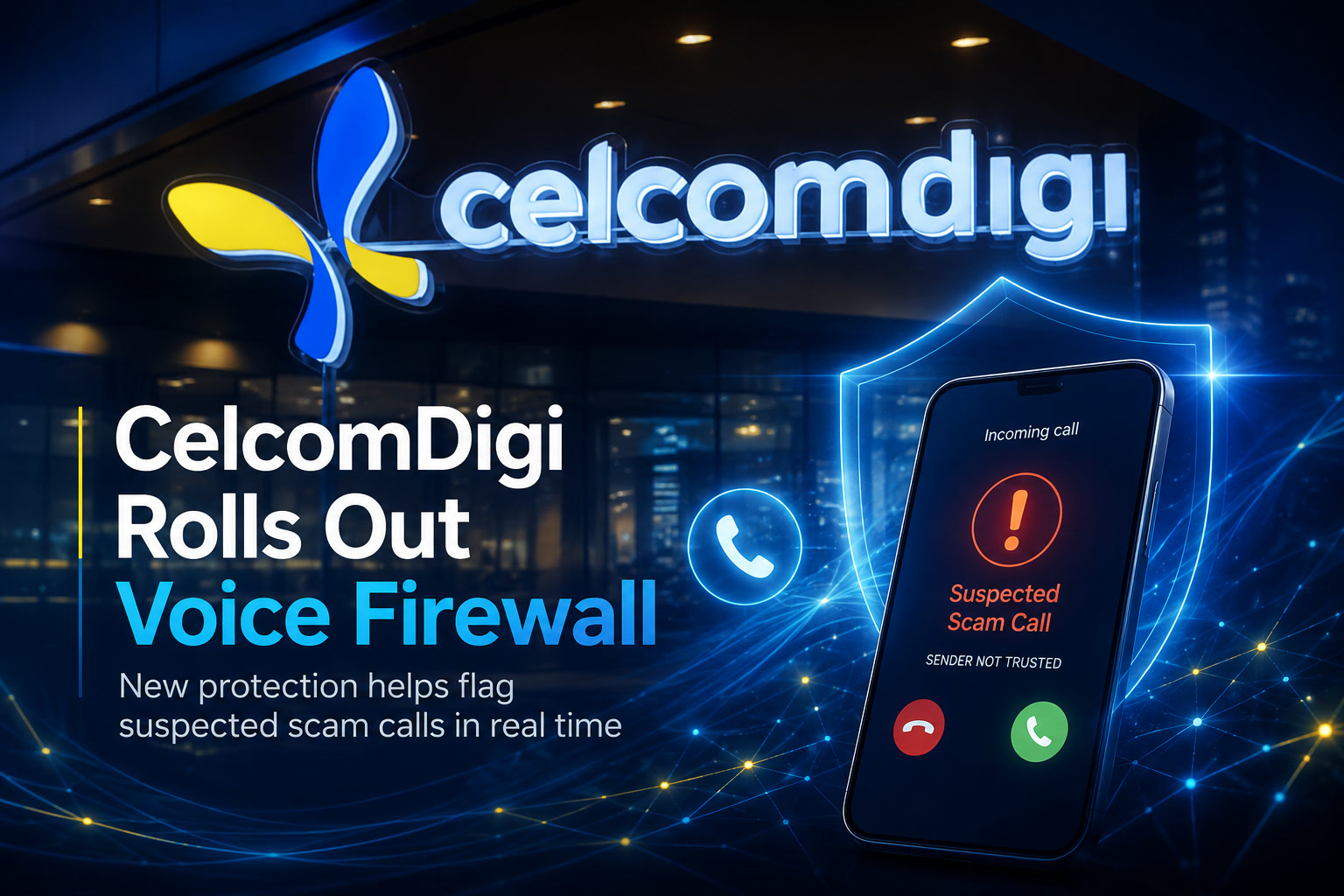
Scam calls have become an everyday nuisance in Malaysia, but CelcomDigi is adding another layer of protection designed to stop suspicious calls before customers even have to decide whether they should answer.
The telco has rolled out a new network-level voice firewall nationwide, capable of analysing incoming calls in real time and identifying activity that may be associated with scams, robocalls or other fraudulent behaviour.
When the system determines that a call is suspicious, it can either prevent the call from reaching the customer entirely or display a "Suspected Scam" warning on the recipient's phone.
The protection is now being made available across CelcomDigi's network, covering its more than 20 million customers.
Scam Detection Happens Inside CelcomDigi's Network
One of the most important aspects of the voice firewall is that customers do not need to depend entirely on an application installed on their phones.
The technology operates directly within CelcomDigi's core telecommunications network.
Incoming call traffic can therefore be analysed before it reaches the customer.
The system examines calling patterns and various risk indicators to determine whether activity resembles known fraudulent or malicious behaviour.
Depending on the assessed risk, CelcomDigi can take different actions.
Some calls may be blocked automatically, while others can still reach the customer but appear with the "Suspected Scam" label.
That warning gives users additional information before they decide whether to pick up.
It is particularly useful because modern scam calls are becoming increasingly difficult to recognise from the phone number alone.
355 Million Suspicious Calls Detected During Pilot
The scale of the problem becomes clearer when looking at CelcomDigi's testing.
During its pilot programme, the telco says the voice firewall detected approximately 355 million malicious or suspicious call attempts.
Of those, around 217 million were identified as robocalls.
Those numbers demonstrate just how much automated and potentially unwanted call traffic moves through telecommunications networks.
Following the nationwide rollout in July, customers receiving calls that match suspicious patterns can now see the warning directly on their phones.
Of course, a "Suspected Scam" label does not necessarily prove that every flagged call is fraudulent.
But it gives customers an important reason to be cautious before sharing information or following instructions from an unfamiliar caller.
The Voice Firewall Complements CelcomDigi's SMS Protection
CelcomDigi already operates a network-level SMS firewall designed to identify and filter malicious or prohibited messages.
The new voice firewall extends a similar approach to telephone calls.
This is significant because scammers frequently move between communication channels.
A campaign might begin with an SMS containing a suspicious link, while another may use automated calls pretending to represent banks, government agencies, delivery companies or other trusted organisations.
Protecting only one channel therefore leaves another open.
By combining SMS filtering with call analysis, CelcomDigi is attempting to identify threats earlier in the communication chain.
The goal is to stop or flag suspicious activity before the customer has to recognise the scam themselves.
That approach is particularly valuable for less technically experienced users who may not immediately recognise common scam tactics.
Why Network-Level Scam Protection Matters
Many anti-scam applications rely on databases of phone numbers already reported by other users.
That can work well for known scammers, but criminals can constantly rotate through new numbers.
Network operators potentially have access to a much broader view of calling behaviour.
For example, suspicious patterns may become visible when one number suddenly attempts to contact unusually large numbers of people or behaves similarly to previously identified robocall campaigns.
By analysing activity at the network level, a telco can potentially react before thousands of customers independently report the same number.
It also means protection can work without every customer having to install and configure a separate security application.
The network effectively becomes part of the defence.
CelcomDigi Is Expanding Its Anti-Scam Tools
The voice firewall forms part of a broader digital-safety push by CelcomDigi.
Earlier in July, the company announced a partnership with IPification to provide network-based phone number verification for digital platforms.
Instead of depending exclusively on SMS one-time passwords, participating services can use telecommunications network information to verify that a mobile number is genuinely associated with a particular user.
That could help platforms deal with problems such as fake accounts, duplicate registrations, identity fraud and account takeovers.
It may also provide online platforms with stronger signals when trying to identify suspicious account behaviour.
CelcomDigi says this capability adds to its existing network API services, which already include phone number verification through platforms such as Google Firebase.
Moving Beyond SMS One-Time Passwords
SMS OTPs have been widely used for authentication for years, but they are not immune to abuse.
Scammers may trick victims into revealing an OTP, while more sophisticated attacks can involve account takeovers or manipulation of mobile credentials.
Network-based verification provides another method of establishing whether the mobile connection and number correspond to the expected user.
It does not necessarily replace every form of authentication, but it can become another useful signal in a broader fraud-prevention system.
This is increasingly important as criminals become better at impersonating legitimate organisations and convincing victims to voluntarily provide security information.
Modern anti-fraud systems therefore need to consider much more than simply whether somebody entered the correct password.
MobileSHIELD and WebSHIELD Add More Protection
CelcomDigi also offers additional security services aimed directly at customers.
MobileSHIELD provides device-level protection against threats such as scams, malicious applications and privacy risks.
WebSHIELD, meanwhile, operates at the network level to help prevent users from reaching phishing sites, fraudulent websites and malicious downloads.
Combined with the SMS and voice firewalls, CelcomDigi is effectively building several layers of protection around common attack methods.
A scammer may attempt to call the victim.
Another may send a malicious SMS.
Someone else may try to direct the victim toward a fake banking or shopping website.
No single defence can stop every attack, which makes layered protection increasingly important.
The "Suspected Scam" Warning Should Still Be Taken Seriously
Customers should treat the new warning as an additional security signal rather than a guarantee.
If an incoming call is labelled "Suspected Scam," the safest response is usually to avoid providing personal information, banking details, passwords, TAC codes or OTPs.
If the caller claims to represent a bank, government department, telecommunications provider or another organisation, contact that organisation independently through its official number.
Do not simply trust the number supplied by the caller.
The same caution should apply even when a call is not labelled suspicious.
No automated detection system can identify every malicious call, particularly when scammers continuously change numbers and techniques.
Network protection can reduce the risk, but customers still remain an important final layer of defence.
Scammers Are Becoming Harder to Recognise
The introduction of technologies like CelcomDigi's voice firewall reflects how much telephone fraud has evolved.
Scam calls are no longer necessarily crude automated recordings coming from obviously strange international numbers.
Attackers can impersonate familiar institutions, spoof caller information and use increasingly convincing scripts.
AI-generated voices and automated calling technology can potentially make these campaigns even more scalable.
That means asking customers to simply "be careful" is no longer enough.
Telecommunications providers, banks, digital platforms and regulators increasingly need to identify suspicious behaviour before it reaches the user.
Network-level detection is one of the ways that responsibility can shift away from relying entirely on individuals.
Final Thoughts
CelcomDigi's nationwide voice firewall is a welcome addition at a time when scam calls have become an increasingly persistent problem.
The scale detected during its pilot programme — 355 million suspicious or malicious call attempts, including 217 million robocalls — shows why automated network protection is becoming necessary.
By analysing call behaviour inside its core network, CelcomDigi can potentially block higher-risk calls altogether while warning customers about others with a clear "Suspected Scam" label.
Combined with its existing SMS firewall, MobileSHIELD, WebSHIELD and network-based phone verification services, the telco is building a more layered approach to digital fraud prevention.
Technology alone will never eliminate scams completely, so users should still remain cautious whenever an unexpected caller asks for money, credentials or personal information.
But if suspicious activity can be detected before the phone even rings, the network itself becomes another line of defence between scammers and their potential victims.











Comments 0