


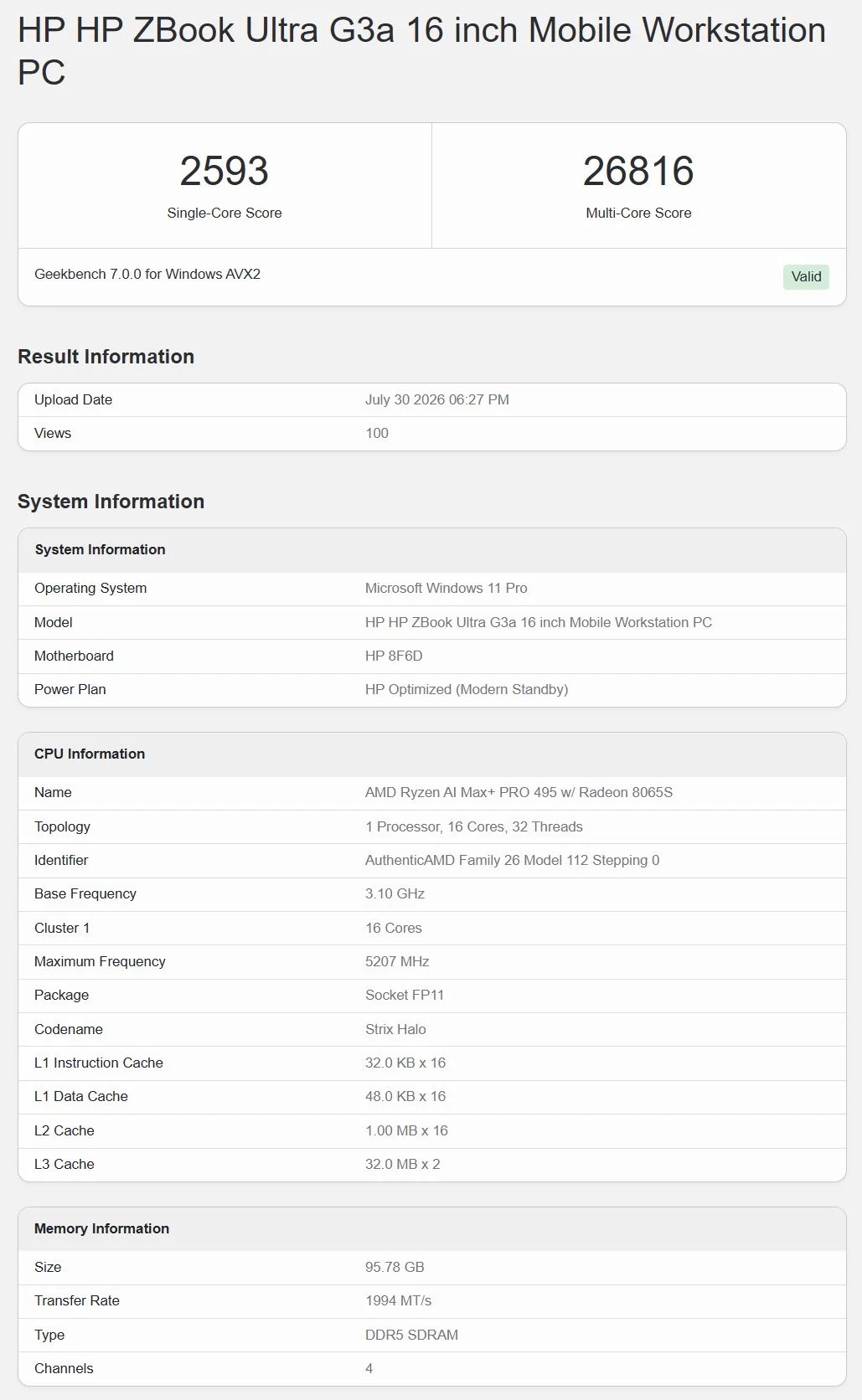
AMD's Ryzen AI Max+ Pro 495 has appeared in the Geekbench 7 database, giving us an early look at what the company's refreshed Gorgon Halo processor may deliver inside high-performance mobile computers. The benchmark was recorded on an unannounced 16-inch HP ZBook Ultra G3a workstation equipped with nearly 96GB of memory, suggesting that manufacturers are already testing serious professional hardware around AMD's latest flagship APU.
While benchmark leaks should always be approached carefully, the result is particularly interesting because this is not simply another conventional laptop processor. Like the Ryzen AI Max+ 395 before it, the new chip combines a powerful desktop-class CPU, capable integrated graphics, unified memory and a dedicated AI engine within one package.
That combination could make it an excellent choice for compact gaming computers, portable workstations and unusual devices such as the ASUS ROG Flow Z13.
A New Gorgon Halo Chip Appears in an HP Workstation
The Geekbench entry identifies the test system as an HP ZBook Ultra G3a 16-inch Mobile Workstation running Windows 11 Pro. It reportedly contains a Ryzen AI Max+ Pro 495 with Radeon 8065S graphics, 16 CPU cores, 32 threads and 95.78GB of memory.
The processor recorded 2,593 points in Geekbench 7's single-core test and 26,816 points in the multi-core test. Geekbench also detected a maximum operating frequency of 5,207MHz, closely matching AMD's official maximum boost specification of 5.2GHz.
These are impressive figures for a processor designed for mobile systems, although they should not be treated as a final measure of real-world performance. Geekbench results can vary according to cooling, power limits, memory configuration, firmware and the performance profile selected by the manufacturer.
The HP workstation may also allow the processor to operate at a much higher sustained power level than a thinner gaming tablet or lightweight laptop.
More of a Refined Upgrade Than a New Architecture
The Ryzen AI Max+ Pro 495 is not an entirely new design. It remains based on AMD's Zen 5 CPU architecture and carries the Gorgon Halo codename.
AMD officially lists the processor with 16 cores, 32 threads, a 3.1GHz base clock and a maximum boost clock of 5.2GHz. It also includes 16MB of L2 cache, 64MB of L3 cache and a default thermal design power of 55W. Manufacturers can configure it anywhere between 45W and 120W, depending on the device and its cooling system.
Compared with the Ryzen AI Max+ 395, the changes appear relatively modest. The older processor operates at a 3.0GHz base clock and boosts up to 5.1GHz, meaning the new model effectively gains another 100MHz at both ends.
That reinforces the impression that Gorgon Halo is a refinement of the existing Strix Halo platform rather than a dramatic generational leap.
However, modest clock increases can still be useful when combined with firmware improvements, faster memory and better power management. More importantly, AMD is retaining the architecture that made the original Ryzen AI Max family so unusual in the first place.
The Radeon 8065S Remains One of the Main Attractions
The processor's integrated Radeon 8065S graphics may be more important than the small CPU clock increase.
AMD lists the GPU with 40 graphics cores operating at up to 3GHz. The company has not moved the design to a completely new graphics architecture, so it remains closely related to the RDNA 3.5 foundation used in the previous generation.
That may disappoint anyone hoping for a major graphics redesign, but 40 compute units inside an APU remain substantial. This is not the type of basic integrated graphics traditionally included simply to display Windows and play videos.
The entire idea behind Ryzen AI Max is to deliver CPU and GPU performance through a shared pool of fast memory. Instead of separating system RAM from dedicated graphics memory, the processor allows both sides to access the same unified memory architecture.
That can be especially helpful for gaming, video editing, 3D creation and local AI workloads, where large amounts of graphics-accessible memory can be more useful than having a small amount of traditional dedicated VRAM.
The Ryzen AI Max+ Pro 495 officially supports up to 192GB of LPDDR5X-8533 memory. Depending on how a manufacturer configures the system, a significant portion of that memory could potentially be allocated to graphics or AI workloads.
AI Performance Is Also Receiving a Small Boost
As the name suggests, the processor is not only being marketed around conventional CPU and graphics performance.
AMD lists the Ryzen AI Max+ Pro 495 with an XDNA-based neural processing unit capable of up to 55 TOPS. Total combined AI performance across the processor can reach up to 131 TOPS, according to AMD's official specifications.
Whether everyday users will immediately benefit from all of that capability is another question. Many current AI-labelled laptop features still feel more promotional than essential.
However, the hardware could become more meaningful for users running large language models, image-generation tools, transcription software and other AI applications locally. Unified memory is particularly valuable here because local AI models can require far more memory than conventional integrated graphics normally receive.
For professional workstations, this could allow certain workloads to run without relying entirely on cloud-based processing or a large dedicated GPU.
The Geekbench Numbers Need Proper Context
Early comparisons suggest that the Ryzen AI Max+ Pro 495's Geekbench result is ahead of the existing Ryzen AI Max+ 395 average, particularly in multi-core performance. However, comparing one leaked result against an average assembled from many different computers is not an entirely fair test.
Different devices may use very different cooling systems and power limits. A 16-inch workstation could sustain substantially more power than a 13-inch tablet, even when both contain processors from the same family.
The tested HP machine may also be using early firmware, unusual memory settings or engineering hardware. Until independent reviews compare the two processors inside similarly configured systems, it is impossible to determine exactly how much of the performance increase comes from the processor itself.
For now, the benchmark confirms that the chip exists, runs at its advertised frequency and is already being tested inside upcoming hardware. That is valuable information, but it is not yet enough to declare it a major performance breakthrough.
The ROG Flow Z13 Has Long Been My Dream Device
Personally, the ASUS ROG Flow Z13 has long been one of those dream devices I wanted but never ended up buying.
The concept is incredibly appealing. It is essentially a powerful Windows gaming computer placed inside a compact tablet-style body, complete with a kickstand, removable keyboard and touchscreen. It can work as a tablet, portable workstation or gaming laptop depending on how it is being used.
The 2025 Flow Z13 already uses AMD's Ryzen AI Max+ 395 with Radeon 8060S graphics. ASUS combines the processor's 16 Zen 5 CPU cores and 40 RDNA 3.5 graphics compute units with unified memory inside a relatively compact 13-inch device.
That existing model demonstrates exactly why AMD's Halo processors make so much sense for the Flow Z13. A conventional gaming laptop normally requires a separate CPU and dedicated graphics chip, both of which consume space, power and cooling capacity.
By placing strong CPU and GPU capabilities into a single package, AMD allows ASUS to build something far more compact without giving up the ability to run demanding software and games.
Why I Held Back from Buying It
As much as I wanted the Flow Z13, I did not buy it. Devices like this usually involve compromises, particularly around price, battery life, heat, repairability and future upgrade options.
A gaming tablet can also be difficult to justify when a conventional laptop offers more performance for the same money. The Flow Z13's unusual form factor is what makes it exciting, but that uniqueness can also make it expensive.
Waiting may turn out to be the better decision if ASUS eventually develops another generation around the Ryzen AI Max+ Pro 495—or perhaps a consumer version of the same platform.
The performance increase may not be revolutionary, but even a modest improvement could be valuable in such a compact device. Higher CPU clocks, slightly faster integrated graphics and more efficient firmware could improve responsiveness without requiring ASUS to redesign the entire concept.

I Hope the Next Flow Z13 Uses This Processor
There is currently no official confirmation that ASUS is preparing a new Flow Z13 with the Ryzen AI Max+ Pro 495. The processor carries AMD's Pro branding and is currently appearing inside an HP workstation, so ASUS could choose a non-Pro equivalent or another Gorgon Halo model instead.
Still, the possibility is difficult to ignore.
The current Flow Z13 is already one of the best demonstrations of what Ryzen AI Max can do. Moving to the refreshed platform would be a logical upgrade, especially if ASUS could combine it with faster memory, improved cooling and better battery management.
Personally, I would also like to see several practical improvements beyond the processor. A next-generation Flow Z13 would be more tempting with longer real-world battery life, a larger or more easily replaceable SSD, improved keyboard stability and pricing that makes it easier to choose over a conventional gaming laptop.
The processor matters, but the complete product experience will determine whether I finally buy one.
A Refresh Can Still Be Important
It is easy to dismiss the Ryzen AI Max+ Pro 495 because it retains the same number of CPU cores and a similar graphics architecture as its predecessor.
However, not every processor release needs to reinvent the entire platform. Refining a successful design can be worthwhile, especially when manufacturers have already gained experience building devices around it.
A refreshed processor may allow laptop makers to improve cooling profiles, memory compatibility, sustained performance and power efficiency. Those changes can matter more in daily use than a dramatic benchmark increase that only appears under ideal conditions.
For compact devices such as the Flow Z13, efficiency and sustained performance are often more important than a brief peak score.
Final Thoughts
The Ryzen AI Max+ Pro 495's Geekbench appearance gives us an early indication of AMD's next step for its high-performance mobile APU platform. The processor retains 16 Zen 5 cores and 32 threads while raising the base clock to 3.1GHz and the maximum boost to 5.2GHz. It also combines Radeon 8065S graphics, support for up to 192GB of unified memory and an NPU rated at up to 55 TOPS.
This looks more like a polished refresh than a completely new generation, so expectations should remain realistic. The leaked benchmark came from a large HP workstation, and its performance may not translate directly to thinner devices.
Nevertheless, I am particularly interested in what this processor could mean for future gaming tablets. The ASUS ROG Flow Z13 has been a dream device of mine for a long time, even though I never bought the existing model.
I hope the next generation adopts the Ryzen AI Max+ Pro 495 or a closely related Gorgon Halo processor. With the right improvements to cooling, efficiency, battery life and pricing, it could finally become the Flow Z13 that convinces me to stop waiting and buy one.











Comments 0