

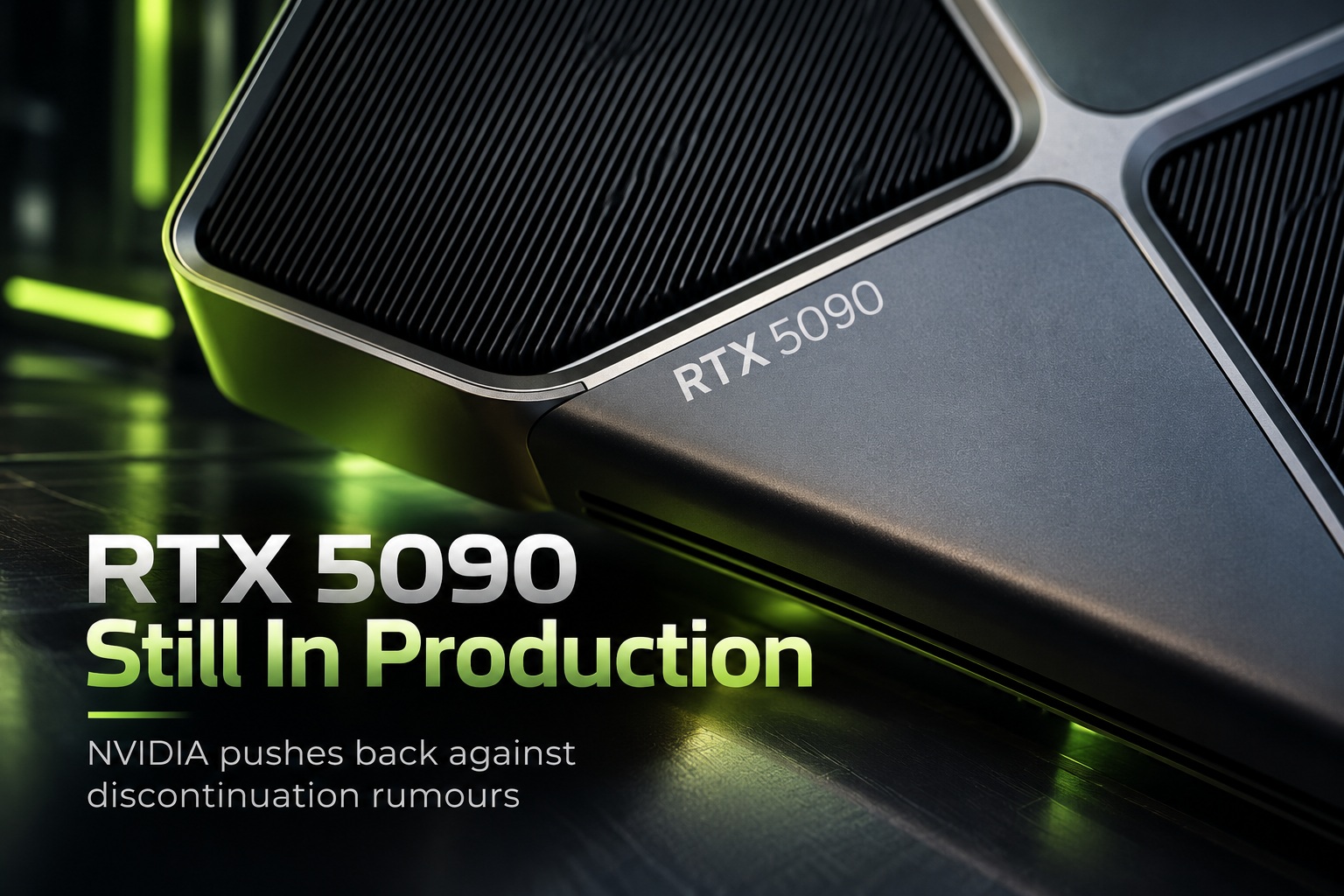
NVIDIA has responded to recent rumours claiming that production of the GeForce RTX 5090 had been discontinued, confirming that its flagship Blackwell gaming GPU is still being manufactured. However, supply remains constrained, which may explain why availability continues to be inconsistent in some markets and why retail prices remain significantly higher than NVIDIA's original recommended pricing.
The clarification was reportedly made during an RTX Spark launch event in Taipei, where NVIDIA acknowledged that production capacity within the supply chain remains limited. Despite those constraints, the company said it continues to manufacture and ship the RTX 5090, including products based on different variants of the underlying GPU.
NVIDIA Says RTX 5090 Production Has Not Stopped
The latest statement directly contradicts rumours that began circulating earlier this month suggesting NVIDIA had placed RTX 5090 production on an indefinite hold.
According to the company, supply-chain capacity remains constrained, but NVIDIA is continuing to work on getting more products into the market. Most importantly for consumers, production of the RTX 5090 has not been discontinued.
That distinction matters. Limited manufacturing can still result in shortages, inconsistent retail availability and inflated pricing, but it is very different from NVIDIA permanently ending production of its flagship consumer GPU.
For buyers who were concerned that remaining RTX 5090 inventory represented the final units available, NVIDIA's clarification should provide at least some reassurance.
Earlier Rumours Suggested GB202 Would Move Entirely To RTX Pro
The original rumour claimed NVIDIA was preparing to redirect future GB202 GPU dies away from consumer GeForce cards and towards its professional RTX Pro lineup.
GB202 is the massive Blackwell GPU powering the RTX 5090, and the logic behind the rumour was fairly easy to understand.
Demand for artificial intelligence infrastructure remains enormous, while professional and enterprise GPUs typically generate considerably higher margins than consumer gaming products. If NVIDIA were faced with limited manufacturing capacity, prioritising professional hardware over enthusiast gaming cards would make commercial sense.
However, NVIDIA's latest statement indicates that GB202 allocation to GeForce has not ended completely.
AI Demand Could Still Be Affecting Supply
Even though the RTX 5090 remains in production, that does not necessarily mean AI demand has no effect on availability.
NVIDIA now serves several rapidly growing markets simultaneously. The company needs advanced silicon for gaming GPUs, professional workstations, AI accelerators, data centres and other high-performance computing products.
When manufacturing capacity is limited, those product families effectively compete for resources.
That could explain why NVIDIA acknowledges supply constraints while maintaining that RTX 5090 manufacturing continues.
The GPU may still be produced, just not necessarily at the volume enthusiast gamers would prefer.
RTX Pro Products Remain Extremely Important To NVIDIA
The professional market has become increasingly important to NVIDIA as AI workloads expand.
A high-end GPU sold into an enterprise or professional environment can often generate substantially more revenue than the same amount of silicon allocated to a gaming product.
That naturally creates speculation whenever supply becomes tight.
From NVIDIA's perspective, however, completely abandoning the flagship GeForce segment would also have consequences. The RTX 5090 serves as a showcase for Blackwell gaming technology and establishes the performance ceiling for the entire RTX 50 generation.
Keeping at least some production active therefore makes strategic sense even if professional products receive greater manufacturing priority.
The Rumoured RTX 5080 24GB Is Still Hanging Around
Interestingly, the original RTX 5090 discontinuation rumour was accompanied by another claim: NVIDIA was preparing a new RTX 5080 with 24GB of GDDR7 memory.
That part of the story has not disappeared.
Separate reports have since suggested the 24GB RTX 5080 could arrive during the first quarter of 2027, potentially as the long-rumoured RTX 5080 Super or a similarly positioned refreshed model.
The card would reportedly use higher-density GDDR7 memory modules to increase VRAM from the current 16GB to 24GB.
Even with RTX 5090 production continuing, such a product would still make sense as a more attainable high-end option.
A 24GB RTX 5080 Would Fill An Important Gap
The current RTX 5080 sits well below the RTX 5090 in overall performance and memory capacity.
Adding 24GB of VRAM would make the 5080 significantly more attractive to creators and users running local AI workloads, where available graphics memory can be just as important as raw GPU performance.
It would also create another premium GeForce option for customers who cannot justify RTX 5090 pricing.
The key question will be whether NVIDIA replaces the existing RTX 5080 16GB or sells both versions alongside one another.
Nothing has been officially announced yet.
Could NVIDIA Have Changed Its Plans?
The timing of NVIDIA's clarification is interesting because the discontinuation rumours generated considerable attention and criticism.
That inevitably raises speculation over whether the company changed its plans following the reaction.
There is currently no evidence confirming that.
It is entirely possible that RTX 5090 production was always intended to continue at reduced capacity and that the original leak simply interpreted constrained production as a complete manufacturing stop.
It is equally possible that NVIDIA adjusted internal allocations after the reports emerged.
Without direct confirmation from the company, either explanation remains speculation.
Limited Production Could Explain The Conflicting Reports
Supply-chain rumours can become particularly confusing because different manufacturers and regions may experience completely different conditions.
One board partner might receive significantly fewer GB202 chips and interpret that as production winding down. Another could continue receiving allocations normally.
Manufacturing schedules can also change from quarter to quarter.
This means a report from one part of the supply chain can be technically accurate for that company while still failing to represent NVIDIA's overall production strategy.
NVIDIA's clarification provides the clearest answer currently available: the RTX 5090 remains in production, although capacity is constrained.
Malaysia Still Has RTX 5090 Cards On Store Shelves
Interestingly, availability does not appear to be the biggest problem in Malaysia.
RTX 5090 cards can still be found through local retailers and are displayed across multiple brands and configurations.
The real problem is pricing.
A typical RTX 5090 in Malaysia currently sells for around RM28,000 on average, putting it far beyond what most gaming enthusiasts would consider reasonable.
At that price, availability becomes somewhat academic. A product can technically be sitting on store shelves while remaining inaccessible to the overwhelming majority of consumers.
RM28,000 For A Gaming GPU Is Extraordinary
The RTX 5090 was already positioned as an ultra-premium graphics card, but current Malaysian pricing takes that positioning to another level entirely.
At around RM28,000, the graphics card alone costs more than many complete high-end gaming PCs.
That amount could fund an entire system containing an RTX 5080, powerful processor, large amounts of memory, premium storage and a high-end monitor — with money potentially still left over.
For professional users who can justify the card as a productivity investment, the economics may be different.
For conventional gaming, however, RM28,000 represents an extremely difficult purchase to justify.
The Original US$1,999 MSRP Feels Almost Fictional Now
NVIDIA originally launched the RTX 5090 with an official price of US$1,999, equivalent to roughly RM8,166 based on the referenced conversion.
Even that price made it an expensive enthusiast product.
Compared with Malaysian retail pricing approaching RM28,000, however, the official MSRP now feels almost detached from the actual market.
Finding an RTX 5090 anywhere near its original recommended price has been extremely difficult.
Anyone who managed to purchase one at launch pricing effectively secured an unusually good deal compared with what buyers face today.
Why Prices Can Stay High Even When Cards Are Available
Retail availability does not automatically cause prices to fall.
If distributors and retailers have only limited access to new inventory, replacement costs remain uncertain. Sellers may therefore maintain high prices even when several units are technically available.
Demand from professional users and AI enthusiasts can also support higher pricing.
The RTX 5090's enormous VRAM capacity and compute performance make it useful beyond gaming, particularly for local AI workloads and content creation.
That creates competition between gamers and buyers who may view the card as a business tool.
The RTX 5090 Has Become More Than A Gaming Card
This is one reason the traditional GeForce market has become increasingly complicated.
The RTX 5090 is marketed as a gaming GPU, but its hardware is useful for far more than games.
Developers can use it for machine learning. Creators can accelerate 3D rendering and video processing. Researchers and enthusiasts can run large AI models locally.
That broader demand makes the RTX 5090 much harder to price purely as a gaming product.
For NVIDIA, it also means there is little incentive to dramatically lower prices while customers from several markets remain willing to buy the available cards.
Existing RTX 5090 Owners Have Nothing To Worry About
For anyone who already owns an RTX 5090, the production rumours were never particularly concerning from a support perspective.
Even if manufacturing eventually ends, driver support will continue for years.
The card remains NVIDIA's most powerful consumer Blackwell product and will continue receiving GeForce software improvements, DLSS updates and game optimisations alongside the rest of the RTX lineup.
The latest clarification simply removes some uncertainty surrounding how long new cards may continue entering the retail channel.
Potential Buyers Should Still Avoid Panic Buying
NVIDIA confirming continued production is also a good reason not to panic buy an RTX 5090 simply because rumours suggest supplies may disappear.
With cards already selling at enormous premiums, fear of missing out could result in paying even more for hardware that remains actively manufactured.
Anyone considering the card should evaluate whether its performance is genuinely necessary for their workload.
For gaming alone, alternatives such as the RTX 5080 may provide far better value.
And if the rumoured 24GB RTX 5080 arrives in early 2027, the high-end GeForce market could become considerably more interesting.
The Bigger Problem Is Still Pricing
Ultimately, whether RTX 5090 production continues may not be the most important issue for Malaysian consumers.
The card exists.
You can find one.
The challenge is finding one at anything remotely resembling the price NVIDIA originally announced.
At approximately RM28,000, the RTX 5090 has effectively moved from enthusiast gaming hardware into luxury workstation territory.
Continued production may gradually improve availability, but unless supply increases significantly, that does not guarantee retail prices will return anywhere near MSRP.
Final Thoughts
NVIDIA has now made its position clear: the GeForce RTX 5090 has not been discontinued. The flagship Blackwell gaming GPU remains in production, although the company acknowledges that supply-chain capacity is constrained and says it is continuing efforts to get more units into the market.
That directly challenges earlier rumours suggesting all GB202 production would be redirected towards RTX Pro products to capitalise on booming AI infrastructure demand. Whether those reports were simply incorrect or NVIDIA's plans changed internally remains unknown.
For Malaysian buyers, though, the bigger problem continues to be price rather than outright availability. RTX 5090 cards can still be found locally, but with average pricing around RM28,000, owning one remains a very expensive proposition.
Anyone who managed to secure an RTX 5090 anywhere close to its original US$1,999 launch MSRP can probably consider themselves fortunate. For everyone else, NVIDIA's confirmation means there should at least be more cards coming — although whether they become substantially more affordable is an entirely different question.











Comments 0