

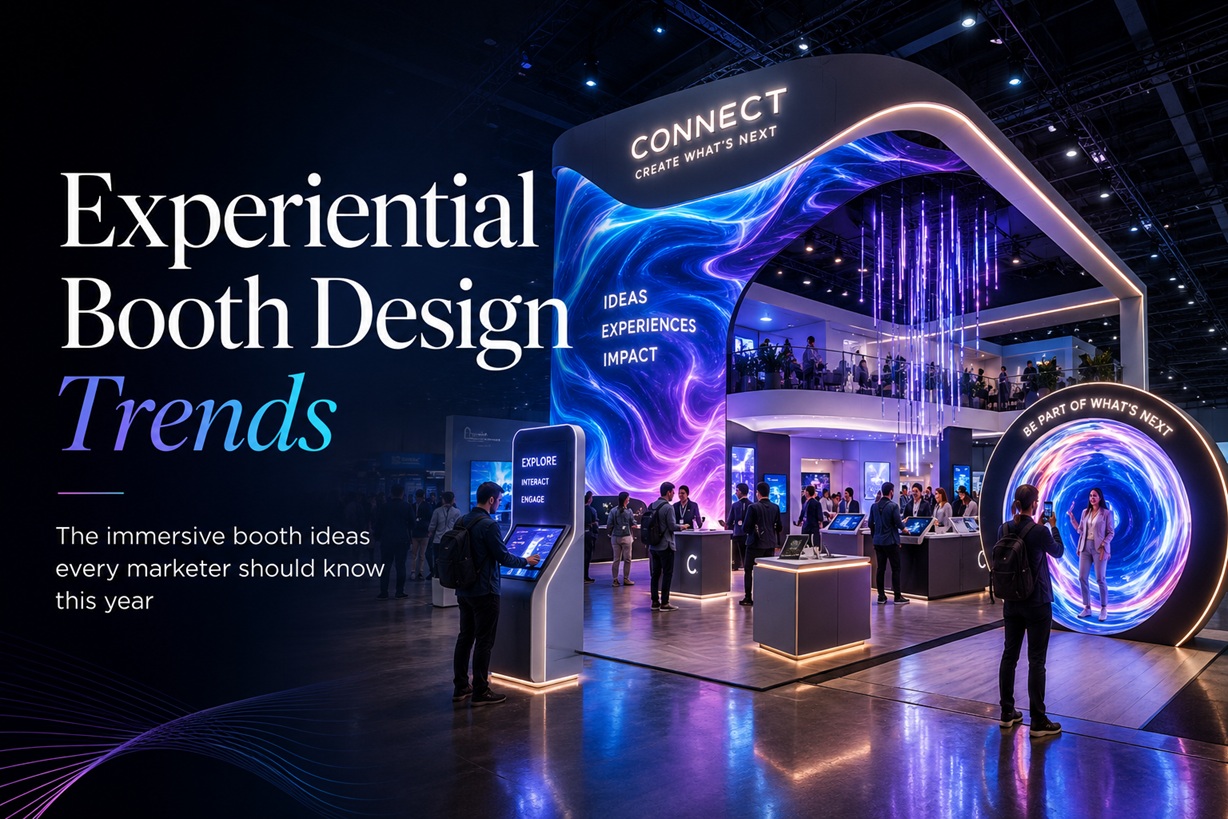
Trade show floors are becoming harder places to stand out. A table, a pull-up banner and a stack of brochures may still technically count as a booth, but they are unlikely to stop anyone who has already walked past dozens of similar displays.
Modern attendees expect something much more engaging. They want to interact with products, explore spaces, try technology, take photos and leave with an experience they can actually remember. That is why experiential booth design is moving from a nice extra to an important part of event marketing strategy.
The best booths today are not simply attractive. They are designed to pull people in, guide them through a story and create enough interest that visitors stay longer, ask questions and eventually become useful leads.
Why Experiential Design Matters More Than Ever
The biggest change in trade shows is that audiences are becoming less interested in passive presentations. Most people do not want to stand in front of a booth while somebody delivers a long sales pitch. They would rather explore something themselves, interact with a product or participate in an activity.
That makes first impressions extremely important. On a busy exhibition floor, visitors usually make very quick decisions about whether a booth looks worth entering. If the purpose of the space is unclear or the design looks identical to everything around it, people simply continue walking.
Experiential marketing can also produce strong returns when it is done properly. The original research cited suggests that many brands report returns several times larger than their initial experiential campaign investment. While results obviously vary between industries and events, the broader point is clear: a memorable physical experience can create stronger engagement than another static advertisement.
The challenge is doing that without turning the booth into a collection of gimmicks.
Booths Are Becoming Small Brand Journeys
One of the strongest design trends is moving away from a single open exhibition area and instead creating several distinct zones.
A visitor might first encounter something designed purely to capture attention. From there, the space could guide them toward an interactive product demonstration, followed by a quieter area where staff can have a proper conversation or discuss requirements.
This approach makes the booth easier to understand. Visitors naturally know where to move next, while staff can focus on particular parts of the experience instead of trying to conduct sales discussions in the middle of a crowded demonstration area.
Lighting, flooring, textures and furniture can also subtly change between zones, helping each section feel different while still belonging to the same brand.
The best result feels less like walking into a temporary stall and more like moving through a short physical story.
LED Walls And Lighting Are Becoming Part Of The Experience
Large printed graphics are not disappearing completely, but premium booths are increasingly using LED displays, backlit panels and programmable lighting to create more flexible environments.
The obvious advantage is visibility. Movement and changing light naturally attract attention on a crowded exhibition floor.
The more useful advantage, however, is adaptability.
The same wall could display a product demonstration during the morning, switch to customer stories later in the day and show social media content when traffic is at its busiest. Lighting can also change depending on what is happening inside the booth.
This gives brands more control over the atmosphere without physically rebuilding the space throughout the event.
Good lighting can also help define different parts of the booth, draw attention toward a product or create a recognisable visual identity that stands out even when viewed from across the hall.
AI And Interactive Technology Are Finally Becoming Useful
Technology has been appearing inside exhibition booths for years, but there has often been a temptation to add screens simply because screens look modern.
That is changing.
Interactive technology is becoming much more purposeful, particularly with the arrival of AI-powered interfaces. An AI concierge, for example, could welcome visitors, answer common questions, recommend demonstrations and direct higher-value prospects toward the appropriate member of the sales team.
That becomes especially useful during busy periods when staff are already occupied.
Touchscreen product configurators can let visitors customise products themselves. Augmented reality can demonstrate equipment that would otherwise be too large or expensive to bring onto the show floor. Interactive recommendation systems can help people discover which product or service best fits their needs.
Gamification can work too, provided the activity actually connects with the brand rather than simply existing to distribute prizes.
The goal should never be to demonstrate how much technology fits inside a booth. It should be to use technology to make the visitor's experience easier, more interesting or more personal.
Sustainable And Modular Booths Are Becoming The Practical Choice
Trade shows traditionally create a surprising amount of waste. Booth structures are built, graphics are printed, events end and much of that material may never be used again.
Brands are increasingly moving toward modular exhibition systems that can be rebuilt and reconfigured across multiple events.
There is an obvious environmental advantage, but there is also a financial one.
A well-designed modular booth can be adapted to different floor sizes, locations and campaigns without forcing the company to start again from scratch every time. Graphic panels can be replaced, sections can be expanded or removed, and lighting can be updated while the underlying structure stays the same.
Recycled materials, reusable graphics and lower-energy LED systems are also becoming more common.
Sustainability therefore does not necessarily mean compromising on appearance. In many cases, modular booth systems actually look more polished because brands can invest in higher-quality components knowing they will be used repeatedly.
Every Booth Now Needs A Moment People Want To Photograph
Social media has changed the value of physical event design.
A striking installation inside a booth is no longer seen only by the people attending the exhibition. If visitors photograph it and share it online, the design can reach audiences far beyond the venue itself.
That is why more brands are deliberately creating photo-worthy moments.
The important distinction is that this should not simply be another wall covered in company logos. Visitors need an actual reason to take the picture.
It might be an unusual sculpture, a dramatic lighting environment, an oversized version of the product or an immersive scene connected to the campaign theme.
When the photo still looks interesting even without a caption explaining it, the concept is probably working.
The branding can remain present, but it should feel like part of the experience rather than the entire purpose of the experience.
Sensory Design Is Making Booths More Memorable
Most booths concentrate heavily on what visitors see, but some of the strongest experiential spaces are beginning to engage several senses at once.
Sound can completely change the atmosphere of a booth. A technology company might use a subtle futuristic soundscape, while a lifestyle brand might choose something warmer and more relaxed.
Texture also matters. Materials that visitors can touch create a more physical connection with the brand, particularly when the product itself involves manufacturing, fashion, interiors or design.
Food and drink can be surprisingly effective as well when they make sense for the environment. Even something as simple as freshly brewed coffee can encourage visitors to slow down, remain in the booth and have a longer conversation.
Scent is another option, though it needs considerably more restraint in a shared exhibition hall.
These details work because memory is not purely visual. People often remember how a place felt long after they have forgotten exactly what was printed on the wall.
The Best Booth Technology Is Almost Invisible
One mistake brands should avoid is designing the booth around whatever technology happens to be fashionable that year.
A visitor should not walk away remembering that the booth contained five touchscreens, three LED walls and an AI chatbot.
They should remember what the brand does and why it matters to them.
Technology works best when it supports that objective quietly in the background. AI can make recommendations. Displays can adapt the story. Interactive tools can simplify demonstrations. Lighting can guide visitors through the space.
But the experience itself still needs a clear purpose.
That is where strong booth design differs from simply adding expensive equipment to an exhibition stand.
Bringing Everything Together
The most successful experiential booths are usually built around a few complementary ideas rather than trying to incorporate every available trend.
A modular structure could create several clearly defined visitor zones. Dynamic lighting might distinguish those areas. An interactive demonstration could provide the main engagement point, while a strong photo opportunity encourages social sharing.
Everything should connect back to the same brand story.
That consistency is what makes a booth feel intentionally designed rather than assembled from a catalogue of exhibition features.
Final Thoughts
Trade show booths are gradually evolving from temporary displays into small-scale branded destinations.
Visitors expect to participate rather than simply observe, which means booth design now needs to consider movement, interaction, technology, atmosphere and even shareability alongside traditional visual branding.
LED environments, AI-powered assistance, interactive demonstrations, modular construction and sensory design all have plenty of potential, but none of them automatically makes a booth successful.
The brands that stand out will be the ones that use those tools to create something genuinely useful or memorable.
On an exhibition floor where every company is competing for the same few seconds of attention, a booth that gives people a reason to stop, explore and stay a little longer already has a significant advantage.











Comments 0