

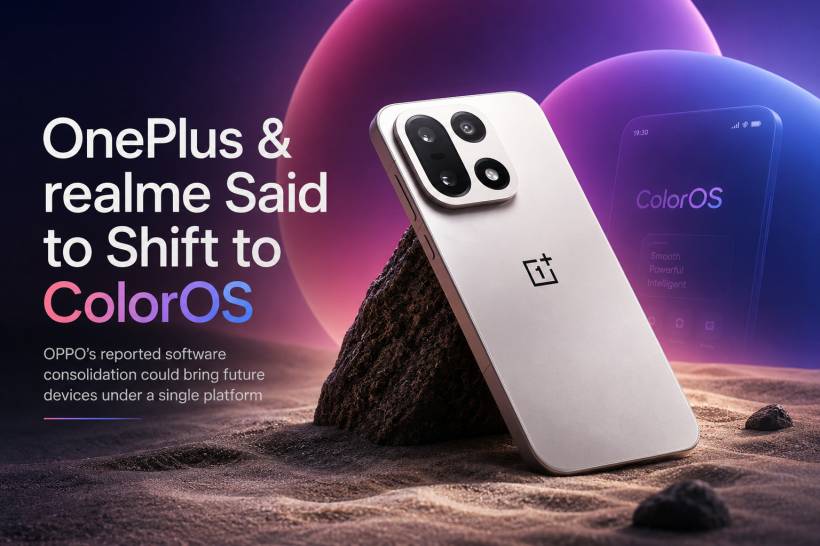
The software identity of OnePlus and realme may be heading for a major change. According to a recent report, OPPO is considering a deeper consolidation of its smartphone brands, which could eventually see OxygenOS and realme UI phased out in favour of ColorOS.
While nothing has been officially confirmed by the companies involved, the reported direction would not be entirely unexpected. OPPO, OnePlus and realme have long been closely connected behind the scenes, sharing technology, development resources and, in some markets, even service infrastructure.
From Separate Brands to a More Unified Strategy
For years, OnePlus positioned itself as the enthusiast-focused brand with a clean, fast and relatively simple Android experience through OxygenOS. realme, meanwhile, focused heavily on value-driven devices aimed at younger users, particularly in competitive markets where specifications and pricing matter most.
OPPO has generally taken a broader mainstream approach, offering devices across premium, mid-range and entry-level segments under the ColorOS platform.
The report suggests that OPPO may now be looking to simplify this structure by bringing software development for all three brands closer together. OnePlus is expected to concentrate more heavily on India and China, while realme could reportedly focus on markets outside its home region.
This would allow the wider group to maintain different product identities and pricing strategies while reducing duplication behind the scenes.
Why ColorOS Could Become the Common Platform
Developing and maintaining a custom Android interface is not a small task. Every major Android update requires months of work involving user-interface design, security improvements, device compatibility testing, feature development and bug fixes.
Maintaining OxygenOS, realme UI and ColorOS as separate platforms means supporting three branding approaches, multiple feature roadmaps and different software update expectations.
By moving more devices to ColorOS, OPPO could centralise those efforts. This could reduce research and development costs, speed up feature deployment and make it easier to provide consistent software support across a larger range of devices.
In practical terms, a shared platform could also allow improvements in camera software, battery optimisation, artificial intelligence tools and security features to reach more devices sooner.
The Shift Has Been Building for Years
OnePlus and OPPO officially began operating more closely together in 2021. Around that period, both brands announced plans to share a common codebase and bring OxygenOS and ColorOS closer under a unified development structure.
Although OnePlus continued to use the OxygenOS name in international markets, many users noticed that the software had already become increasingly similar to ColorOS in its design, settings layout and underlying features.
realme UI has also shared many visual and technical similarities with ColorOS over the years. Because of this, a possible full transition may feel less dramatic for many realme users.
For OnePlus users, however, the reaction could be very different.
OxygenOS Still Has a Strong Following
OxygenOS built its reputation on a clean interface, smooth performance and a less cluttered approach than many other Android skins. It became one of the key reasons why early OnePlus devices developed such a loyal fanbase.
While later versions of OxygenOS moved closer to ColorOS, many OnePlus users still associate the brand with software that feels lighter, faster and more straightforward than a typical feature-heavy Android interface.
A full switch to ColorOS may therefore create concern among long-time fans. They may worry about more pre-installed applications, visual changes, different privacy settings or a software experience that feels less distinct from OPPO devices.
Of course, whether those concerns become reality will depend on how OPPO chooses to customise ColorOS for each brand.
What This Could Mean for Existing Users
Current OnePlus and realme owners are unlikely to see an immediate change to their existing devices. Smartphone companies generally continue supporting older models under their original software names for a period of time, especially where update commitments have already been made.
The bigger impact would likely be on future launches.
New OnePlus and realme phones could potentially share more of the same design language, system features and software tools as OPPO devices. The brands may still retain their own launchers, wallpapers, apps or visual styling, but the underlying operating system could become far more unified.
This may be good news for users who value frequent updates and consistent features. On the other hand, it could reduce the unique character that once separated OnePlus, realme and OPPO from one another.
Final Thoughts
The reported move towards ColorOS reflects a wider trend in the smartphone industry. As competition becomes tougher and development costs continue rising, brands are increasingly looking for ways to share platforms and resources without losing their market identity.
For OPPO, a unified software strategy could make business sense. For users, though, the experience will depend on whether the company can preserve what people liked about OnePlus and realme in the first place.
OnePlus fans may be especially watchful. The brand became popular not just because of hardware specifications, but because OxygenOS gave it a personality of its own. Whether that identity can survive under a more unified ColorOS approach remains to be seen.











Comments 0