

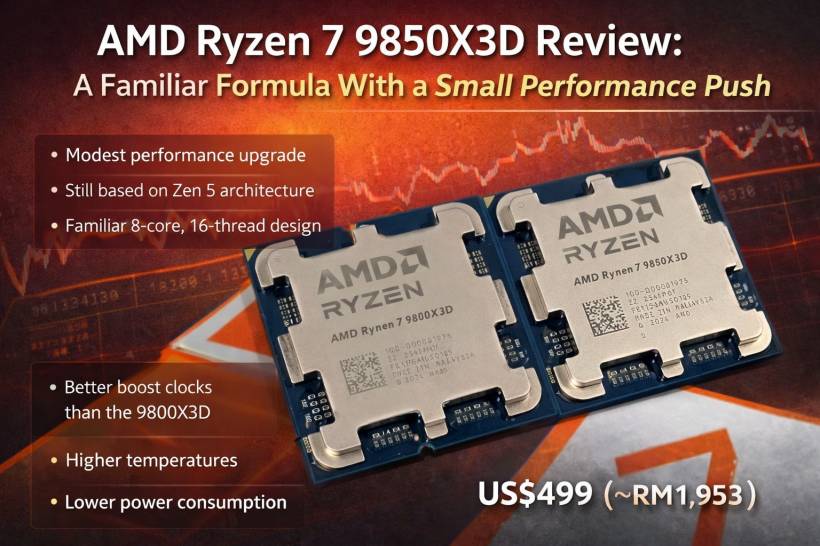
AMD's Ryzen X3D lineup has built a strong reputation among PC enthusiasts, especially gamers who want the extra edge that 3D V-Cache can bring. So whenever a new X3D chip appears, expectations naturally rise. People start wondering whether this is the next must-have upgrade or another major leap for gaming performance.
With the Ryzen 7 9850X3D, though, AMD does not seem interested in dramatically changing the story. This is not one of those processors that arrives with a bold new direction or a completely fresh identity. Instead, it feels more like a careful refinement of something that was already working well. It offers a bit more speed, keeps the same overall design philosophy, and positions itself as another option for buyers who want an upper-end gaming CPU without stepping all the way up to the more expensive models.
That makes the 9850X3D an interesting release, but also a slightly awkward one. It is clearly not a revolutionary product, yet it is not meaningless either. It sits in that familiar middle ground where the improvements are real, just not dramatic enough to completely reshape the conversation.
More Refresh Than Reinvention
At its core, the Ryzen 7 9850X3D stays very close to what AMD already established with the Ryzen 7 9800X3D. The architecture remains the same, based on Zen 5, with the same 4nm compute design and 6nm I/O die. It also keeps the same 8-core, 16-thread layout and the same generous L3 cache configuration that defines the X3D family.
The biggest difference is the boost clock, which now reaches 5.6GHz. That puts it 400MHz higher than the 9800X3D, and that is really the main point of separation. Beyond that, there is very little here that feels fundamentally new.
Because of that, the 9850X3D gives off the impression of being a refresh rather than a major new chapter in AMD's desktop CPU strategy. It looks like AMD took a formula that already had proven appeal, adjusted the tuning slightly, and sent it back into the market as a slightly faster, slightly newer option.
There is nothing necessarily wrong with that approach. In fact, many buyers would probably welcome a familiar chip with a little extra polish. The issue is simply that it makes the processor harder to get excited about in a big-picture sense.
Test Setup and Comparison
For benchmarking, the processor was tested in a review setup provided by AMD. The platform itself was not entirely new, with most of the supporting hardware staying consistent apart from a different motherboard. That helps keep comparisons relatively straightforward, since the focus stays on the CPU rather than on changes in surrounding components.
The Ryzen 7 9850X3D was compared against the Ryzen 9 9950X and the Ryzen 7 9800X3D. While the Ryzen 9 9950X3D would have been a useful point of comparison too, it was not available during this round of testing.
That still leaves enough context to understand where the 9850X3D fits. The most important comparison, of course, is against the 9800X3D, because that is the processor it most directly resembles and the one many buyers will naturally weigh it against.
AMD Ryzen 7 9800X3D vs Ryzen 7 9850X3D
At a glance, the Ryzen 7 9850X3D looks very similar to the 9800X3D, with the biggest difference being its higher boost clock. While both chips share the same Zen 5 foundation, 8-core 16-thread layout, and 104MB of L3 cache, the newer model offers only a modest performance uplift rather than a major leap.
| Specification | Ryzen 7 9800X3D | Ryzen 7 9850X3D |
| Architecture | Zen 5 | Zen 5 |
| Cores / Threads | 8 / 16 | 8 / 16 |
| Max Boost Clock | 5.2GHz | 5.6GHz |
| L3 Cache | 104MB | 104MB |
| Gaming Focus | Yes | Yes |
| Performance Uplift | - | Small improvement |
| Power Efficiency | Good | Better |
| Thermals | Better controlled | Runs hotter |
| Best For | Gamers wanting strong X3D value | Buyers wanting the slightly newer option |
Gaming and Benchmark Performance
Once the benchmarks begin, the story becomes fairly clear. The Ryzen 7 9850X3D is faster than the 9800X3D in certain tests, but the gains are modest. This is not the sort of chip that storms ahead and makes its predecessor immediately feel outdated.
In synthetic workloads, there are places where the extra clock speed gives it an advantage. The uplift is visible enough to confirm that the processor is indeed quicker, but not to the degree that it transforms the user experience in a major way.
Gaming is where expectations tend to be highest for any X3D chip, and here the results are mixed but generally solid. In some games, the 9850X3D performs almost identically to the 9800X3D. In others, the improvements are present but small. There are even cases where the difference is so narrow that most players would never notice it outside of a benchmark chart.
Monster Hunter Wilds is one of the examples where the newer chip does not clearly pull ahead. Even so, the results are still strong in absolute terms. Running above 100fps alongside an RTX 5090 is hardly disappointing, even if the performance does not create much distance from its sibling.
The same general pattern continues in Battlefield 6 and Expedition 33. The higher boost clock helps somewhat, but not enough to create a dramatic performance gap. Still, maintaining frame rates beyond 200fps in some situations, and comfortably over 100fps in others, is nothing to dismiss. The processor remains a high-performance gaming chip by any practical standard.
Cyberpunk 2077 stands out as the title where the Ryzen 7 9850X3D does manage to pull ahead more convincingly. That gives the chip at least one showcase result where the extra tuning appears to pay off more clearly. But even then, the overall takeaway remains the same: this is an incremental step, not a giant leap.
Power Draw and Thermal Behavior
One of the more interesting parts of the results comes from power and temperature behavior. Surprisingly, the Ryzen 7 9850X3D appears to consume less power than the 9800X3D. That is a welcome outcome, especially in a market where efficiency is increasingly part of the conversation.
The trade-off, however, is heat.
While power consumption is lower, the chip runs noticeably hotter. Peak temperatures hovered around 91°C on average, with occasional spikes reaching 93°C. That is not necessarily alarming for a modern high-performance desktop CPU operating within its design limits, but it is still something builders should pay attention to.
In practical terms, this means anyone considering the 9850X3D should not treat cooling as an afterthought. Even if the processor is efficient in one sense, it still seems eager to push its thermal limits under load. A capable cooling solution will matter if you want the chip to perform consistently without running uncomfortably hot.
Pricing and Overall Value
At US$499, which works out to roughly RM1,953, the Ryzen 7 9850X3D lands in a position that is easy to understand but slightly harder to justify enthusiastically. It costs just a bit more than the 9800X3D, and for that extra money, what you are really getting is a modest 400MHz bump and small performance gains in selected workloads.
That does not make it a bad product. Far from it. It is still a very capable gaming CPU, and in the right build, it will deliver excellent results. The question is whether it feels exciting enough to stand on its own.
For users coming from much older platforms, such as Ryzen 5000 or even certain Ryzen 7000 systems, the 9850X3D can make sense as part of a broader upgrade. The same goes for buyers moving away from Intel's recent higher-end desktop offerings and wanting a strong gaming-focused alternative. In those scenarios, the chip fits neatly into a premium build strategy.
But for someone already using a 9800X3D, the argument becomes much weaker. The improvements are simply too minor to feel transformative.
Final Thoughts
The AMD Ryzen 7 9850X3D feels like a processor that exists because there was room for it, not because the market was desperately waiting for it. It is competent, fast, and undeniably good at what it does. But it also feels very safe, very familiar, and a little too close to the chip that came before it.
That does not mean it should be ignored. For buyers putting together a new gaming rig and wanting a modern X3D option, it is still a strong candidate. It delivers high frame rates, performs well across the board, and gives AMD another solid entry in its gaming CPU lineup.
Still, this is one of those releases where the biggest compliment may also be the most restrained one: it works, it performs well, and it gives buyers another 3D V-Cache option. It just does not do much beyond that.











Comments 0