

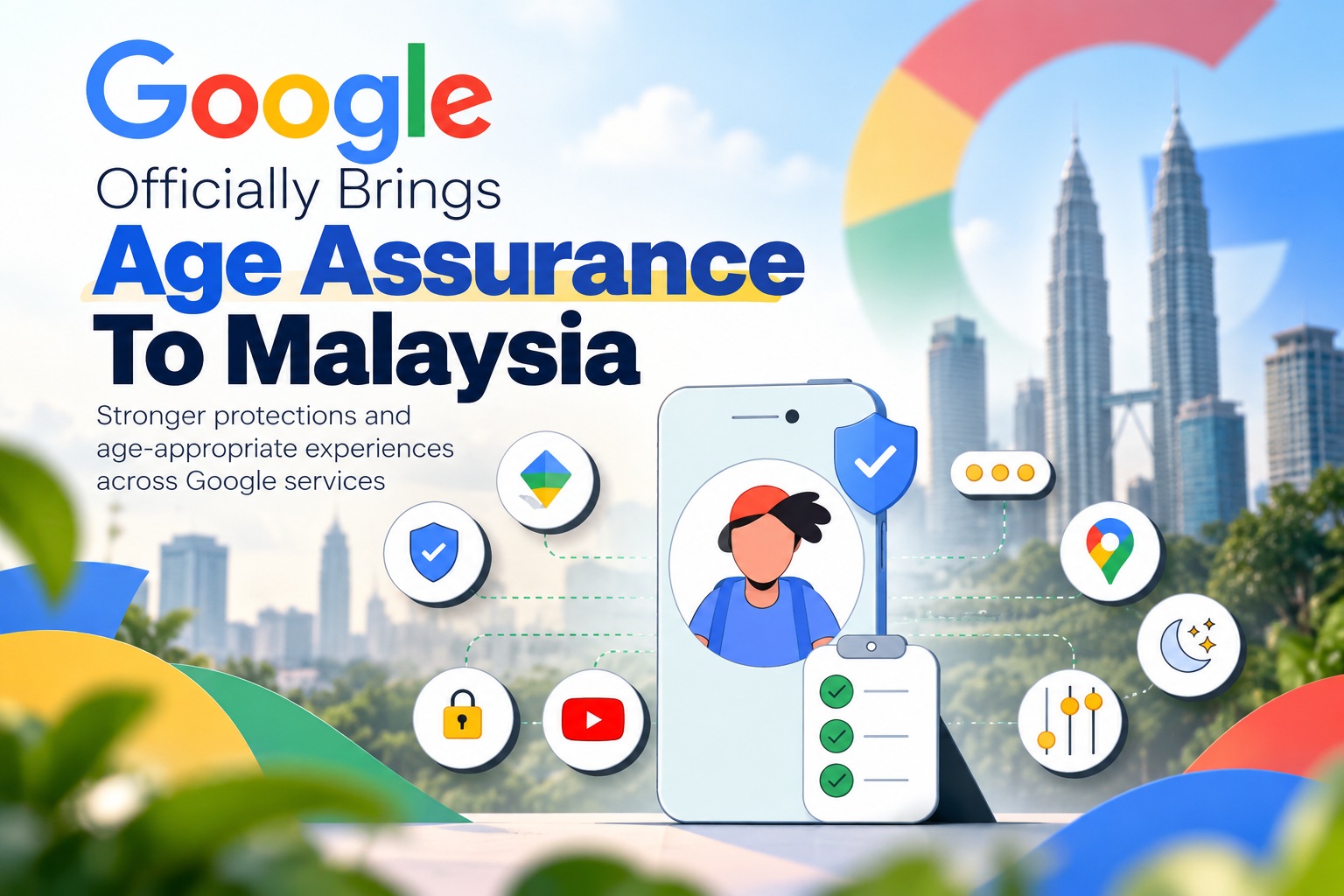
Google has officially introduced its age assurance technology in Malaysia, following earlier rollouts in Singapore and several other markets. The system is designed to estimate whether a user is above or below the age of 18 so that Google can automatically apply what it describes as more age-appropriate experiences across its products and services.
Users identified as likely being under 18 will receive a broader range of protections without needing to configure them manually. These safeguards affect services including Google Search, Google Play, Gemini, Maps and YouTube, with the aim of reducing exposure to mature content, limiting personalised advertising and encouraging healthier usage habits among younger users.
Under-18 Accounts Will Receive Additional Protections
If Google's system determines that a user is likely under 18, several account settings will automatically become more restrictive. SafeSearch will be enabled by default, helping filter explicit material from Google Search results.
Mature content will also be restricted across Google Play and Gemini, reducing the likelihood that younger users encounter material intended for adults. Personalised advertising will be disabled, preventing ads from being tailored based on an underage user's activity or inferred interests.
Google Maps will also disable Location Timeline for accounts estimated to belong to users below 18. This prevents the service from maintaining the same kind of historical location record that may otherwise be available to adult users.
YouTube Gets Additional Digital Wellbeing Controls
YouTube is receiving its own set of protections as part of the age assurance rollout. Google will automatically enable several Digital Wellbeing features for users considered under 18.
These include "Take a break" reminders, which encourage users to step away after spending extended periods watching videos, and "Time for bed" reminders intended to reduce late-night viewing.
The platform will also introduce additional protections around recommendation systems. Google says this includes measures designed to limit repeated exposure to certain types of content, reducing the possibility that younger users repeatedly encounter the same potentially sensitive or unhealthy themes.
Google Uses Machine Learning To Estimate Age
Rather than asking every user to submit identification documents upfront, Google's age assurance system uses machine learning to estimate whether an account belongs to someone above or below 18.
The model analyses signals already associated with the user's Google account. One example highlighted by the company is the type of information the user searches for, although the system may consider a range of existing account signals when making its assessment.
Google says the process does not require the company to collect additional data specifically for age estimation. Instead, it relies on information already available within the account and uses those existing signals to make a prediction.
The System Does Not Depend Only On A User's Declared Birthday
Age assurance differs from simply trusting the birthday entered when a Google account is created. A user may have entered an incorrect age, deliberately or otherwise, making self-declared information less reliable when determining which protections should apply.
The machine-learning approach attempts to identify whether the behaviour and signals associated with an account are consistent with someone under or over 18. This allows Google to apply additional protections even when the age originally entered into the account may not accurately reflect the user's real age.
At the same time, estimation naturally creates the possibility that some adults will be classified incorrectly, which is why Google includes a verification process.
Users Will Be Told When Their Account Is Affected
Users whom Google estimates to be under 18 will not have the changes applied silently. The company says affected users will receive notifications explaining what has changed and why.
These notifications may appear by email as well as while users interact with Google products. The information will also explain how someone can challenge the decision if they are an adult but have been incorrectly classified as being under 18.
This gives users an opportunity to verify their actual age rather than remaining permanently subject to the automatically applied restrictions.
Adults Can Verify Their Age Using ID Or A Selfie
Adults who are incorrectly identified as being under 18 can verify their age in one of two ways. One option is to provide a photo of a government-issued identification document.
The second option is to submit a selfie, which Google can use as part of the age verification process. Once the user's age has been confirmed, the additional restrictions associated with an under-18 account can be adjusted accordingly.
The announcement, however, does not explain in detail how long these verification images are retained after the process is complete.
The Handling Of Verification Images Remains An Important Question
The option to verify age using a government-issued ID or selfie naturally raises privacy questions. Both methods potentially involve highly sensitive personal information, particularly where official identity documents are concerned.
Google's announcement explains how users can verify their age but does not specify whether images submitted during the process are automatically deleted once verification is finished.
That detail will likely matter to privacy-conscious users who may be comfortable proving their age but do not necessarily want copies of identification documents or biometric-style images retained longer than necessary.
SafeSearch Becomes One Of The First Lines Of Protection
SafeSearch is one of the most visible changes for accounts estimated to belong to minors. When enabled, the feature attempts to filter sexually explicit material and other mature content from Google Search results.
The setting already exists for users who want to enable it manually, but age assurance allows Google to switch it on automatically when it believes the account belongs to someone under 18.
This reduces reliance on younger users configuring their own content protections or on parents remembering to enable every setting individually.
Google Play Will Restrict Mature Content
Google Play is another service affected by the new age assurance system. Users estimated to be under 18 will face restrictions on mature applications and content.
This could influence which apps, games or other material appear within the store and what younger users are allowed to access. The objective is to create a store experience that better reflects the user's estimated age.
Applying these controls automatically also gives Google a consistent way of protecting younger users across different devices linked to the same account.
Gemini Will Also Apply Age-Based Restrictions
Google's Gemini AI assistant is included in the rollout as well. Accounts estimated to belong to users under 18 will face restrictions on mature material when interacting with Gemini.
That is increasingly important as AI assistants become capable of responding to a much wider range of questions than traditional search engines. A system designed for adults may discuss subjects differently from one configured for younger users.
Age assurance gives Google another mechanism for adapting Gemini's behaviour according to the estimated age of the person using the account.
Personalised Advertising Will Be Disabled
Users classified as being under 18 will no longer receive personalised advertising based on their account activity. Instead, the ads presented to them will not use the same level of behavioural targeting available for adults.
This reduces the amount of personalisation applied to younger users and limits the use of their activity for advertising purposes.
The change is consistent with wider efforts across the technology industry to place stronger restrictions around how children's and teenagers' information is used for advertising.
Location Timeline Will Be Turned Off
Google Maps' Location Timeline will also be disabled automatically for younger users. The feature normally allows users to maintain a history of places they have visited and routes they have taken.
While some people find this useful for remembering previous journeys or locations, it also creates a detailed record of movement over time. For minors, Google is choosing to disable that functionality as part of its enhanced privacy protections.
The Maps application itself will remain usable for navigation and location searches; the change specifically concerns the ongoing historical timeline.
The System Is Designed To Work Across Google Services
One of the more significant aspects of age assurance is that the estimate can influence several Google products rather than being limited to one individual app.
A single determination about whether an account likely belongs to someone under 18 can affect Search, YouTube, Play, Maps, Gemini and advertising settings simultaneously.
That creates a more consistent experience than having each service maintain completely separate age controls. It also gives Google the ability to apply protective defaults automatically across its wider ecosystem.
Machine Learning Makes Age Estimation More Flexible
The use of machine learning allows Google to evaluate patterns rather than relying entirely on one piece of information. A user's activity may provide enough signals for the model to estimate whether the person is more likely an adult or minor.
This approach can be useful when account profile information is incomplete or inaccurate. However, no estimation system is perfect, which means false positives and incorrect classifications remain possible.
That is why the verification process is important. Automated estimation may determine the default protections, but users still need a way to correct the result when the system gets it wrong.
Age Assurance Is Different From Full Identity Verification
It is important to distinguish between estimating someone's age and verifying their full identity. Google's system is primarily trying to determine whether the user falls above or below the 18-year threshold.
The company does not necessarily need to know exactly who the user is before applying additional protections. In many cases, the machine-learning system can make an age estimate without requiring government identification.
Identity documents or selfies become relevant mainly when an adult wants to prove that the automatic estimate was incorrect.
The Rollout Reflects Growing Pressure Around Online Child Safety
Age assurance is becoming increasingly important across online platforms as governments, regulators and technology companies look for ways to better protect younger users.
Social networks, gaming services, video platforms and AI systems all face growing pressure to prevent children from accessing inappropriate content or being exposed to harmful recommendation patterns.
Google's approach attempts to address this without requiring every user to complete full identity verification from the beginning. Instead, automated estimation applies stronger protections when the system believes they are needed.
The Malaysian Rollout Could Affect A Large Number Of Services
Because Google services are deeply integrated into Android phones, web browsers and everyday online activity, the arrival of age assurance in Malaysia could affect a significant number of users.
Younger users may notice different Search results, fewer mature apps in Google Play, altered Gemini responses, changed YouTube recommendations and fewer personalised advertisements.
Parents may also benefit from some of these protections being applied automatically instead of needing to configure every Google service separately.
The effectiveness of the system will ultimately depend on how accurately the age model identifies minors without incorrectly restricting adults.
Adults May Occasionally Need To Correct The System
No machine-learning system can estimate age perfectly, particularly when working from behavioural information rather than a verified date of birth. Some adults may therefore find themselves suddenly receiving under-18 restrictions.
Google's notification system should make these situations easier to identify. Users will be informed that their account settings have changed and given instructions on how to confirm their actual age.
The inconvenience will largely depend on how straightforward the verification process is and how quickly the restrictions are removed after successful verification.
Privacy Will Remain Central To Acceptance
The success of age assurance will depend not only on accuracy but also on whether users trust how the system handles their information.
Google says it is relying on signals already associated with accounts rather than collecting additional data specifically for the age estimation model. That may reassure users who do not want another layer of personal information collected simply to determine whether they are adults.
However, the verification stage still raises questions because users may need to submit identification or a selfie. Clear information about retention, processing and deletion of those images would therefore help provide greater transparency.
Final Thoughts
Google's rollout of age assurance in Malaysia introduces a new layer of automatic protection for users the company believes are under 18. Using machine learning and existing account signals, Google estimates whether someone is an adult or minor and adjusts several services accordingly.
Under-18 accounts will receive protections including SafeSearch by default, restrictions on mature content in Google Play and Gemini, the removal of personalised advertising and the disabling of Google Maps Location Timeline. YouTube users will also receive stronger Digital Wellbeing features and additional safeguards around repetitive recommendations.
The system does not require every user to submit identification, which makes the approach less intrusive than universal age verification. However, adults who are wrongly classified may need to prove their age through a government-issued ID or selfie.
The biggest remaining question concerns what happens to those verification images after the process is complete, as Google's announcement does not clearly explain whether they are immediately deleted.
Overall, the Malaysian rollout reflects a broader shift towards online platforms taking more responsibility for identifying younger users and applying stronger protections automatically. The challenge will be balancing those protections with accuracy, privacy and a verification process that does not create unnecessary friction for adults.











Comments 0