

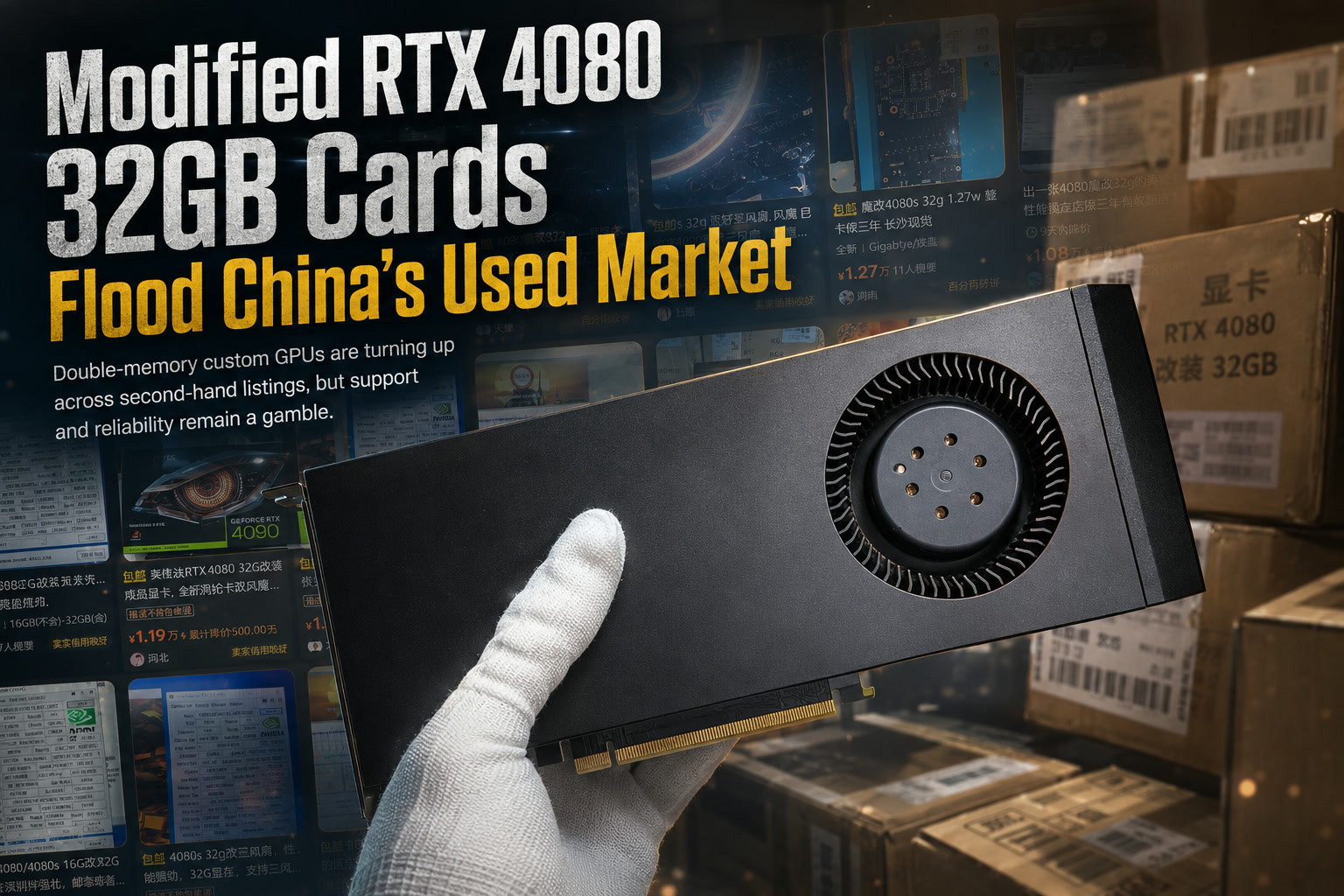
China's second-hand graphics card market has become an increasingly interesting place to watch, especially as hardware modders continue pushing consumer GPUs far beyond their original specifications. The latest example involves the NVIDIA GeForce RTX 4080, with modified versions carrying a massive 32GB of GDDR6X memory now reportedly appearing in significant numbers across Chinese resale platforms.
That is double the memory NVIDIA originally equipped the RTX 4080 with, turning what was already a powerful gaming GPU into something considerably more unusual.
The RTX 4080 Was Never Supposed to Have 32GB
When NVIDIA launched the GeForce RTX 4080 in 2022, the card arrived with 16GB of GDDR6X VRAM connected through a 256-bit memory interface.
The original specifications were already substantial, with thousands of CUDA cores and memory bandwidth exceeding 700GB/s. At the time, it sat just below the flagship RTX 4090 within NVIDIA's Ada Lovelace generation, before the RTX 4080 Super eventually arrived as a refreshed version.
What is now appearing in China, however, is something NVIDIA never officially produced: an RTX 4080 equipped with 32GB of memory.
These aren't engineering samples or secret NVIDIA products. They are aftermarket modifications, with technicians replacing and reconfiguring the memory hardware on existing RTX 4080 boards.
And apparently, there are now enough of them circulating that they are becoming relatively common on Chinese second-hand marketplaces.
They Aren't Exactly Cheap Either
The unusual memory configuration comes with a substantial asking price.
Reports suggest some of these modified RTX 4080 32GB cards are being listed for more than 10,000 yuan, which works out to roughly RM6,000, depending on exchange rates.
At that price, buyers clearly aren't being targeted purely as ordinary gamers.
After all, doubling the VRAM does not suddenly make an RTX 4080 twice as fast in games. Most games aren't going to take advantage of 32GB of graphics memory in the first place.
Where the extra memory becomes much more interesting is in workloads such as AI model inference, local generative AI, machine learning experiments, 3D rendering, large texture projects, scientific workloads and other GPU-intensive applications where VRAM capacity can become a limiting factor.
A GPU can have plenty of processing power, but if a workload needs 20GB of memory and the card only has 16GB available, performance suddenly becomes irrelevant because the workload may simply not fit.
That makes these heavily modified cards potentially attractive to a very different audience.
China's GPU Modding Scene Has Done This Before
The RTX 4080 isn't the first Ada Lovelace GPU to receive this treatment.
Modified RTX 4080 Super cards with 32GB of VRAM have previously appeared in China as well, reportedly in even greater quantities.
Then there are the more extreme examples.
Custom RTX 4090 and RTX 4090D cards carrying 48GB of memory have also surfaced, effectively doubling the official 24GB capacity of NVIDIA's flagship gaming-class GPUs.
The trend illustrates how sophisticated the GPU modification ecosystem has become.
Instead of simply repairing graphics cards, some workshops are effectively rebuilding portions of them, replacing memory chips, modifying board configurations and adapting firmware or drivers to make hardware operate in configurations NVIDIA never intended to sell.
It is impressive from a technical perspective, but it also creates an entirely different category of risk for buyers.
The Real Attraction May Be AI Rather Than Gaming
A 32GB RTX 4080 might sound like the ultimate gaming graphics card, but gaming probably isn't the biggest reason these cards exist.
Modern AI workloads have made GPU memory extremely valuable.
Running larger language models locally, generating high-resolution images, processing video through AI models or experimenting with machine-learning frameworks can consume enormous amounts of VRAM.
That has created an unusual market where some users care more about memory capacity per dollar than conventional gaming benchmarks.
An RTX 4080 with 32GB may therefore occupy an interesting middle ground. It retains the computational capabilities of the RTX 4080 while providing substantially more memory for workloads that would otherwise require considerably more expensive professional GPUs.
Of course, there is an enormous catch.

Driver Support Becomes Complicated
NVIDIA never released an official 32GB RTX 4080.
That means NVIDIA's standard GeForce driver stack isn't designed around this particular hardware configuration.
The normal RTX 4080 remains fully supported through NVIDIA's official drivers, but those drivers expect the GPU to have its standard 16GB memory configuration.
Modified cards can therefore require customized drivers, patches or other workarounds to function correctly.
That creates an ongoing maintenance problem.
Every major driver update, operating system update or new application could potentially introduce compatibility issues. Instead of simply downloading the newest NVIDIA Game Ready Driver and installing it, owners of these cards may need to wait for a compatible modification or manually patch their setup again.
For an enthusiast who enjoys experimenting with unusual hardware, that might be acceptable.
For someone expecting a normal plug-and-play graphics card, it could become frustrating very quickly.
Reliability Is Another Big Question
Then there is the physical modification itself.
Replacing graphics memory on a modern high-end GPU is not remotely comparable to upgrading RAM in a desktop PC. The memory chips are soldered directly onto the graphics card's PCB and require specialized equipment, precise soldering and considerable technical expertise.
The quality of the finished product therefore depends heavily on whoever performed the modification.
A well-equipped workshop with experienced technicians may produce a card that operates reliably.
A poorly executed modification could result in memory errors, crashes, overheating, instability or eventually complete hardware failure.
And because these aren't officially manufactured 32GB RTX 4080 cards, buyers shouldn't expect NVIDIA or the original board manufacturer to provide warranty coverage if something goes wrong.
Essentially, purchasing one means trusting the person or company that performed the conversion.
Used Hardware Adds Another Layer of Uncertainty
There's another detail worth remembering: many of these cards are being sold through second-hand channels.
That introduces questions beyond the VRAM modification itself.
Buyers may not know how heavily the original GPU was previously used, whether it spent years running continuous compute workloads, whether components were replaced during refurbishment or whether the board has undergone multiple repairs.
A beautifully cleaned cooler and a fresh set of thermal pads don't necessarily reveal the history of the GPU underneath.
That doesn't automatically make these cards unreliable, but it does mean buyers need to approach them very differently from a brand-new retail GPU.
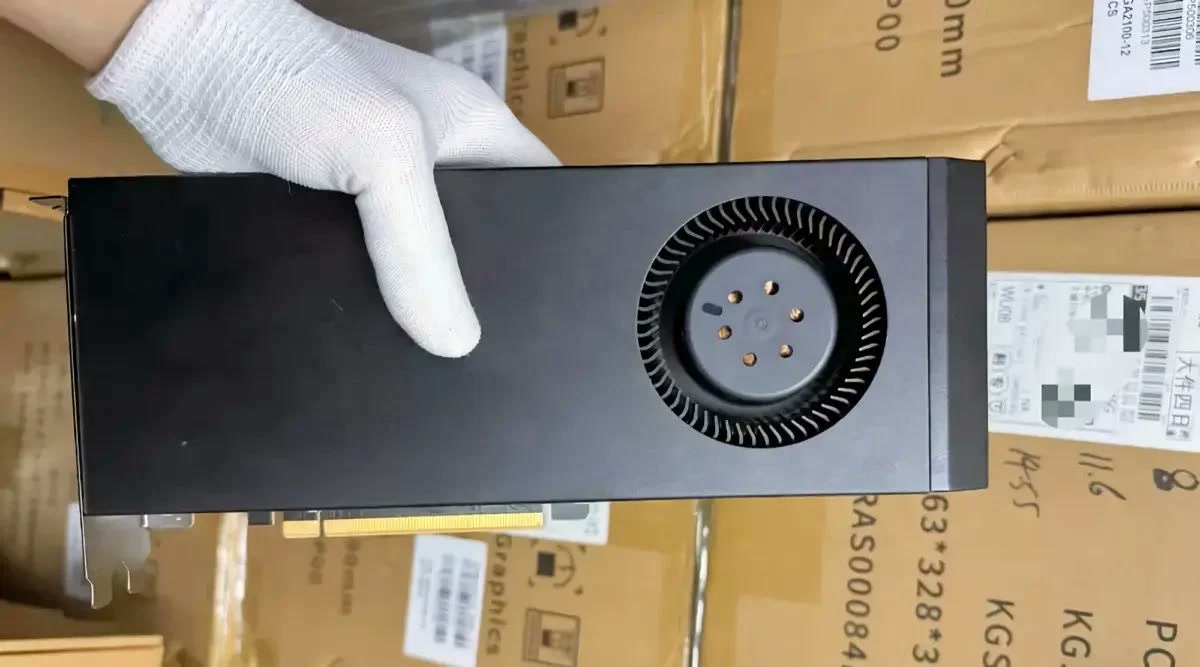
32GB Sounds Amazing, but It Isn't Automatically Better
Seeing "RTX 4080 32GB" on a listing is certainly eye-catching.
But VRAM capacity alone doesn't determine performance.
The GPU still has the same fundamental RTX 4080 architecture and processing resources. Adding another 16GB of memory doesn't magically transform it into an RTX 4090 or a professional workstation GPU.
For gaming, the difference between 16GB and 32GB could be negligible in many titles.
For AI, rendering and other memory-intensive workloads, however, that additional VRAM could genuinely make workloads possible that simply wouldn't fit on the standard card.
That distinction is important.
These modified GPUs are less about making the RTX 4080 faster and more about removing its memory limitation.
A Fascinating Example of Where the GPU Market Is Heading
The growing number of modified RTX 4080 32GB cards appearing in China shows just how valuable high-capacity GPUs have become.
A few years ago, enthusiasts modifying graphics cards were usually chasing higher clocks, extreme cooling or benchmark records.
Today, one of the most desirable upgrades is simply more VRAM.
The explosion of AI workloads has changed what many users expect from GPUs, and the demand for large memory capacities is encouraging hardware modders to create configurations that manufacturers never officially offered.
For technically experienced buyers who understand exactly what they're purchasing, a 32GB RTX 4080 could be an intriguing piece of hardware.
For everyone else, though, the lack of official drivers, uncertain warranty coverage and unpredictable quality of the modification make these cards considerably riskier than their impressive specifications might suggest.
Final Thoughts
A 32GB RTX 4080 is undeniably fascinating because it demonstrates just how far skilled hardware modification can go. Doubling the VRAM of a high-end GPU potentially opens the door to much larger AI and professional workloads without moving into extremely expensive workstation hardware.
But this is very much enthusiast territory.
You're not buying an NVIDIA-supported RTX 4080 32GB. You're buying a modified piece of hardware whose stability, driver compatibility and long-term reliability depend heavily on the quality of the conversion.
For most gamers, the standard RTX 4080's 16GB remains more than sufficient. But for AI enthusiasts constantly running into VRAM limits, it's easy to understand why these strange 32GB cards have found a market.











Comments 0