

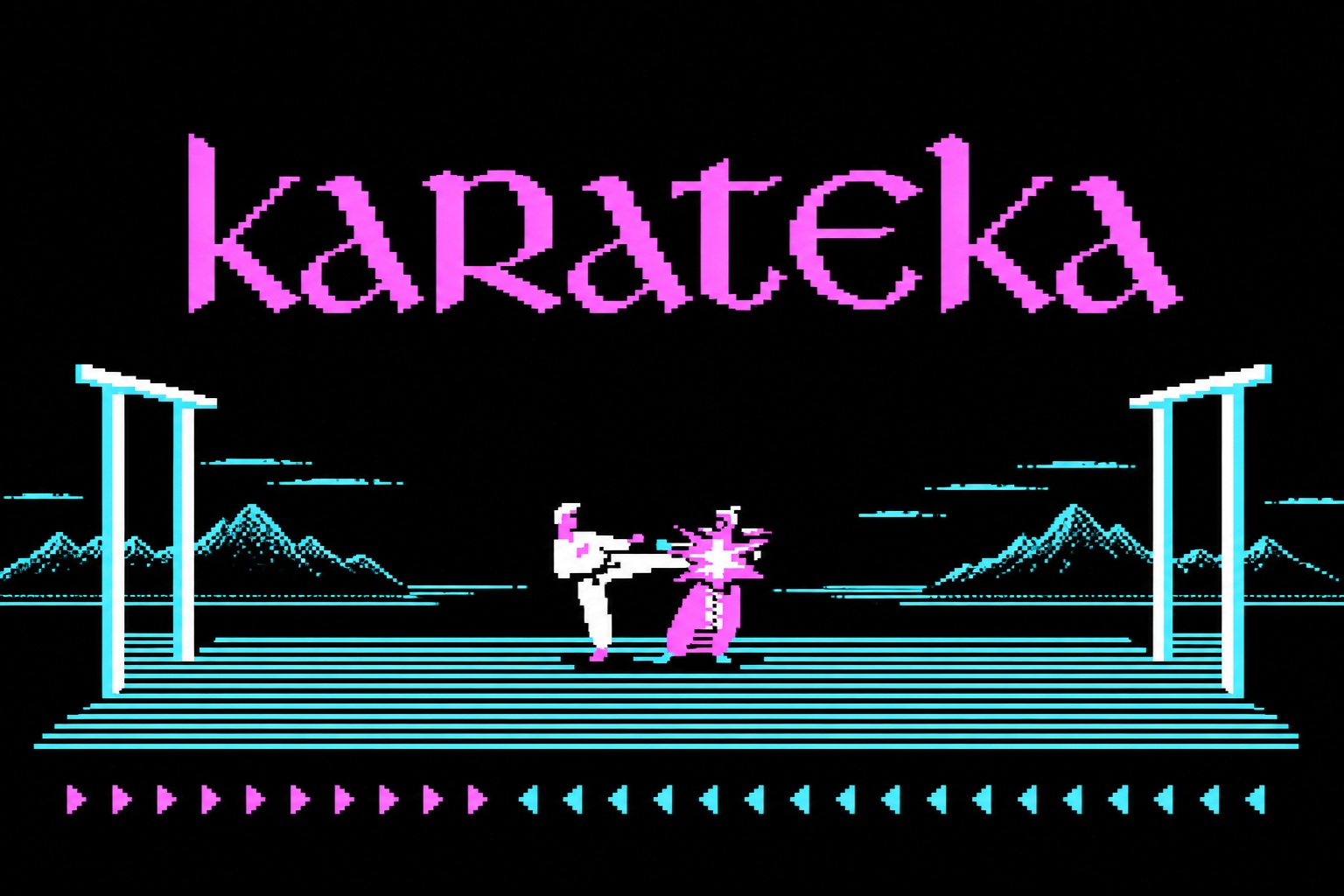
Karateka is one of the most important early examples of a video game attempting to feel like an interactive movie. Created by Jordan Mechner and originally released for the Apple II in 1984 before reaching DOS in 1986, the game follows a lone martial artist travelling into the fortress of the evil warlord Akuma. Princess Mariko has been captured and imprisoned inside, leaving the player to fight through Akuma's guards one opponent at a time before confronting the warlord himself. The premise is deliberately simple, allowing the animation, combat, atmosphere, and cinematic presentation to carry the adventure.
Unlike faster arcade fighting games, Karateka approaches martial arts with a surprisingly deliberate rhythm. The hero must alternate between travelling through the fortress and entering a fighting stance when enemies approach, carefully judging distance before attacking. Punches and kicks need to be timed rather than repeatedly thrown without thought, while reckless movement can leave the player vulnerable to a quick defeat. Its combat may appear basic by modern standards, but the emphasis on spacing, timing, observation, and discipline gives every confrontation a tense quality.
Now playable online through Lemon Web Games, Karateka brings its martial arts combat, dramatic fortress journey, fluid character animation, and classic rescue story directly into the web browser. Players can advance toward Akuma's inner chambers, confront increasingly dangerous guards, manage their health carefully, and learn the rhythm required to survive each one-on-one battle. The experience remains remarkably focused, with almost every screen contributing either to the journey or the confrontation waiting ahead. For anyone interested in early cinematic games, classic DOS action, or the creative history behind Prince of Persia, Karateka remains an essential title to experience.
A Simple Story Told Cinematically
Karateka wastes little time establishing its goal. Akuma has imprisoned Princess Mariko, and the unnamed hero approaches the fortress alone to rescue her. There is no complicated exposition, inventory system, or lengthy dialogue sequence standing between the player and the mission.
What made the story remarkable in the mid-1980s was how it was presented. Mechner used techniques inspired by cinema, including dramatic cuts between characters, establishing shots, and brief sequences showing events elsewhere in the fortress. These moments make the player feel as though events are unfolding beyond the immediate screen.
The narrative remains straightforward throughout, but that simplicity works in its favour. Every enemy defeated moves the hero physically closer to Mariko and Akuma. Progress through the fortress is simultaneously progress through the story.
Jordan Mechner Designed Karateka to Move Like a Film
Karateka was created while Jordan Mechner was studying at Yale, where his interest in cinema heavily influenced the project. Instead of treating character movement as a handful of disconnected sprites, he wanted animation to look fluid and believable. Rotoscoping techniques helped give characters movements that appeared unusually natural for a computer game of the period.
The hero shifts his weight, advances carefully, strikes with recognizable martial arts movements, and reacts physically when hit. Enemies receive the same attention, making confrontations feel like choreographed fights rather than two symbols exchanging damage.
This philosophy would become even more famous several years later with Prince of Persia. Karateka represents an earlier stage of Mechner's experimentation with animation, storytelling, and cinematic game design. Many of the ideas that later defined his career are already clearly visible.
The DOS Version Brought the Adventure to IBM PCs
Karateka reached DOS in 1986, bringing Mechner's martial arts adventure to IBM-compatible computers. The DOS version uses the limited graphics and sound capabilities available to PC players of the period, giving it a distinctly early computer-game appearance.
Its visual presentation is much simpler than modern games, yet the animation remains the star. Characters move across the screen with a smoothness and physicality that stand out against the relatively sparse backgrounds.
For players exploring early DOS history, this version is particularly interesting because it demonstrates how ambitious design ideas could survive significant technical limitations. Karateka does not require elaborate graphical effects to create tension. The animation and pacing do most of the work.
Running and Fighting Are Separate States
One of Karateka's most important mechanics is the distinction between ordinary movement and combat stance. When no enemy is present, the hero can move more quickly through the fortress. Once danger approaches, however, adopting a proper fighting stance becomes essential.
This distinction creates an unusual vulnerability. Approaching an opponent casually rather than preparing for combat can place the hero at an immediate disadvantage. The game expects players to respect the approaching enemy instead of simply charging forward.
It is a small mechanic with a surprisingly large effect on the atmosphere. Karateka treats each guard as a genuine confrontation. The player needs to prepare before engaging rather than treating enemies as disposable obstacles.
Combat Depends on Distance and Timing
Karateka's fights occur one-on-one, with both fighters facing each other from the side. Attacks are based around punches and kicks, but simply pressing attack repeatedly is rarely the safest strategy. Position determines whether a strike will connect, while poor timing can expose the player to retaliation.
Learning the correct distance is therefore essential. Standing too far away wastes attacks, while moving too close without defending properly allows the opponent to strike first. Players gradually develop a sense for when to advance and when to hold position.
The slower rhythm makes each opponent feel more significant than the enemies in many contemporary action games. Instead of clearing large crowds, the player faces a sequence of individual martial artists. Each fight becomes a small duel.
Watching the Opponent Matters
Enemies in Karateka are not simply targets waiting to be hit. They advance, attack, retreat, and respond to the player's position. Watching their movements can provide important clues about when it is safe to strike.
Aggressive play can work against weaker guards, but stronger opponents punish carelessness. The player eventually learns to wait for openings rather than initiating every exchange.
This gives the combat an almost conversational rhythm. One fighter moves, the other responds, and control of the space between them constantly changes. The controls remain simple, but the interaction creates more tension than the small number of actions might suggest.
Health Makes Every Encounter Important
Both the hero and his opponents have limited health, meaning every successful strike matters. Losing too much health early in the journey can make later encounters considerably more dangerous. Players therefore need to win efficiently rather than accepting unnecessary damage.
Health can recover when the hero is given enough time away from immediate combat, encouraging players to avoid rushing blindly from one opponent into another. Those brief pauses create a useful contrast between tension and recovery.
The system gives the journey continuity. A fight is not completely isolated from what came before it because poor performance can affect what happens next. Managing survival becomes part of the larger mission.
Akuma's Guards Become Increasingly Dangerous
The first opponents provide an opportunity to understand the fundamental rhythm of fighting. As the player travels farther into the fortress, however, guards become more demanding and mistakes become increasingly costly.
Stronger enemies require better control of spacing and timing. Strategies that worked against earlier opponents may become unreliable when facing a faster or more aggressive fighter.
This gradual increase in difficulty gives Karateka its sense of progression despite the absence of experience points or equipment upgrades. The hero does not become statistically stronger. Instead, the player becomes better at using the same fundamental techniques.
The Fortress Creates a Continuous Journey
Karateka does not feel like a selection of disconnected fighting arenas. The hero moves continuously deeper into Akuma's stronghold, crossing exterior areas, corridors, gates, and interior spaces while approaching Mariko's prison.
That physical progression helps the adventure feel purposeful. Every stretch of empty ground represents distance gained toward the objective, and every guard feels like another layer of Akuma's defence.
The relatively simple environments also keep attention focused on movement and combat. There are few distractions from the central mission. The fortress exists primarily as a stage for the hero's advance.
Environmental Dangers Break Up the Fighting
Not every threat in Karateka is another martial artist. The fortress contains hazards capable of ending the rescue attempt if the player reacts incorrectly. These moments prevent the journey from becoming nothing more than a repeated sequence of identical duels.
One particularly memorable danger involves Akuma's trained bird, which can attack the hero and rapidly reduce health. Other sections require awareness of what is happening in the environment rather than relying entirely on combat instincts.
These surprises are especially effective because the game normally establishes a steady rhythm. When something breaks that rhythm, it immediately attracts attention. The player cannot simply operate on autopilot.
The Bird Became One of Karateka's Most Famous Threats
Akuma's bird is remembered by many players because it arrives as an unexpected challenge during the journey. Unlike the human guards, it approaches differently and requires the player to adjust quickly.
The encounter demonstrates how little Karateka needs to create tension. There is no elaborate boss arena or cinematic explosion. A single fast-moving threat can be dangerous because the player already understands how valuable health has become.
Surviving it feels like another step deeper into hostile territory. By this stage, the game has made it clear that Akuma's fortress will not rely solely on karate fighters to stop the rescue.
Akuma Waits at the End
Everything ultimately leads toward Lord Akuma. The guards, hazards, and increasingly tense journey exist to protect the man responsible for Mariko's imprisonment. Reaching him means surviving nearly everything the fortress can throw at the player.
The final confrontation feels significant because of how focused the entire game has been on reaching it. There are no side missions or unrelated distractions. From the opening moment, Akuma has been the destination.
Defeating him is therefore both a combat victory and the culmination of the journey. The game's simple storytelling gives the confrontation clarity. Players know exactly why they are there and what remains to be done.
Princess Mariko Provides One Last Lesson
Rescuing Mariko may appear to be the obvious conclusion, but Karateka contains a famous final detail that perfectly reflects the game's emphasis on stance and body language. Approaching her as though she were another opponent can lead to an unexpected consequence.
The moment reinforces something the game has quietly taught from the beginning: posture matters. Fighting stance is appropriate for enemies, but not every interaction should be treated as combat.
It is a clever ending because it uses an established gameplay mechanic rather than a lengthy explanation. Even after Akuma has been defeated, the player still needs to understand what the hero's actions communicate.
Minimalist Presentation Strengthens the Atmosphere
Karateka uses comparatively sparse scenery and limited interface elements, particularly in the DOS version. Rather than filling the screen with information, the game allows the characters and their movements to dominate the action.
This makes every approaching enemy immediately noticeable. When a guard appears, attention naturally shifts toward the space between the two fighters.
The simplicity also supports the cinematic quality Mechner wanted to achieve. The screen resembles a stage where the characters perform the important actions. Nothing unnecessary competes with the choreography.
Karateka Helped Point Toward Prince of Persia
Jordan Mechner later became even more famous for Prince of Persia, but many of the ideas associated with that game can already be found in Karateka. Fluid animation, physical movement, cinematic storytelling, environmental danger, and dramatic pacing all appear here in an earlier form.
Karateka demonstrated that action games could create emotion through animation and presentation rather than relying entirely on scores or speed. Characters could move with weight and intention, while simple cutaways could make the world feel larger.
For that reason, playing Karateka today is interesting beyond simple nostalgia. It provides a glimpse into an important stage in the evolution of cinematic game design.
A Game Built Around Discipline Rather Than Button Mashing
Karateka rewards players who remain patient. Charging directly toward every opponent and attacking constantly usually produces worse results than approaching carefully and observing the enemy.
That philosophy suits the martial arts theme perfectly. Victory comes from control, spacing, and choosing moments effectively rather than overwhelming opponents with dozens of complicated techniques.
The game becomes much more enjoyable once this rhythm is understood. Early fights that initially feel awkward begin to resemble deliberate exchanges. Learning when not to attack becomes almost as important as learning when to strike.
Why Karateka Still Matters Today
Many modern games contain cinematic cutscenes, realistic animation, and carefully choreographed action, but those techniques were far less common when Karateka first appeared. Mechner was experimenting with ways of connecting gameplay and cinematic storytelling on hardware with severe limitations.
The result helped demonstrate that games could present dramatic stories without abandoning interactivity. Small cutaways, fluid animation, and deliberate pacing could create a surprisingly strong sense of narrative.
Its influence extends beyond its simple rescue story. Karateka represents an important moment when developers were beginning to think seriously about how games could borrow techniques from film while remaining games.
Playing Karateka Online Today
Through Lemon Web Games, Karateka can now be played directly in your web browser with no downloads or setup required. Features of the web-based version include:
New players should resist the urge to rush directly into combat. Enter a fighting stance before approaching guards, observe their movement, and learn the distance from which your attacks connect reliably. Taking fewer unnecessary hits makes later sections considerably easier.
It is also worth slowing down whenever the normal rhythm changes. Karateka occasionally introduces dangers that do not behave like standard opponents, so reacting automatically can be costly. Careful observation remains useful throughout the entire journey.
Who Should Play Karateka
Karateka is particularly worthwhile for players interested in video game history. Its systems are straightforward today, but the emphasis on animation, storytelling, and dramatic presentation was unusually ambitious when the original game appeared. Experiencing it directly makes its historical importance much easier to appreciate.
It also remains enjoyable as a compact martial arts challenge. Once the combat rhythm begins to make sense, defeating guards through careful timing becomes genuinely satisfying. The simplicity allows the player's own improvement to remain clearly visible.
Play Karateka Online Now
Karateka turns a straightforward rescue mission into a focused journey through one of gaming's earliest cinematic action experiences. Fight Akuma's guards, manage the distance between opponents, use punches and kicks carefully, survive the dangers hidden throughout the fortress, and continue pushing deeper toward Princess Mariko.
Through Lemon Web Games, players can experience the classic DOS version directly in a modern browser and discover the game that helped establish Jordan Mechner long before Prince of Persia. Its controls are simple, but its deliberate combat and dramatic presentation still give the adventure a personality of its own.
Final Thoughts
Karateka is a remarkably focused game. It tells a simple story about a martial artist entering an enemy fortress to rescue Princess Mariko, yet Jordan Mechner used that straightforward premise to explore animation, cinematic storytelling, pacing, and physical combat in ways that were unusually ambitious for the mid-1980s. Even the transition between running and fighting communicates something about the hero's state and intentions.
Its combat rewards patience rather than complexity. Players do not need enormous move lists or special attacks; they need to understand distance, timing, health, and when to enter a fight. That restraint gives encounters a distinctive rhythm and allows the fluid character animation to remain central to the experience.
Through Lemon Web Games, Karateka can now be experienced directly in the browser as both an entertaining martial arts challenge and an important piece of video game history. It may look simple beside modern action games, but its influence can be felt in the cinematic adventures that followed. For players interested in seeing where some of Jordan Mechner's most important design ideas began, the journey into Akuma's fortress remains well worth taking.











Comments 0