

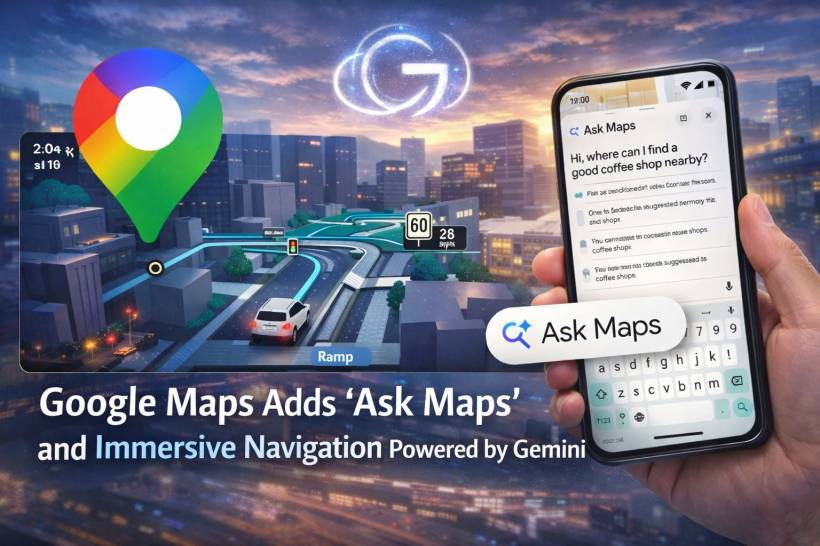
Google Maps is about to become a lot more conversational and a lot more visually helpful, thanks to a fresh wave of Gemini-powered upgrades. Google has introduced two major AI-driven additions for Maps called Ask Maps and Immersive Navigation, both designed to make getting around feel more natural, more personalised, and less like a constant battle with tiny buttons and last-minute lane changes.
On paper, these sound like feature updates. In practice, they point to something bigger. Google is clearly trying to turn Maps from a navigation tool into more of an intelligent travel assistant, one that not only tells you where to go, but also helps you figure out where you should go in the first place.
Ask Maps Wants to Replace the Usual Search-and-Scroll Routine
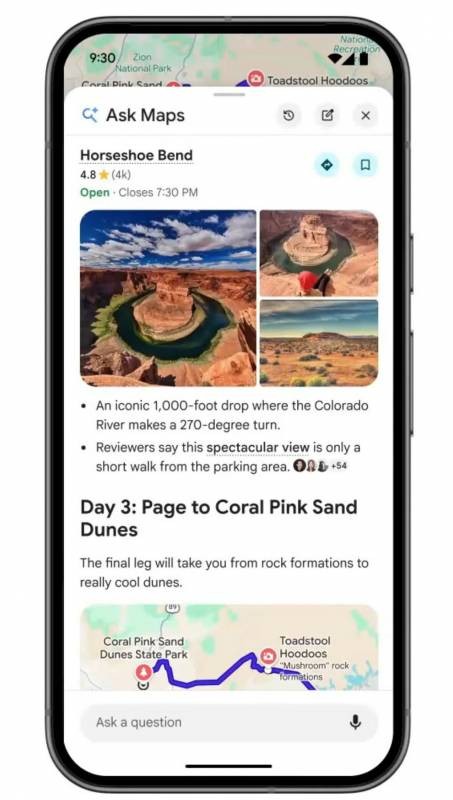
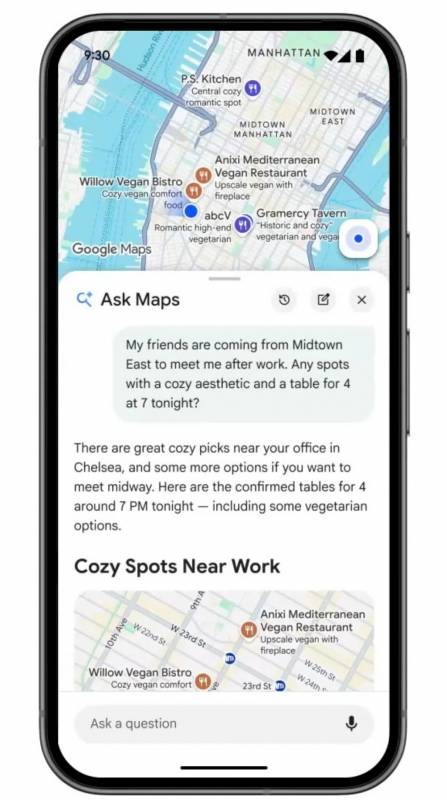
The first new feature, Ask Maps, focuses on making discovery easier. Instead of typing a few keywords and scrolling through a long list of results, users can ask more natural, real-world questions and get answers in a more conversational way.
For example, instead of manually searching for a convenience store, checking opening hours, reading reviews, and then figuring out whether it is on the way, a user could simply ask Maps for somewhere to charge their phone nearby. From there, the app can suggest suitable places along with directions and a map tailored to the request.
That may sound simple, but it is actually a meaningful shift in how people use navigation apps. A lot of the frustration with digital maps has never been the directions themselves. It has been the time spent researching places before the journey even begins. People often jump between reviews, saved locations, search results, and different apps just to decide on a stop. Ask Maps is trying to compress all of that into a single experience.
A More Personal Version of Search Inside Maps
What makes Ask Maps more interesting is that it is not only pulling from general place listings. Google says Maps draws from information covering more than 300 million locations, while Gemini can also use signals such as a user's search history and saved places to make recommendations feel more relevant.
That means the app is not just answering a question in a generic way. It is potentially trying to answer it in a way that fits the person asking. If someone frequently saves cafés, certain shopping spots, or particular types of destinations, Maps may be able to respond with suggestions that feel more aligned with their usual habits.
This is exactly the sort of direction Google has been moving toward across its services. Search is becoming more conversational, assistant features are becoming more context-aware, and recommendation tools are becoming more personalised. Bringing that same logic into Maps feels like a natural next step.
Immersive Navigation Is About Reducing Guesswork on the Road
The second major addition, Immersive Navigation, is aimed more directly at the actual driving experience. Anyone who has ever missed a turn because the map view felt too flat, too cluttered, or too late will probably understand why Google is focusing here.
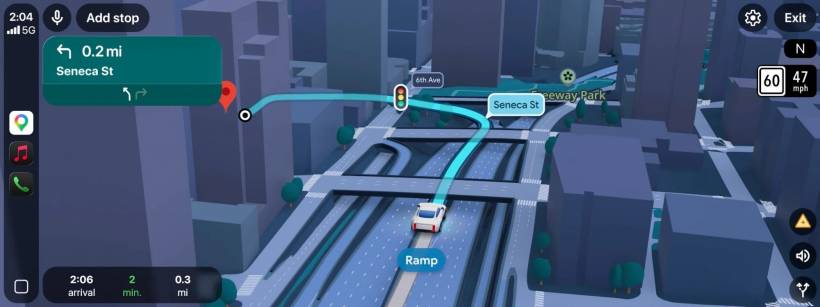
Immersive Navigation introduces refreshed visuals with a more detailed 3D presentation of the surrounding environment. The idea is to make the road ahead easier to read before the driver gets there. Instead of relying only on a basic overhead route line, Maps will show terrain more clearly and surface important road details in a way that is easier to understand at a glance.
This includes information such as lane layouts, traffic lights, and stop signs. In practical terms, that could help reduce those frustrating moments where a driver realises too late that they are in the wrong lane or that a complicated junction is coming up faster than expected.
It is the kind of improvement that sounds small until you picture it in real use. When people are already concentrating on traffic, weather, and unfamiliar roads, clearer visual guidance can make a big difference.
More Context Before You Make the Turn
Google is also enhancing how Maps prepares drivers for what is ahead. With broader views, smart zooming, and transparent building effects, the app is meant to offer a better sense of spatial awareness as users approach turns, exits, and lane changes.
That is important because navigation is not only about being technically accurate. It also needs to feel understandable in motion. Many existing map systems tell users what to do, but not always in a way that feels intuitive in the moment. A more immersive layout could help bridge that gap between instruction and real-world orientation.
This is especially useful in urban areas, where dense road layouts, flyovers, closely packed junctions, and multi-lane turns can make standard navigation feel a bit abstract.
Route Trade-Offs and Real-Time Problems Are Getting More Attention
Another welcome improvement is that Google Maps will now do a better job of explaining route alternatives. Instead of just showing multiple route lines and a time difference, the app will also point out trade-offs such as toll roads or longer travel times.
That is useful because the fastest route is not always the one people actually want. Some drivers may prefer to avoid tolls, while others may rather spend a bit more if it saves a significant amount of time. Giving users clearer context makes route choices feel more informed rather than automatic.
On top of that, Maps will continue surfacing real-time disruptions such as crashes and roadworks. While this is already something modern map apps do, the smarter use of visual guidance and AI context could make those alerts more timely and easier to act on.
Even the Arrival Experience Is Being Improved
Google is not only focusing on the journey itself. It is also refining what happens before arrival and at the destination.
Before users even head out, Maps can preview the destination using Street View imagery and offer parking suggestions. Then, as the destination gets closer, the app will mark the entrance to help users avoid awkward guesswork about where exactly they are supposed to stop.
That last part may sound minor, but it solves one of the most common annoyances in modern navigation. Reaching the general area is easy. Figuring out the exact entrance, especially in shopping areas, office blocks, apartment complexes, or unfamiliar commercial zones, is where people often get stuck.
Google also says it has improved the voice guidance so it sounds more natural. That may not be the flashiest update, but smoother voice prompts can make navigation feel less robotic and easier to follow over longer drives.
Availability Is Still Limited for Now
At the moment, these features are not rolling out everywhere.
Ask Maps is currently available only in the United States and India on Android and iOS, with desktop support expected later. Immersive Navigation is also limited for now, rolling out across the US for eligible Android devices, CarPlay, Android Auto, and vehicles with Google built-in.
So while the features sound promising, users in many regions will still need to wait before seeing them in action. Google has not yet confirmed a broader international rollout timeline.
That is often how these AI-driven features launch. They start in a few major markets first, where Google can refine performance, observe usage patterns, and deal with edge cases before expanding further.
This Is Part of a Bigger Shift for Google Maps
Taken together, these updates show that Google Maps is becoming more than a utility for directions. It is evolving into a more intelligent layer that sits between discovery, planning, and real-time navigation.
Ask Maps addresses the decision-making stage by helping users find the right place more naturally. Immersive Navigation tackles the stress of actually getting there. One helps before the trip. The other helps during the trip. That pairing is smart, and it makes the overall Maps experience feel more complete.
It also reflects how Google wants Gemini to quietly power everyday experiences rather than just live inside a chatbot window. Instead of asking users to open a separate AI app for help, Google is embedding that intelligence into tools people already use every day.
Final Thoughts
Google's latest Maps updates show how AI is starting to reshape even the most familiar apps in more practical ways. Ask Maps and Immersive Navigation are not just about adding flashy new features for the sake of it. They are about removing friction from the way people search, plan, and drive.
If these tools work as intended, they could make Google Maps feel less like a passive map and more like an active guide that understands what users need, what matters on the road, and what information is worth surfacing before confusion sets in.
For now, the rollout remains limited, but the direction is clear. Google wants Maps to be smarter, more aware, and far more useful than simply drawing a blue line from one place to another.











Comments 0