

Artificial intelligence may be changing the way people write, research, and organise ideas, but one of the world's most important scientific repositories is making something very clear: authors are still responsible for what they submit.
ArXiv.org, the widely used open-access repository for scientific papers, is now taking a firmer position against papers that contain obvious signs of unchecked AI-generated content. The concern is not simply that researchers are using AI tools. The bigger issue is when authors appear to submit material produced by large language models without properly checking, editing, verifying, or taking responsibility for the final work.
This is becoming a serious problem in academic publishing. AI can help draft explanations, organise notes, summarise material, and speed up writing. However, it can also invent references, misrepresent findings, create fake citations, and leave behind strange assistant-style comments that clearly do not belong in a research paper. When those mistakes appear in a submission, it raises an uncomfortable question: if the authors did not notice something so obvious, how carefully did they check the rest of the paper?
The Problem Is Not AI Use Alone
The important point here is that arXiv is not simply saying researchers can never use AI. The issue is careless or irresponsible use.
According to Thomas G. Dietterich, the current chair of arXiv's Computer Science Section, if a paper contains clear evidence that the authors failed to review AI-generated output, then the trustworthiness of the entire paper becomes questionable. In that kind of situation, arXiv may impose a one-year ban. After that, future submissions from the same authors may need to be accepted first by a reputable peer-reviewed venue before being allowed on arXiv again.
That is a serious penalty, but it also reflects how important trust is in scientific publishing. A research paper is not just a blog post or a casual online comment. It becomes part of the academic record, and other researchers may read it, cite it, build on it, or use it to guide future work.
If the paper contains hallucinated references or leftover chatbot instructions, it damages confidence not only in that paper, but also in the submission process itself.
What Counts As Obvious AI Negligence
Some AI-related mistakes are easy to spot. One example is a hallucinated reference, where an AI system invents a paper, author, journal, or citation that does not actually exist. This is especially dangerous in academic work because references are supposed to support claims and connect research to existing knowledge.
Another obvious warning sign is when a paper accidentally includes meta-comments from the AI tool. For example, a section might say something like, "Here is a 200-word summary; would you like me to make any changes?" That kind of text makes it clear that the authors did not properly review the generated content before submitting it.
These are not small formatting errors. They are signs that the paper may have been assembled with little care. In research, that is a major problem because accuracy and accountability matter.
Authors Still Own The Responsibility
Dietterich also highlighted a key principle in arXiv's Code of Conduct: when someone signs their name as an author, they take full responsibility for everything in the paper, regardless of how it was created.
That point matters because AI tools can sometimes create a false sense of distance. An author may feel that an error was "the AI's fault," but academic publishing does not work that way. If your name is on the paper, the responsibility is yours.
This applies whether the content was written manually, generated with AI, edited using AI, translated using software, or assembled from multiple tools. The final submission is still the author's responsibility.
That is a reasonable standard. AI can assist the writing process, but it cannot become an excuse for weak checking, fake citations, or careless scholarship.
There Will Still Be A Review Process
ArXiv has also clarified that bans will not be applied casually or automatically. According to Dietterich, the internal process requires a moderator to document the problem first, followed by confirmation from the relevant Section Chair before a penalty is imposed.
That means there is some level of human oversight before action is taken. Appeals will also be possible if a ban is issued.
This matters because AI detection is not always perfect. A policy like this needs to be careful, especially when it can affect researchers' ability to submit work. The stronger cases are likely to involve unmistakable evidence, such as fake references or obvious chatbot leftovers, rather than vague suspicions based only on writing style.
Why arXiv Is Acting Now
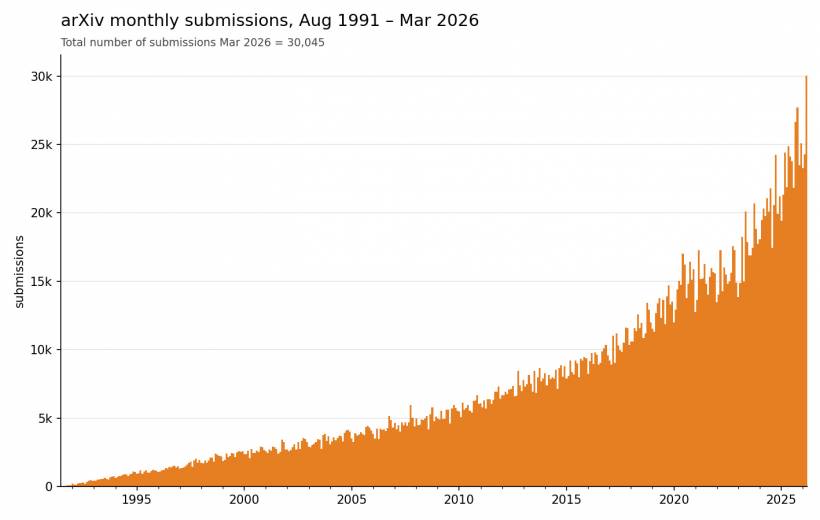
The rise of AI-generated content has created a new challenge for academic platforms. ArXiv receives a large number of submissions, and moderators already have to deal with low-quality, off-topic, or problematic papers. AI now makes it easier for people to generate large volumes of text quickly, including text that may look academic on the surface but lacks real verification underneath.
Steinn Sigurðsson, an astrophysics professor at Penn State and scientific director at arXiv, suggested that the public does not see many of the worst submissions because they are already rejected. Some, according to him, are extremely poor. The tougher penalty is partly intended to discourage repeated abuse by inexperienced users or bad actors who may otherwise flood the system with low-quality AI-generated material.
This is the part that matters most. The issue is not just one bad paper. The concern is scale. If AI makes it easy to generate many weak or fake papers, platforms like arXiv need stronger ways to protect the quality of the repository.
AI-Generated Content Is Already A Serious Academic Issue
This problem is not limited to arXiv. AI-generated content has already become a major concern across academic publishing, peer review, and conference submissions.
One example mentioned in the discussion is the 2026 International Conference on Learning Representations, better known as ICLR. Reports around the conference suggested that a significant portion of peer reviews showed signs of AI assistance, with some allegedly being fully AI-generated. The issue was less widespread among submitted papers, but still noticeable enough to raise concern.
This points to a bigger problem. If AI is used responsibly, it can help researchers polish language, organise arguments, and improve clarity. But if it is used to generate reviews, papers, or citations without careful human judgement, the whole academic process starts to weaken.
Peer review depends on expert attention. Research papers depend on evidence. Citations depend on accuracy. AI can support those tasks, but it cannot replace the responsibility behind them.
A Reasonable Line In The Sand
The reaction from many academics appears to be broadly supportive, especially because the policy is focused on obvious negligence rather than banning AI outright. Ethan Mollick, a Wharton professor known for studying AI, described the approach as reasonable, at least in the short term.
That makes sense. A total ban on AI use would be difficult to enforce and probably unrealistic. Many researchers already use AI tools in some form, whether for language polishing, brainstorming, coding assistance, or summarisation.
A better approach is to focus on accountability. Authors should be allowed to use tools, but they should not be allowed to submit unchecked AI output and pretend it is carefully verified research.
What This Means For Researchers
For researchers, the message is simple: AI can be part of the writing process, but it cannot replace proper academic discipline.
Before submitting a paper, authors need to check every reference, verify every claim, review every generated paragraph, and remove any AI-generated artefacts that do not belong. They also need to make sure the work reflects their own understanding and responsibility.
This is especially important for early-career researchers, students, and independent authors who may be tempted to use AI as a shortcut. A paper that looks polished is not necessarily reliable. AI can produce confident-sounding text even when the information is wrong.
In academic work, sounding correct is not enough. The work actually has to be correct, supported, and accountable.
Final Thoughts
arXiv's crackdown on unchecked AI-generated papers feels like a necessary step in the current research environment. The platform is not rejecting technology outright, but it is drawing a clear line against careless submissions that show authors did not properly review what they submitted.
That line is important. Scientific research depends on trust, and trust depends on authors taking responsibility for their work. If a paper contains fake references, chatbot leftovers, or obvious signs of unreviewed AI output, it becomes difficult to trust anything else in the submission.
AI will almost certainly remain part of academic writing, just as spellcheckers, grammar tools, reference managers, and coding assistants have become part of modern research workflows. But the responsibility still belongs to the author. arXiv's message is direct and fair: use the tools if you want, but check your work properly before putting your name on it.











Comments 0