

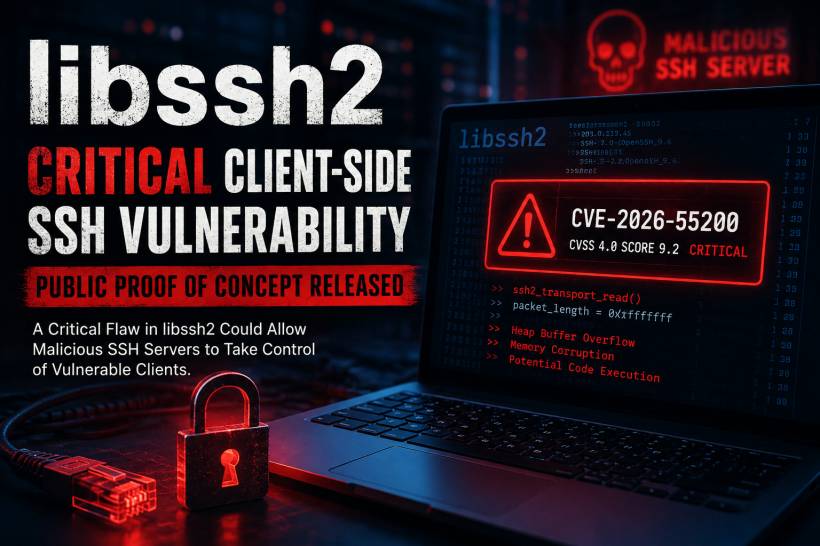
A newly disclosed vulnerability in libssh2, a widely used open-source library for SSH, SCP, and SFTP connections, has been rated critical and assigned CVE-2026-55200. The issue affects libssh2 versions up to and including 1.11.1, and its risk has increased following the release of public proof-of-concept material.
Unlike many SSH vulnerabilities that focus on a server being attacked from the outside, this issue affects the client side. In practical terms, the risk arises when an application using libssh2 connects to a malicious, hijacked, or otherwise untrusted SSH server.
Why This Matters
libssh2 is not always installed as a clearly visible standalone package. It can be bundled into software products, appliances, internal tools, backup agents, firmware updaters, development utilities, PHP environments, and applications that use SSH or SFTP in the background.
That makes the vulnerability more difficult to track. An organisation may believe its operating system packages are fully updated, while an older vulnerable copy of libssh2 remains embedded inside another product.
How the Vulnerability Works
The flaw exists in the way libssh2 processes incoming SSH packets during the initial connection handshake. A malicious SSH server can send specially crafted connection data containing an abnormal packet-length value.
According to the advisory, this can lead to an integer-overflow condition and an undersized memory allocation. Subsequent processing may then write beyond the intended memory buffer, causing memory corruption. Depending on the affected application, system protections, and how libssh2 is implemented, this could potentially lead to code execution.
The important point is that the attacker does not need valid SSH credentials. The vulnerable client only needs to initiate a connection to the attacker-controlled server.
Public Proof of Concept Increases Urgency
A public proof of concept has been released, including a tested trigger framework and controlled local demonstration environment. The advisory notes that it is not a ready-made remote exploit for every production target, as successful exploitation depends heavily on the application binary, memory protections, operating system mitigations, and the way libssh2 is linked into the software.
Still, publicly available exploit research can speed up further testing, scanning, and weaponisation efforts. Even without confirmed real-world exploitation at this stage, organisations should treat the issue as a priority.
Which Systems May Be at Risk
The most exposed environments are likely to be systems that initiate outbound SSH or SFTP connections to external, third-party, partner-managed, or otherwise untrusted infrastructure.
This could include:
• Backup and synchronisation agents
• Software deployment platforms
• Development tools and source-control workflows
• Internal scripts that pull files through SFTP
• Network appliances and vendor products with bundled SSH functionality
Because the affected library may be statically linked or bundled, normal package-manager checks may not identify every vulnerable instance.
Recommended Actions for Organisations
The advisory recommends starting with a full inventory of systems, applications, appliances, and internally developed tools that use libssh2. This should include bundled or statically linked copies that may not appear in standard operating-system package records.
Organisations should then apply a vendor-supplied update, a supported distribution backport, or a validated patched build containing the upstream fix referenced in the advisory. Until patching is complete, outbound SSH connections should be limited to known and trusted destinations wherever possible.
Other sensible measures include enforcing SSH host-key verification, monitoring applications for unexpected crashes or terminations, and reviewing unusual outbound SSH activity. Security teams should also contact vendors to confirm whether products include libssh2 and whether the fix has been incorporated.
The advisory further recommends addressing related libssh2 issues, including CVE-2026-55199 and CVE-2025-15661, during the same remediation cycle.
Final Thoughts
CVE-2026-55200 is a reminder that trusted outbound connections can still introduce serious risk. SSH and SFTP are widely relied upon for secure administration, development, integrations, and file transfers, but the client software making those connections must be secured just as carefully as the servers on the other side.
The priority is to identify where libssh2 is used, confirm whether embedded copies are vulnerable, and restrict unnecessary outbound SSH connections until updates are in place.











Comments 0