

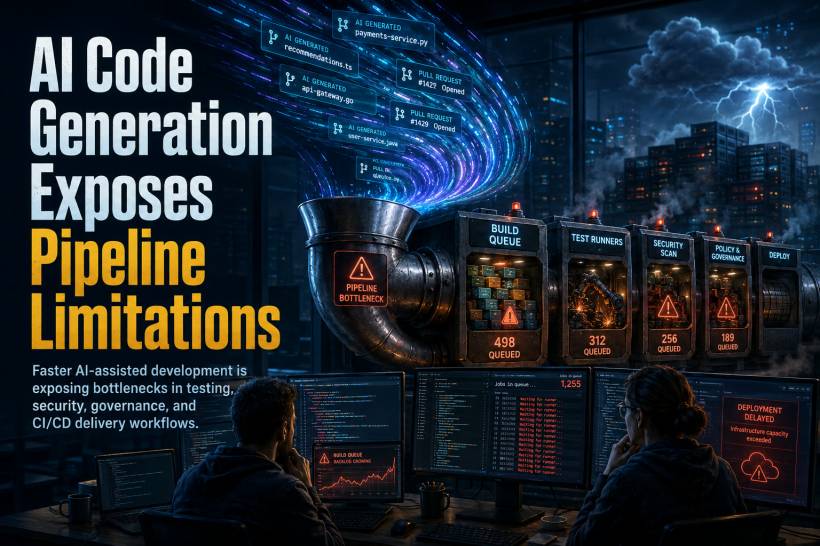
AI coding assistants were supposed to make software teams dramatically faster. In many organisations, they have done exactly that at the developer level. Tools such as GitHub Copilot can help engineers write boilerplate code, draft tests, explain unfamiliar functions and speed up routine work. But as more developers use AI to generate code at a much higher volume, a different problem is becoming impossible to ignore: the rest of the software delivery process often cannot keep up.
According to Harness Field CTO Martin Reynolds, the industry has focused heavily on code generation while overlooking the infrastructure required to safely test, review, secure and deploy that additional output.
GitHub Copilot reaching its fifth anniversary has become a useful point for reflection. The key question is no longer whether AI can help developers write code faster. It clearly can. The more important question is whether the organisation's CI/CD pipelines, testing tools, cloud budgets and governance practices are ready for the amount of code that AI can now produce.
Writing Code Faster Does Not Automatically Mean Shipping Faster
Many companies introduced AI coding tools with a simple productivity goal: help developers spend less time on repetitive tasks and more time delivering useful features.
The problem is that faster code generation creates pressure everywhere else in the software development lifecycle.
A developer may now be able to prepare more pull requests in a day, but every one of those pull requests still needs to be built, tested, scanned for vulnerabilities, reviewed by humans and deployed through controlled release processes. If those downstream systems remain unchanged, the organisation simply moves the bottleneck from the keyboard to the pipeline.
Instead of waiting for developers to write code, teams begin waiting for build runners, security scans, test environments and approval queues.
This is why some organisations are seeing an uncomfortable outcome after rolling out AI assistants at scale: individual developers may feel faster, but the wider engineering platform becomes slower, more expensive and harder to manage.
AI-Generated Pull Requests Can Overload CI/CD Systems
Traditional CI/CD environments were designed around human-paced development.
In a typical workflow, an engineer might submit a few meaningful pull requests each day. The pipeline can allocate compute resources, run automated tests, perform static analysis and send the change for review without overwhelming the system.
AI changes the volume and pattern of activity.
With AI assistance, teams can generate far more pull requests, experimental branches, test updates and refactoring proposals. Some of those changes will be valuable. Others may be incomplete, duplicated, poorly scoped or contain subtle errors that the developer did not fully notice before submitting them.
Every submission still consumes resources.
Build servers must compile the code. Automated test suites need to run. Security tools must scan the changes. Containers may need to be created temporarily. Cloud usage rises. Review queues grow.
For organisations operating large engineering teams, this can quickly become costly. The company is no longer only paying for the AI coding subscription. It is also paying for the additional compute, storage, testing capacity and security processing required to handle the increased output.
In many cases, a large percentage of AI-generated changes may never reach production. They are rejected, reworked or abandoned after testing. That means the organisation can end up spending money to generate code and then spending more money to prove that the code should not be deployed.
Testing and Security Need to Shift Earlier
One of the biggest weaknesses in older delivery pipelines is that they often detect problems too late.
Legacy static application security testing tools may scan an entire codebase overnight, or only run after a pull request reaches a central CI environment. That model may have been acceptable when code changes arrived gradually, but it becomes inefficient when AI-assisted development creates a much higher flow of submissions.
The more effective approach is to move validation closer to the developer.
Rather than waiting for a cloud pipeline to discover basic syntax issues, insecure patterns or obvious logic mistakes, organisations can introduce faster local checks directly in the developer workflow. This may include IDE-based scanning, incremental security analysis, local unit testing and automated policy checks before the pull request is created.
This does not remove the need for centralised CI/CD controls. It reduces unnecessary workload before the code reaches them.
The goal is simple: catch low-quality or risky changes early, before they consume expensive cloud resources and block the delivery queue.
Elastic Build Infrastructure Is Becoming Essential
Static build environments struggle when AI-assisted teams create sudden spikes in activity.
A traditional setup may rely on a fixed pool of build servers. That works reasonably well when development activity is predictable, but it can fail when dozens or hundreds of pull requests arrive within a short period.
Many platform teams are responding by using more elastic infrastructure, often through Kubernetes-based build runners or other containerised execution environments.
These environments can scale up when demand increases, allowing multiple builds and tests to run in parallel. Once the work is complete, the temporary containers can be shut down to reduce unnecessary cost.
This kind of architecture is becoming increasingly important for enterprises that want to use AI coding tools at scale. Without it, developers may generate code quickly only to face long pipeline queues, delayed feedback and unpredictable deployment schedules.
However, elastic infrastructure alone is not enough. Scaling compute can solve capacity problems, but it can also make overspending easier if governance is weak.
The ROI Question Is Still Unclear
AI coding tools are often introduced with an expectation of measurable productivity gains. But proving their return on investment is more difficult than it first appears.
Finance leaders want to know whether AI subscriptions are helping teams ship more valuable features, reduce delivery time or improve software quality. Yet many organisations still lack the data needed to separate useful AI output from expensive noise.
A team may appear highly productive because it is generating more code, more pull requests and more test activity. But those metrics do not automatically mean the company is delivering better outcomes.
The more meaningful questions are:
• How much AI-generated code passes automated testing?
• How much reaches production?
• How often does AI-generated code require rework?
• How much additional cloud spend is created by builds, scans and retries?
• Are developers solving real business problems faster, or simply producing more code to review?
Without this visibility, companies may struggle to understand whether AI is creating genuine value or simply shifting costs into infrastructure and operational overhead.
Token Costs Could Become a Major Governance Issue
The financial side of AI coding is also becoming more complicated as vendors move towards consumption-based pricing models.
Unlike traditional software licences, where organisations pay a predictable fee per user, AI services may charge based on token usage, model complexity, API calls or agent activity. This means costs can rise quickly when developers use larger models, send large context windows or run autonomous workflows repeatedly.
Gartner has warned that AI coding costs could become increasingly significant as token consumption grows and vendors expand usage-based licensing models.
The issue is not only that advanced models are expensive. It is that developers naturally optimise for speed and convenience. Without clear controls, they may use powerful models for tasks that could be handled by smaller, cheaper options.
For example, a simple formatting task, unit test update or code explanation may not require a high-end frontier model. If every task is routed through the most expensive model available, costs can rise much faster than productivity gains.
A More Disciplined Model for AI-Assisted Development
To control costs and reduce delivery risk, organisations need a clearer operating model for AI use in software engineering.
A practical approach starts by defining what kind of work AI should handle and how much autonomy it should have.
Some tasks should remain fully human-led, especially those involving architecture, security-sensitive changes, production infrastructure or high-impact business logic. Other tasks may be suitable for human-and-AI collaboration, where AI drafts code but the developer validates the result. Lower-risk tasks may eventually be automated more heavily, provided strong controls are in place.
Model selection also matters. Smaller models may be sufficient for frequent, straightforward tasks, while more advanced models should be reserved for complex work where the additional cost is justified.
Context management is another major area. Developers should avoid sending unnecessary information into AI prompts. Cleaner, more focused context can reduce token use while often improving the quality of the response.
Organisations should also introduce clear limits, including token budgets, monitoring dashboards, escalation thresholds and automated controls when usage becomes excessive.
Token usage should not be treated as an invisible technical detail. It should become part of normal engineering governance, discussed during sprint reviews and platform optimisation sessions in the same way teams discuss cloud costs, security findings or build failures.
Autonomous Agents Raise the Stakes Further
The next challenge is agentic AI.
Unlike simple code assistants, agentic systems may attempt to work across entire repositories, open pull requests, resolve bugs, run tests, modify infrastructure or make multi-step decisions with limited human involvement.
This could offer major benefits, but it also introduces much greater risk when deployed into legacy delivery environments.
An autonomous agent can generate far more activity than a single developer. If it is poorly governed, it may create large volumes of changes, consume significant infrastructure resources and introduce security or quality issues at scale.
Before organisations give agents broad access to repositories and deployment systems, they need strong foundations. That includes reliable testing, clear approval workflows, cost controls, secure access boundaries and the ability to trace exactly what the agent did.
AI should not be allowed to move faster than the organisation's ability to verify and govern its output.
Final Thoughts
The first five years of AI coding assistants have shown that generating code is only one part of modern software delivery.
The real challenge is what happens after the code is written.
AI can help developers move faster, but it can also expose weak CI/CD pipelines, outdated testing models, limited security capacity, unclear ownership and poor cost visibility. Companies that simply add AI tools to existing delivery systems may find that they create more congestion than acceleration.
The organisations that benefit most from AI-assisted development will not be the ones generating the most code. They will be the ones that modernise their entire delivery pipeline so it can validate, secure, govern and deploy that code responsibly.
In the AI era, the strongest engineering teams will not just write software faster. They will build delivery systems capable of handling that speed without sacrificing quality, security or financial control.











Comments 0